-
Cappella Palatina
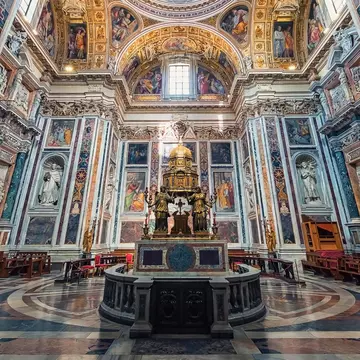
Downstairs in the Palazzo dei Normanni, just off the three-tiered loggia, is Palermo's premier tourist attraction, the Cappella Palatina, designed by Roger II in 1130. The chapel was under restoration at the time of research, with the ceiling and most of the walls covered by scaffolding, but the work is meant to be finished in the summer of 2008, when you should be able to see the mosaics in renewed shiny splendour.
-
Castello della Zisa
A short bus or car journey southwest from Piazza Castelnuovo leads to Castello della Zisa, one of the only remaining monuments to the decadence of Moorish Palermo. With muqarnas vaults, latticework windows, fountains and even a wind chamber to protect the emir's family from the scirocco (the hot African wind), the villa deserves its name which comes from the Arabic al aziz, meaning 'magnificent'.
-
Chiesa della Magione
Across Piazza Magione from Lo Spasimo is the Chiesa della Magione, also known as La Magione. It's a fine example of the more austere Romanesque style that the Normans brought to Sicily.
-
Chiesa di San Cataldo
While La Martorana preserves its interior, the small pink-domed Chiesa di San Cataldo is almost bare inside. It was founded in the 1150s by Maio of Bari (William I's emir of emirs) but Maio's murder in 1160 meant it was not finished - hence the lack of adornment within. However, the main interest lies in the exterior, which illustrates perfectly the synthesis of Arab-Norman styles.
-
Chiesa di San Domenico
The Chiesa di San Domenico lies Off Via Roma. It was built in 1640 following the design of architect Andrea Cirincione; the façade was added in 1726 after the buildings that once occupied the square were demolished to give the church some space.
-
Chiesa di San Francesco d'Assisi
The Piazza San Francesco d'Assisi (M0151) is Palermo's picture-perfect piazza, overlooked by the charming Chiesa di San Francesco d'Assisi , which features a fine rose window and a flamboyant Gothic portal; it's understandably popular on the wedding circuit. The church's most interesting feature is the rare arch of the Cappella Mastrantonio (Chapel of Mastrantonio), carved in 1468 by Francesco Laurana and Pietro da Bonitate, and one of the only true examples of Renaissance art in Palermo.
-
Chiesa di San Giovanni degli Eremiti
Just south of the Palazzo dei Normanni, the Chiesa di San Giovanni degli Eremiti is Palermo's best-known example of the Norman-Arab architectural mix. Built under Roger II, it is topped by five red domes and set in a pretty, tree-filled garden with cloisters (admission around offering temporary respite from the chaos outside. The bare interior of the now deconsecrated church features some badly deteriorated frescoes.
-
Chiesa di San Giovanni degli Eremiti Tower
There is a tower next door to the Chiesa di San Giovanni degli Eremiti that has lovely views of the pink domes, with the spires of the cathedral thrown in.
-
Chiesa di San Giuseppe dei Teatini
In the southwestern corner of the Quattro Canti is the Chiesa di San Giuseppe dei Teatini, topped by a soaring cupola. The monumental interior is baroque at its brashest, and has been lovingly restored after it suffered substantial damage during WWII.
-
Chiesa di Sant'Agostino
The centrepiece of the Capo quarter is the imposing monastery of Chiesa di Sant'Agostino, which ran the region in medieval times.
-
Advertisement
-
Chiesa di Santa Caterina
Closing off the eastern side of the square is the Chiesa di Santa Caterina, Palermo's finest baroque church. Belonging to a Dominican monastery, the church is held in trust by seven very old nuns, who kept the doors of the church shut for 14 years, finally opening them again for visitors on Christmas Eve 2006. The entrance is on Piazza Bellini.
-
Chiesa di Santa Zita
The 14th-century Chiesa di Santa Zita church is named after the tired patron saint of domestic servants. The church's funerary chapels are particularly lavish, thanks to the clever idea of the Dominican priests who acquired the church in the 16th century to allow rich families to bury their dead here, thus collecting income for the priests' monastery.
-
Complessa di Santa Maria dello Spasimo
Behind the Galleria Regionale Siciliana is the Complessa di Santa Maria dello Spasimo, with its elegant polygonal apse and a tall slender nave that has stood for centuries without a roof. The only example of northern Gothic in Sicily, the church was built by a wealthy doctor, Girolamo Basilicò, on his return from the Holy Land in the early 1500s.
-
Convento dei Cappuccini
Despite its famous manuscript collection and the tomb of novelist Giuseppe Tomasi di Lampedusa in the adjoining cemetery, the Convento dei Cappuccini is best known for its altogether more macabre catacombs, where the mummified bodies of some 8000 Palermitans who died between the 17th and 19th centuries are on show.
-
Fontana Pretoria
Across Via Maqueda is Piazza Pretoria (M013A), a crowd of imposing (and recently restored) churches and buildings that surround the fabulously ostentatious - and, unfortunately, fenced-off - Fontana Pretoria. The fountain dominates the piazza, with its tiered basins rippling out in concentric circles crowded with nude nymphs, tritons and river gods that leap about the water.
-
Galleria d'Arte Moderna
Moved from its abode inside the walls of Teatro Politeama, Palermo's Galleria d'Arte Moderna is located in a wonderfully restored old complex. The building's interior is sleek and very 'modern art', but the art itself is unfortunately not very heartstopping. Divided over three floors, the artwork is dedicated largely to Sicily and Palermo as its subjects, thus ruling out pieces that might be otherwise interesting and brightening to the collection.
-
Galleria Regionale Siciliana
The arterial Via Alloro hides Palermo's best museum, the wonderful Galleria Regionale Siciliana, full of treasures and paintings from the Middle Ages to the 18th century. The building itself is a gorgeous Catalan-Gothic palace sensitively transformed into an exhibition space in 1957 by Carlo Scarpa, one of Italy's leading designers.
-
Giardino Garibaldi
Surrounded on all sides by elegant palazzi, gentrified Piazza Marina (M0154) is Palermo's quietest piazza, and its small Giardino Garibaldi encloses Palermo's oldest tree, a venerable 25m-high, 150-year-old ficus benjamin . Dedicated to Garibaldi, the square has witnessed its fair share of bloody executions.
-
Hammam
You'll hardly need any more heat if you're here in the summer, but you'll surely crave some peace and tranquillity after you've been schlepping around the busy streets of Palermo all day. In case of the latter, head over to the city's only hammam, a modern affair with a lavish marble-faced bath hall and a mean, brick-domed steam room.
-
Il Capo Cathedral
Ambitious builders, the Normans converted mosques and palaces, giving rise to the Arab-Norman style that is unique to Sicily. Chief among these is the Il Capo Cathedral , an extraordinary feast of ziggurat crenellations, majolica cupolas, geometric patterns and blind arches.
-
Advertisement
-
Il Capo Cathedral Treasury
Inside the Il Capo Cathedral is a magnificent treasury, whose most extraordinary exhibits are the fabulous 13th-century crown of Constance of Aragon (wife of Frederick II), made by local craftsmen in fine gold filigree and encrusted with gems, and a tooth extracted from Santa Rosalia, whose ashes are also kept here in a silver reliquary.
-
La Martorana
Palermo's most famous - and beautiful - medieval church is La Martorana, which is often buzzing with wedding ceremonies (always scheduled late morning and usually on Saturdays).
-
Museo Archeologico Regionale
One of the most important museums of its kind in Europe, the wonderful Museo Archeologico Regionale houses an extensive collection of archaeological artefacts. Among its treasures are Phoenician sarcophagi from the 5th century BC, 10,000 Etruscan artefacts, Greek carvings from Selinunte, the Hellenistic Ariete di bronzo di Siracus (Bronze Ram of Syracuse), the largest collection of ancient anchors in the world, and finds from archaeological sites throughout the island.
-
Museo Diocesiano
The Museo Diocesiano houses an important and rather extensive collection of artworks from the cathedral and churches destroyed during WWII; these include paintings, and marble, fresco and mosaic fragments. There's a friendly guide who will explain the significance of each piece (they are largely unmarked), though she speaks Italian and French only.
-
Museo Etnografico Pitrè
The Palazzina Cinese houses the Museo Etnografico Pitrè, Sicily's best ethnographic museum. It holds over 5000 objects, including traditional costumes, pottery, puppets, votive offerings, torture instruments and a model of the 18th-century Carrozza di Santa Rosalia (a massive cart used to carry the effigy of the saint through the streets during the Festino di Santa Rosalia).