Things to do in Sardinia
-
A
Chiesa di Sant'Efisio
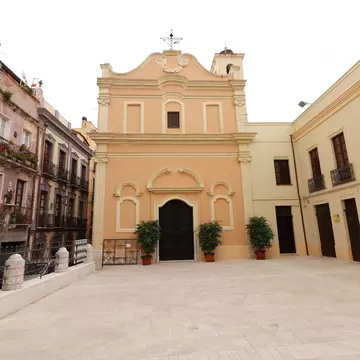
Despite its unassuming façade and modest interior, the most important church in the Stampace quarter is the Chiesa di Sant'Efisio. It's dedicated to Cagliari's patron saint, St Ephisius, a Roman soldier who converted to Christianity and later lost his head for refusing to recant his new-found faith. The church is supposedly built on the site of the martyr's prison.
He's stood the city in good stead throughout the years, saving the populus from a hideous plague in 1652 - when the church got its marble makeover - and repelling Napoleon's fleet in 1793. You can even see French cannonballs embedded in the wall beneath a picture of St Ephisius stirring up the storm that sent …
reviewed
-
B
Ghetto degli Ebrei
The area around Via Santa Croce was once the Ghetto degli Ebrei, the synagogue standing where the Chiesa di Santa Croce now looms (currently under restoration). Under Spanish rule the entire community was expelled in 1492 and today nothing much remains except the name, applied to a Restored Former Barracks. It's now a good place to catch temporary art and photographic exhibitions.
reviewed
-
C
Marina
Browse-worthy indeed, the Cagliari waterfront is known as Marina and it's the most atmospheric part of town, with little lanes full of artisans' shops, delicatessens and loads of good eateries. This neighbourhood is also blessed with plenty of churches: the Chiesa di Sant'Eulalia on Piazza Sant'Eulalia is the most interesting thanks to its attached museum.
reviewed
-
D
Osteria Taverna Paradiso
This unpretentious trattoria is presided over by Pasquale Nocella, the artistic-looking guy with the wild hair. The food here is excellent: hearty plates of grilled steak, mountains of steaming pasta, and lots and lots of cheese. The osteria has even won awards for its cheese. The pasta with aubergines and smoked ricotta packs a flavourful punch.
reviewed
-
E
Dal Corsaro
A classic of Cagliari's fine-dining scene, Dal Corsaro attracts the glad-rag scenesters who want to be seen. Stiff white tablecloths, silver wine buckets and elegant couples murmuring over floral arrangements set the scene for some outrageously good food, while white-smocked waiters provide impeccable service.
reviewed
-
F
Bastione San Remy
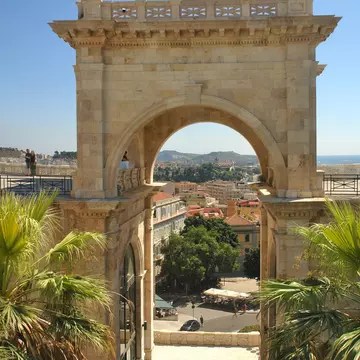
Once a strong point in the fortifications, the bastion is now a belvedere offering views across the city and its lagoons. For decades a flea market has set up here on Sunday, perhaps the successor to the 1948 fair, which was held as the city tried to pull itself out of the postwar mire.
reviewed
-
G
Trattoria Maristella
Visitors and locals flock to this bustling little trattoria for reliable seafood and local specialities such as culurgiones (ravioli stuffed with potato, pecorino cheese and mint) and crema catalana, a delicious creamy dessert. Booking recommended.
reviewed
-
H
Caffè degli Spiriti
Grab a hammock, lie back and enjoy the vibe at this stylish lounge bar on the Bastione San Remy. If you get the munchies call for pizza (€7) or grilled meat (€17).
reviewed
-
I
Caffè Librarium Nostrum
A modish Castello bar with panoramic seating on top of Cagliari’s medieval ramparts. Occasional live music jacks up the atmosphere in the brick-lined interior.
reviewed
-
J
Antico Caffè
Unfortunately located on a busy road junction, this is Cagliari’s most famous cafe. Sip cocktails on the terrace or inside amid the polished wood and brass.
reviewed
Advertisement
-
K
Chiesa di Santo Sepolcro
Visit the Chiesa di Santo Sepolcro, whose most astonishing feature is an enormous 17th-century gilded wooden altarpiece housing a figure of the Virgin Mary.
reviewed
-
L
Orto Botanico
The Orto Botanico is one of Italy’s most famous botanical gardens.
reviewed
-
Monte Ortobene
About 7km northeast of Nuoro is the granite peak of Monte Ortobene, capped by its massive statue of the Redentore (Christ the Redeemer). It's a place of veneration, but it's also a favourite picnic spot for locals. On 29 August (starting bright and early at 06:00) the brightly clothed faithful make a pilgrimage here from the cathedral. Afterwards Mass is celebrated in the nearby Chiesa di Nostra Signora del Monte, and there's another late-morning Mass at the feet of the statue.
After the spirit has been taken care of, the thoughts of the Nuoresi turn to more terrestrial needs. Many fan out in the woods (full of ilex, pine, fir and poplar) and open picnic hampers, while ot…
reviewed
-
M
Museo d'Arte (MAN)
From past to present, the Museo d'Arte (MAN) museum is the only serious contemporary art gallery in Sardinia. Its permanent collection is a wonderful sample of 20th-century Sardinian art, including big-name artists such as Antonio Ballero, Giovanni Ciusa-Romagna, Mario Delitalia and abstract artist Mauro Manca. Local sculptors Francesco Ciusa and Costantino Nivola are also represented.
To see a bronze copy of Francesco Ciusa's Madre dell'Ucciso (Mother of the Killed), which won a prize at the Venice Biennale in 1907, you should visit the Chiesa di San Carlo (Piazza San Carlo).
This permanent show is usually accompanied by more wide-ranging temporary exhibits, usually held …
reviewed
-
N
Museo della Brigata Sassari
Sassari is rightly proud of its military heritage, especially the well-decorated Sassari Brigade, which fought with great gallantry during WWI. You can glean something of the terrible conditions they endured in the tiny Museo della Brigata Sassari in the military barracks.
Uniforms, photos, documents and other memorabilia evoke the ghastly conditions and ferocious bravery of the brigade, who were thrown into the thick of the trench fighting against the Austrians in northern Italy. You can even read the letter in which the Austro-Hungarian commander first gave the brigade their epithet 'the red devils'. There are old guns and grenades on show, and a re-creation of a modern…
reviewed
-
O
Il Castello
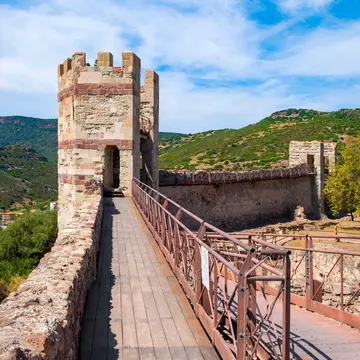
The precipitous white stone walls of medieval Cagliari, with two of the grand Pisan towers still standing, enclose what has always been known as Il Castello. The Sardinians call it Su Casteddu, a term they also use to describe the whole city. The walls are best admired from afar - one good spot is the Roman amphitheatre across the valley to the west.
Inside the battlements, the medieval city reveals itself like Pandora's box. The university, cathedral, museums and Pisan palaces are wedged into a jigsaw of narrow high-walled alleys. Once the stately residence of officials, the old town is now strung together by lines of washing, with the shops shuttered and many of the hou…
reviewed
-
P
Duomo Cathedral
The onion-domed bell tower of the Duomo Cathedral dominates the Oristano skyline.
Most of what you see today is a baroque makeover, although some elements, including the apses and a chapel, survive from a Gothic predecessor. The 14th-century wooden sculpture Annunziata or Madonna del Rimedio, in the first chapel on the right as you enter, is believed to be by Nino Pisano, a Tuscan sculptor whose late-Gothic works stand on the cusp of the Renaissance. Two marble panels that once fronted the statue bear 11th- to 12th-century sculptural reliefs on one side depicting Daniel in the lion's den. The other side, carved about 300 years later by an unknown Catalan artist, depicts a…
reviewed
-
Q
Piazza Satta
A brief walk northwest up Via Satta will bring you to Piazza Satta, the square dedicated to the great poet Sebastiano Satta (1867-1914), who was born in a house here. In true Nuoro style the town felt that a cultural memorial was necessary and commissioned sculptor Costantino Nivola (1911-88) to come up with something.
Nivola whitewashed the square to provide a blank background for a series of granite sculptures that rise up like menhirs. Each sculpture has a carved niche containing a small bronze figurine (a clear wink at the prehistoric bronzetti) depicting a character from Satta's poems. It was a typically unusual idea and must originally have been an impressive sight.…
reviewed
-
R
Marogna
Agostino Marogna has been working in the business for years and now owns the finest coral shop in Alghero, at Palazzo d'Albis.
Their signature necklaces composed of big, round coral beads often take years to create. As there is only a certain amount of coral for sale each year, they often have to put these necklaces aside until the new season, when they have to hunt for exactly the same shade and quality of coral. One such necklace with beads measuring 11mm in diameter will set you back a cool around €11,000, rising to around €30,000 for beads measuring 13mm.
Not everything in the shop is this expensive, and it's certainly worth a visit to see the sheer artistry of som…
reviewed
-
S
Cripta di Santa Restituta
Virtually next door to the Chiesa di Sant'Efisio is the Cripta di Santa Restituta, which has been in use since pre-Christian times. It's a huge, eerie natural cavern where the echo of leaking water drip-drips. Originally a place of pagan worship, it became the home of the martyr Restituta in the 5th century and a reference point for Cagliari's early Christians. The Orthodox Christians took it over - you can still see remnants of their frescoes - until the 13th century, when it was abandoned.
In WWII it was used as an air-raid shelter, a task it was not up to, since many died while holed up here during a raid in February 1943. It's interesting to make out the wartime graff…
reviewed
Advertisement
-
T
Castello di San Michele
A stout three-tower Spanish fortress, Castello di San Michele stands in a commanding position northwest of the city centre. It was built in the 10th century to protect the capital from the province of Cagliari and it has been much added to over the years. Its location is spectacular and its grounds are a peaceful green space to get away from the city.
The castle is used for temporary exhibitions, so the times and entry prices can change. To get there take city bus 5, which has a terminus at the foot of the hill on Via Bacu Abis. From there, a paved road runs for 800m up to the castle. During the museum opening times, a shuttle bus runs from the parking lot up to the castl…
reviewed
-
Nora
About 30km southwest of Cagliari, the archaeological zone of Nora is what’s left of a once powerful ancient city. Founded by Phoenicians in the 11th century BC, it passed into Carthaginian hands before being taken over by the Romans and becoming one of the most important cities on the island. Upon entry, you pass a single melancholy column from a former temple and then a small but beautifully preserved Roman theatre. To the west are the substantial remains of the Terme al Mare (Baths by the Sea). Four columns stand at the heart of what was a patrician villa; the surrounding rooms retain their mosaic floor decoration.
reviewed
-
Grotta di Nettuno
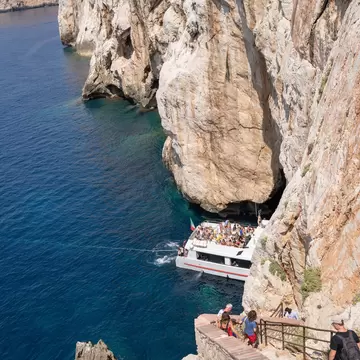
A vertiginous 654-step staircase descends 110m of sheer cliff to the Grotta di Nettuno, an underground fairyland of stalactites and stalagmites. If you don’t fancy the staircase, there are ferries from Alghero – Traghetti Navisarda, departing hourly between 9am and 5pm from June to September, and four times daily in the rest of the year. Otherwise, there’s a daily bus from Via Catalogna (€2, 50 minutes) which departs Alghero at 9.15am and returns at midday. From June to September, there are two extra runs at 3.10pm and 5.10pm, returning at 4.05pm and 6.05pm.
reviewed
-
Museo Diocesano d'Arte Sacra
In the grand spaces that were once the Oratorio del Rosario is the cathedral museum. It houses a good collection of religious art including silverware, statuary, paintings and wood carving. A ghoulish touch is the reliquary of what is claimed to be one of the innocenti (newborn babies slaughtered by Herod in his search for the Christ child). The tiny skull is chilling, but apparently it appealed to Alghero artist Francesco Pinna, who received it from a Roman cardinal in the 16th century. The low, flat arch of the former chapel is clearly inspired by the Catalan Gothic style.
reviewed
-
U
Hotel Ristorante Gallura
Unlike the hotel, the restaurant of the Gallura is absolutely top-notch. The menu reads like a dictionary of Gallurese dishes, and the waiters dash back and forth carrying intriguing platters of exotic food such as smoked cuttlefish with wild beetroot, fish cooked in a paste of courgette and ricotta, and rabbit in saffron. Go with the recommendations - it's all good.
Lovely Rita Denza, the maestro behind it all, flits from table to table in her apron making sure her customers can navigate the multitude of choices. Reservations are essential.
reviewed