Things to do in Jerusalem
-
A
Educational Bookshop
East Jerusalem’s best bookshop has an impressive range of books and DVDs pertaining to the Arab–Israeli conflict, as well as a good selection of magazines and Palestinian music CDs. It also boasts a reading balcony, cafe and function room. Journalists, aid workers, activists and other politically aware people make this place a regular stop on their East Jerusalem wanderings.
reviewed
-
B
Dome of the Rock
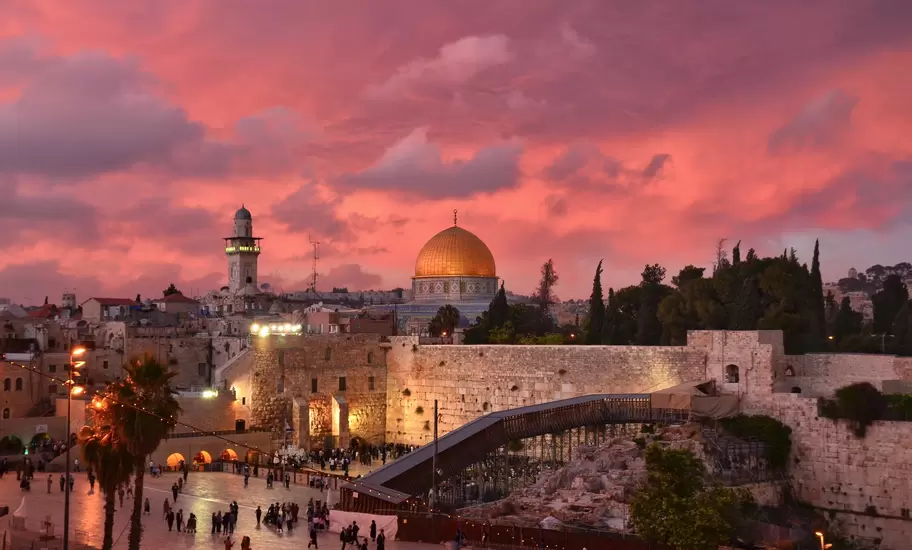
The jewel in the Temple Mount crown is the gold-plated Dome of the Rock, the enduring symbol of the city and undoubtedly one of the most photographed buildings on earth. As its name suggests, the dome covers the slab of stone sacred to both the Muslim and Jewish faiths. It was here that Abraham prepared to sacrifice his son and from which, according to Islamic tradition, the Prophet Mohammed launched himself heavenward to take his place alongside Allah.
The building was constructed between AD 688 and 691 under the patronage of the Umayyad caliph Abd al-Malik. His motives were shrewd as well as pious - the caliph was concerned that the imposing Christian Church of the Holy…
reviewed
-
C
Focaccio Bar
The combination of good food at reasonable prices has made this one of the most popular restaurants in town. The speciality of course is focaccia, baked fresh in the taboun (clay oven) and eaten on a sunny patio. A variety of toppings is available and portions are large and reasonably priced; try the Bulgarian cheese and olive spread (32NIS). The menu also includes a nice 350g entrecôte steak, deep-fried calamari and fried mushroom dishes.
reviewed
-
D
Babette
Waffles and coffee are the specialities of this popular student hang-out, which is just big enough to fit half a dozen standing patrons.
reviewed
-
E
Via Dolorosa
The ultimate Jerusalem walking tour is, of course, the Via Dolorosa, the route that Jesus is believed to have taken as he carried his cross to Calvary. The walk (around 30 minutes) is easily done on your own, but for a somewhat more unique experience join the Franciscan Fathers on Fridays as they lead a cross-bearing procession along the route. Each stop marks the stations of the cross. To begin the route known today, head deep into the Muslim Quarter, in the direction of Lions Gate.
Before embarking on the walking tour, you might want to visit St Anne's Church and the Ecce Homo Convent of the Sisters of Zion, both located close to the first station. The First Station is …
reviewed
-
F
Damascus Gate
The scene in front of the Damascus Gate is a microcosm of the Palestinian world - vendors heave goods in and out of the Old City, families picnic on the steps and Israeli soldiers tap their truncheons. You'll also spot elderly women from the villages trying to sell herbs and produce; most of them wear intricately embroidered dresses that are a part of their dowry and identity.
The gate itself dates in its present form from the time of Süleyman the Magnificent (who oversaw the gate's construction between 1537 and 1542), although there had been a gate here long before the arrival of the Turks. This was the main entrance to the city as early as the time of Agrippas, who rule…
reviewed
-
Kidron Valley
Historically the oldest section of Jerusalem, the Kidron Valley has archaeological remnants that date back more than 4000 years. This is the site of the legendary 'City of David', which was actually a city long before David slung any stones. There are also a number of graves and tombs in the area, particularly in the Valley of Jehoshaphat.
Steep topography has isolated the valley from the rest of the city (the best access is via the Dung Gate or the Lion's Gate in the Old City), but it's definitely worth trekking down here for a morning of exploration.
reviewed
-
G
Souq al-Qattanin
The recently renovated Souq al-Qattanin was originally a Crusader market improved by the Mamluks in the mid-14th century. Almost 100m long, it has 50 shops on the ground floor with residential quarters above. About halfway down is a gate that leads to the 'Al-Quds University Jerusalem Studies Centre'. If it's open, climb up to the roof for a spectacular view of the Temple Mount.
The market also included two hammams (public baths), which have been closed for years but are one of many city projects planned for renovation.
reviewed
-
H
Mosque of the Ascension
Sometimes confusingly referred to as the Church of the Ascension, the Mosque of the Ascension is a Muslim-administered building in an odd little octagonal Crusader reconstruction of an earlier Byzantine structure. Saladin authorised two of his followers to acquire the site in 1198 and it has remained in Muslim possession since. Hours are irregular but someone is usually around most mornings to open it up.
reviewed
-
Chakra
This casual but classy dining experience whips up legendary seafood dishes cooked with Mediterranean spices. Less expensive pastas are also available and there are steaks too (but these are nothing special). Stick with the seafood; choose the aubergine and tahina side dish and you’ll have a wonderful gastronomic experience. It’s located under Cup o’ Joe, with the entrance in the back.
reviewed
Advertisement
-
I
Village Green
A vegetarian’s delight, this kosher restaurant offers homemade dishes made from the freshest ingredients. It’s cafeteria style with various offerings of vegetable soups, quiches, veggie burgers, pizza, blintzes, savoury pies and lasagne, all served with home-baked bread. Meals are sold by weight (8.5NIS per 100g). If you still have room for dessert try one of the freshly baked pies.
reviewed
-
J
Arts & Crafts Lane
The products here are mainly Judaica and of excellent quality. It's open daily except Shabbat.
reviewed
-
K
City of David
The oldest part of Jerusalem, the City of David was the Canaanite settlement captured by King David some 3000 years ago. The excavations are the result of work, still ongoing, started in 1850. There is much to see here, and quite a bit of walking is involved, so set aside a good part of your morning.
reviewed
-
Haram ash-Sharif/Temple Mount
A walk up to the Haram ash-Sharif/Temple Mount is a time-honoured privilege sanctified by the thousands of pilgrims who have trod before you. An open plaza of cypress trees and ancient paving stones, the architecture that exists today dates back to the first Muslim conquest, around 1400 years ago, including the unmistakable Dome of the Rock. But the history of the Mount goes back much further, with the first Jewish Temple having been placed here a thousand years before Christ.
There are few patches of ground as holy, or as disputed, as this one, and as such it's one of the required stops on a visit to the Old City.
The Temple Mount, known to Muslims as the Haram ash-Sharif…
reviewed
-
Mamluk Buildings
Overshadowed by the splendours of the Haram ash-Sharif/Temple Mount, and clustered outside its northern and western walls, stand excellent examples from the golden age of Islamic architecture: Palace of the Lady Tunshuq (1388), Tomb of the Lady Tunshuq (1398), Ribat Bayram Jawish (1540), Tariq Bab al-Hadad St (1358 to 1440), Souq al-Qattanin, Sabil Suleyman and the Tomb of Turkan Khatun (1352).
This area was developed during the era of the Mamluks (1250-1517), a military dynasty of former slaves ruling out of Egypt. They drove the Crusaders out of Palestine and Syria and followed this up with an equally impressive campaign of construction, consolidating Islam's presence i…
reviewed
-
L
Western Wall
The builders of the Western Wall could never have fathomed that one day their modest creation would become the most important religious shrine for the Jewish people. Indeed, when it was built some 2000 years ago it was merely a retaining wall supporting the outer portion of the Temple Mount, upon which stood the Second Temple. (The Second Temple was constructed around 520 BC.)
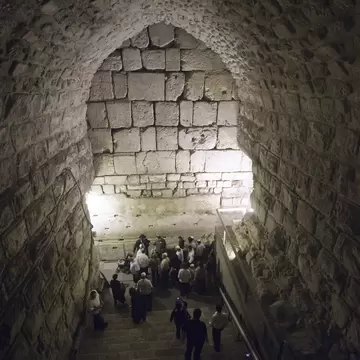
But following the destruction of the temple in AD 70, Jews were sent into exile and the precise location of the temple was lost. Upon their return they purposely avoided the Temple Mount, fearing that they might step on the Holy of Holies, the ancient inner sanctum of the temple barred to all except…
reviewed
-
Mea She'arim
A throwback to older times, Mea She'arim was developed by ultraorthodox Eastern European immigrants who modelled their Jerusalem home like the ones they remembered back in Poland, Germany and Hungary. Despite their transition to the Holy Land, residents have maintained the customs, habits and dress of 18th-century Eastern Europe.
This includes conservative dress, black fedoras for men and floor-scraping dresses for women. Even in the height of the Middle Eastern summer it's still customary to wear thick padded coats and fur hats. You might even have the sense that you've stumbled upon an Eastern European shtetl (ghetto) of the 1880s.
In a few of the most traditional famili…
reviewed
-
M
Hezekiah's Tunnel
The highlight of a visit to the City of David complex is Hezekiah's Tunnel, a 500m-long underground passage of waist-deep water that ends at the Pool of Siloam, where it is said that a blind man was healed after Jesus told him to wash in it. The purpose of the tunnel was to channel water flowing from the Gihon Spring, a temperamental source of water that acts like a siphon, pouring out a large quantity of water for some 30 minutes before drying up for several hours.
Gihon, appropriately, means 'gushing' and the spring is the main reason why the Jebusites settled in the valley rather than taking to the adjacent high ground. There is believed to be enough water to support a…
reviewed
-
Valley of Jehoshaphat
The word Jehoshaphat in Hebrew means 'God shall judge', and this narrow furrow of land, located between the Temple Mount and the Mount of Olives, is where it is said that the events of the Day of Judgement are to take place.
According to belief, all of humanity will be assembled together on the Mount of Olives, with the Judgement Seat on the Haram opposite. Two bridges will appear, spanning the valley, one made of iron and the other made of paper. According to God's judgement each person will be directed to cross one or the other. But there's no suspense, the Bible gives the ending away: the iron bridge will collapse and those sent across it die, while the paper bridge ho…
reviewed
-
N
Christian Quarter
Jerusalem's Christian Quarter is an attractive blend of clean streets, souvenir stalls, hospices and religious institutions belonging to 20 different Christian sects. At its centre stands the Holy Sepulchre, and everyone, tourists and pilgrims alike, tends to be drawn towards it.
As you enter from Jaffa Gate, the first two streets to the left - Latin Patriarchate Rd and Greek Catholic Patriarchate Rd - indicate the tone of the neighbourhood, named as they are after the offices there. The roads lead to St Francis St and in this quiet area around New Gate the local Christian hierarchy resides in comfort.
Heading straight across Omar ibn al-Khattab Sq you'll find a narrow pas…
reviewed
Advertisement
-
O
Mount of Olives
Offering visitors a big slice of biblical history, along with some of the most spectacular views over Jerusalem, is the Mount of Olives. According to the Book of Zechariah, this is where God will start to redeem the dead when the Messiah returns on the Day of Judgement. In order to get a good place in line, Jews have always preferred to be buried here and to date some 150,000 people have been laid to rest on these slopes.
Aside from being the world's oldest continually used cemetery, there are many churches commemorating the events that are believed to have led to Jesus' arrest and his ascension to heaven.
Most of the Mount's churches and gardens are open in the morning, c…
reviewed
-
Muslim Quarter
Strolling does not come easy in the Muslim Quarter - visiting the sights here is more a matter of dodging, weaving and ducking. You'll need agility as heavily laden carts go trundling past, children zip by with reckless abandon and merchants manhandle you into their shops.
Challenging as it may seem, the hustle and bustle of the Muslim Quarter is relieved by the fragrance of the spice shops, the sight of colourful headgear bobbing amid the crowd and the joy of a hot tea taken on the roof of a guesthouse, with the Dome of the Rock dominating every view.
The Muslim Quarter runs from Damascus Gate east and south towards the Temple Mount. Enter the melee at permanently congest…
reviewed
-
P
Shrine of the Book
Shrine of the Book is where the Dead Sea Scrolls are kept. The distinctive pot lid-shaped roof is meant to symbolise the pots in which the Dead Sea Scrolls were kept. The scrolls, totalling 800 in all, were found in 1947 and date back to the time of the Bar Kochba Revolt (AD 132-35). They deal with both secular and religious issues and were thought to have been written by an ascetic group of Jews called the Essenes, who inhabited the area for about 300 years.
The most important of the Dead Sea Scrolls is the Great Isaiah Scroll, the largest and best preserved. It is the only biblical scroll that has survived in its entirety, and takes centre place in the room. The 54 colu…
reviewed
-
Q
Armenian Quarter
Somewhat shuttered behind high walls and enormous wooden doors, the Armenian Quarter of Jerusalem plods along unnoticed, as it has for centuries. If the very presence of an Armenian Quarter strikes you as a bit odd, consider that Armenia was the first nation to officially embrace Christianity when their king converted in AD 303. They established themselves in Jerusalem sometime in the following century.
The Kingdom of Armenia disappeared at the end of the 4th century and Jerusalem was adopted as their spiritual capital. They have had an uninterrupted presence here ever since.
The core of the quarter is actually one big monastic compound. The Armenian presence in Jerusalem …
reviewed
-
Sataf Nature Trail
Walkers will enjoy the Sataf nature trail, a two- to four-hour hike in the hills west of Jerusalem. The hike begins from the Sataf Junction. A bus from Jerusalem's central bus station to Kibbutz Tsova will drop you there. From the junction, follow the road with the brown sign marked 'Sataf' past the car park for 1.5km until you reach the national park. Sataf, located at 600m above sea level, was one of many Arab villages in the area to be deserted in the 1948 Arab-Israeli War.
Two springs and pools are in the village. You are not allowed in the pool but you can climb into the tunnel that feeds the spring (bring a torch). From the village, a marked trail descends to the ri…
reviewed