Things to do in Northern Ireland
-
Falls Road Republican Murals
The first republican murals appeared in 1981, when the hunger strike at the Maze prison saw the emergence of dozens of murals supporting the hunger strikers. In later years republican muralists broadened their scope to cover wider political issues, Irish legends and historical events. After the Good Friday Agreement of 1998, the murals came to demand police reform and the protection of nationalists from sectarian attacks.
Common images seen in republican murals include the phoenix rising from the flames (symbolising Ireland reborn from the flames of the 1916 Easter Rising), the face of hunger striker Bobby Sands, and scenes and figures from Irish mythology. Common slogan…
reviewed
-
A
Cave Hill
The best way to get a feel for Belfast's natural setting is to view it from above. In the absence of a private aircraft, head for Cave Hill (368m) which looms over the northern fringes of the city. The view from its summit takes in the whole sprawl of the city, the docks and the creeping fingers of urbanisation along the shores of Belfast Lough. On a clear day you can even spot Scotland lurking on the horizon.
The hill was originally called Ben Madigan, after the 9th-century Ulster king, Matudhain. Its distinctive, craggy profile, seen from the south, has been known to locals for two centuries as 'Napoleon's Nose' - it supposedly bears some resemblance to Bonaparte's hoot…
reviewed
-
B
Bloody Sunday Memorial
A simple granite obelisk that commemorates the 14 civilians who were shot dead by the British Army on 30 January 1972. Bloody Sunday tragically echoed Dublin's Bloody Sunday of November 1920. Derry's Bloody Sunday was a turning point in the history of the Troubles. On Sunday 30 January 1972, the Northern Ireland Civil Rights Association organised a peaceful march through Derry in protest against internment without trial, which had been introduced by the British government the previous year.
Some 15,000 people marched from Creggan through the Bogside towards the Guildhall, but were stopped by British Army barricades at the junction of William and Rossville Sts. The main ma…
reviewed
-
C
Peace Line
There are steel gates that mark the beginning of the so-called Peace Line, the 6m-high wall of corrugated steel, concrete and chain link that has divided the Protestant and Catholic communities of West Belfast for almost 40 years. Begun in 1970 as a 'temporary measure', it has now outlasted the Berlin Wall, and zigzags for some 4km from the Westlink to the lower slopes of Black Mountain. These days the gates in the wall remain open during the day, but most are still closed from 17:00 to 08:00.
There are now more than 20 such barriers in Belfast, and a total of more than 40 throughout Northern Ireland, the most visible sign of the divisions that have scarred the province f…
reviewed
-
Original Belfast Black Taxi Tours
Black-taxi tours of West Belfast's murals - known locally as the 'bombs and bullets' or 'doom and gloom' tours - are being offered by an increasing number of taxi companies and local cabbies. These can vary in quality and content, but in general they're an intimate and entertaining way to see the sights and can be customised to suit your own interests. There are also historical taxi tours of the city centre.
For a one-hour tour expect to pay around £25 total for one or two people, and around £8 per person for three to six. Call and they will pick you up anywhere in the city centre. A recommended company is Original Belfast Black Taxi Tours.
reviewed
-
D
Kelly's Cellars
Kelly's is Belfast's oldest pub (1720) – as opposed to tavern; see White's Tavern – and was a meeting place for Henry Joy McCracken and the United Irishmen when they were planning the 1798 Rising. The story goes that McCracken hid behind the bar when British soldiers came for him. A bit rough around the edges (a description that could apply to some of the regulars too), it remains resolutely old-fashioned, but pulls in a broad cross-section of Belfast society and is a good bet for impromptu traditional music sessions.
reviewed
-
E
Botanic Inn
The ‘Bot’ is the second pillar of Malone Rd’s unholy trinity of student pubs, along with the ‘Eg’ and the ‘Welly Park’ (Wellington Park). The latter has sadly been renovated into airport-departure-lounge anonymity, but the Bot is still a wild place, with dancing in the upstairs Top of the Bot club Wednesday to Saturday (people queue down the street to get in), live acoustic music in the Back Bar on Monday and Wednesday, and big-screen sport when there’s a match on.
reviewed
-
F
Nick's Warehouse
A Cathedral Quarter pioneer (opened in 1989), Nick's is an enormous red-brick and blond-wood wine bar and restaurant, buzzing with happy drinkers and diners. The seasonal menu is strong on local produce, and the wine list is intriguing.
reviewed
-
G
Museum of Free Derry
The Museum of Free Derry, just off Rossville St, chronicles the history of the Bogside, the civil rights movement and the events of Bloody Sunday through photographs, newspaper reports, film clips and the accounts of first-hand witnesses, including some of the original photographs which inspired the murals of the People's Gallery.
reviewed
-
H
Botanic Gardens
The green oasis of Belfast's Botanic Gardens is a short stroll away from the university. Just inside the Stranmillis Rd gate is a statue of Belfast-born William Thomson, Lord Kelvin, who helped lay the foundation of modern physics and who invented the Kelvin scale which measures temperatures from absolute zero (-273°C or 0°K).
The gardens' centrepiece is Charles Lanyon's beautiful Palm House, built in 1839 and completed in 1852, with its birdcage dome, a masterpiece in cast-iron and curvilinear glass. Nearby is the unique Tropical Ravine, a huge red-brick greenhouse designed by the garden's curator Charles McKimm and completed in 1889. Inside, a raised walkway overlooks …
reviewed
Advertisement
-
I
Belfast Castle
Built in 1870 for the third Marquess of Donegall, in the Scottish Baronial style made fashionable by Queen Victoria's then recently built Balmoral, the multi-turreted pomp of Belfast Castle commands the southeastern slopes of Cave Hill. It was presented to the City of Belfast in 1934.
Extensive renovation between 1978 and 1988 has left the interior comfortably modern rather than intriguingly antique, and the castle is now a popular venue for wedding receptions. Upstairs is the Cave Hill Visitor Centre with a few displays on the folklore, history, archaeology and natural history of the park. Downstairs is the Cellar Restaurant and a small antiques shop.
Legend has it that th…
reviewed
-
J
Ulster Museum
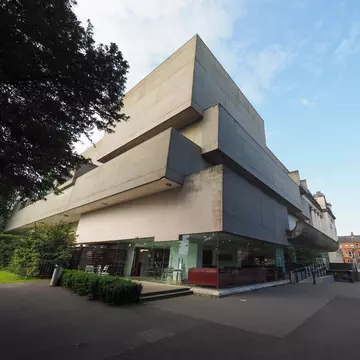
Recently reopened after a major revamp, the Ulster Museum is now one of the North's don't-miss attractions. You could spend several hours browsing the beautifully designed displays, but if you're pressed for time don't miss the Armada Room; Takabuti, a 2500-year-old Egyptian mummy; the Bann Disc; and the Snapshot of an Ancient Sea Floor.
On the ground floor, a potted history of the Troubles leads up to the first-floor History Zone where the Armada Room houses a display of artefacts and jewellery recovered from the 1588 wreck of the Girona and other Spanish Armada vessels. Among its many treasures is a 16th-century ruby-encrusted golden salamander, bronze cannons, and perso…
reviewed
-
K
Sandwich Co
Sandwich Co sells white bread, brown bread, baguettes, panini, ciabatta - this place offers good-value, choose-your-own sandwiches and salads. Also at 61 Strand Road.
reviewed
-
L
Charlie's Gourmet Sandwich Bar
Charlie's is good place for cheap, healthy and filling sandwiches, and also serves a range of breakfasts from toasted soda bread to the full Ulster fry.
reviewed
-
M
Bookfinders
A studenty second-hand bookshop and book-finding service with a gallery, cafe and regular poetry readings.
reviewed
-
People's Gallery Murals
The 12 murals that decorate the gable ends of houses along Rossville St, near Free Derry Corner, are popularly referred to as the People's Gallery. They are the work of Tom Kelly, Will Kelly and Kevin Hasson, known as 'the Bogside Artists'. The three men have spent most of their lives in the Bogside, and lived through the worst of the Troubles.
Their murals, mostly painted between 1997 and 2001, commemorate key events in the Troubles, including the Battle of the Bogside, Bloody Sunday, Operation Motorman (the British Army's operation to retake IRA-controlled no-go areas in Derry and Belfast in July 1972) and the 1981 hunger strike. The most powerful images are those painte…
reviewed
-
N
St Columb's Cathedral
Built between 1628 and 1633 from the same grey-green schist as the city walls, St Columb's Cathedral was the first post-Reformation church to be built in Britain and Ireland, and is Derry's oldest surviving building.
In the porch (under the spire, by the St Columb's Court entrance) you can see the original foundation stone of 1633 that records the cathedral's completion, inscribed: If stones could speake/Then London's prayse/Should sounde who/Built this church and/Cittie from the grounde.
The smaller stone inset, inscribed 'In Templo Verus Deus Est Vereo Colendus' (The True God is in His Temple and is to be truly worshipped), comes from the original church built here in 11…
reviewed
-
O
Free Derry Corner
The Bogside district, to the west of the walled city, developed in the 19th and early 20th centuries as a working-class, predominantly Catholic, residential area. By the 1960s, its serried ranks of small, terraced houses had become an overcrowded ghetto of poverty and unemployment, a focus for the emerging civil rights movement and a hotbed of nationalist discontent.
In August 1969 the three-day 'Battle of the Bogside' - a running street battle between local youths and the Royal Ulster Constabulary (RUC) - prompted the UK government to send British troops into Northern Ireland. The residents of the Bogside and neighbouring Brandywell districts - 33,000 of them - declared …
reviewed
-
P
Navan Fort
Perched atop a drumlin a little over 3km west of Armagh is Navan Fort, the most important archaeological site in Ulster. It was probably a prehistoric provincial capital and ritual site, on a par with Tara in County Meath.
The Irish name Emain Macha means 'the twins of Macha', Macha being the same mythical queen or goddess after whom Armagh itself is named (from Ard Macha, 'heights of Macha'). The site is linked in legend with the tales of Cúchulainn and named as capital of Ulster and the seat of the legendary Knights of the Red Branch.
It was an important centre from around 1150 BC until the coming of Christianity; the discovery of the skull of a Barbary ape on the site …
reviewed
-
City Walls
Derry's walled city is Ireland's earliest example of town planning. It is thought to have been modelled on the French Renaissance town of Vitry-le-François, designed in 1545 by Italian engineer Hieronimo Marino; both are based on the grid plan of a Roman military camp, with two main streets at right angles to each other, and four city gates, one at the end of each street.
Completed in 1619, Derry's city walls are about 8m high and 9m thick, with a circumference of about 1.5km, and are the only city walls in Ireland to survive almost intact. The four original gates (Shipquay, Ferryquay, Bishop's and Butcher's) were rebuilt in the 18th and 19th centuries, when three new ga…
reviewed
Advertisement
-
Q
Tower Museum
Just inside the Magazine Gate is the award-winning Tower Museum , housed in a replica 16th-century tower house. Head straight to the fifth floor for a view from the top of the tower, then work your way down through the excellent Armada Shipwreck exhibition, which tells the story of La Trinidad Valenciera - a ship of the Spanish Armada which was wrecked at Kinnagoe Bay in Donegal in 1588.
It was discovered by the City of Derry Sub-Aqua Club in 1971 and excavated by marine archaeologists. On display are bronze guns, pewter tableware and personal items - a wooden comb, an olive jar, a shoe sole - recovered from the site, including a 2.5-tonne siege gun bearing the arms of Ph…
reviewed
-
R
Parliament House
The dazzling white neoclassical façade of Parliament House at Stormont is one of Belfast's most iconic buildings; in the North, 'Stormont' carries the same connotation as 'Westminster' does in Britain and 'Washington' in the USA - the seat of power. For 40 years, from its completion in 1932 until the introduction of direct rule in 1972, it was the seat of the parliament of Northern Ireland.
More recently, on 8 May 2007, it returned to the forefront of Irish politics when Ian Paisley and Martin McGuinness - who had been the best of enemies for decades - laughed and smiled as they were sworn in as first minister and deputy first minister respectively.
The building occupies …
reviewed
-
S
Queen's University
If you think that Charles Lanyon's Queen's College (1849), a Tudor Revival building in red brick and honey-coloured sandstone, has something of an Oxbridge air about it, that may be because he based the design of the central tower on the 15th-century Founder's Tower at Oxford's Magdalen College.
Northern Ireland's most prestigious university was founded by Queen Victoria in 1845, one of three Queen's colleges (the others, still around but no longer called Queen's colleges, are in Cork and Galway) created to provide a nondenominational alternative to the Anglican Church's Trinity College in Dublin. In 1908 the college became the Queen's University of Belfast, and today its…
reviewed
-
T
Guildhall
Standing just outside the city walls opposite the Tower Museum, the neo-Gothic Guildhall was originally built in 1890, then rebuilt after a fire in 1908. As the seat of the old Londonderry Corporation, which institutionalised the policy of discriminating against Catholics over housing and jobs, it incurred the wrath of nationalists and was bombed twice by the Irish Republican Army (IRA) in 1972.
From 2000 to 2005 it was the seat of the Bloody Sunday Inquiry (www.bloody-sunday-inquiry.org.uk), headed by Lord Saville, which sat from March 2000 till December 2004. The inquiry heard from 900 witnesses, received 2500 witness statements, and allegedly cost the British taxpayer …
reviewed
-
U
Linen Hall Library
Opposite City Hall, on North Donegall Sq, is the Linen Hall Library. Established in 1788 to 'improve the mind and excite a spirit of general inquiry', the library was moved from its original home in the White Linen Hall to the present building a century later. Thomas Russell, the first librarian, was a founding member of the United Irishmen and a close friend of Wolfe Tone. Russell was hanged in 1803 after Robert Emmet's abortive rebellion.
The library houses some 260,000 books, more than half of which are part of its important Irish and local-studies collection. The political collection consists of pretty much everything that has been written about Northern Irish politic…
reviewed