TehranThings to do

Things to do in Tehran

‹ Prev

of 4

  1. A

    Taj Mahal

    In the hotel of the same name, the Taj has a reputation for serving the best Indian food in Iran. The curries here are mouth-watering and there is a good range of vegetarian options. Pity about the location.

    reviewed

  2. B

    Ananda Vegetarian Restaurant & Coffee Shop

    Way up in north Tehran the Ananda is a gem if you’re a vegetarian, and delightful even if you’re not. Run in association with the Iranian Society of Vegetarians, there’s no chance of finding rogue bits of meat here and the food is both delicious and cheap. We can recommend the Ananda lasagne (IR35,000) and Ananda calzone (IR33,000), the freshly made salad (no plastic wrap!) and the service and setting.

    reviewed

  3. C

    Akbar Mashti Bastani

    Akbar Mashti became famous for his ice cream in the 1950s and today his son continues to sell what he modestly describes as ‘the most famous ice cream in Iran and the world’. Try the pistachio bastani (IR7000) and you’ll probably agree.

    reviewed

  4. The Peacock Throne

    There has long been confusion about the origins of the Peacock (or Naderi) Throne that now sits in the National Jewels Museum. The real story is this: In 1798 Fath Ali Shah ordered a new throne to be built. His artists made quite a job of it, encrusting the vast throne that looks more like a bed with 26,733 gems.

    Set into its top was a carved sun, studded with precious stones, so the throne became known as the Sun Throne. Later Fath Ali married Tavous Tajodoleh, nicknamed Tavous Khanoum or Lady Peacock, and the throne became known as the Peacock Throne in her honour.

    Fath Ali certainly had a taste for gems, but one of his predecessors, Nader Shah, liked the finer things to…

    reviewed

  5. D

    Gilac

    The ambience, décor, music and food presentation at Gilac are more reminiscent of Europe than Iran. But the delicious food is wonderfully Caspian. It’s a favourite of vegetarians, with the mirza ghasemi (IR22,000), borani bademjan (IR25,000) and dokhtar-e luce (‘spoilt girl’, IR27,000) starters all delicious; in combination, they’d happily make a meal on their own. The fish and veal dishes are also excellent.

    reviewed

  6. E

    Coffee Shop & Vegie Restaurant of Iranian Artists’ Forum

    This dedicated vegetarian restaurant is excellent value and a good place to meet young, educated and artistic Tehranis. It’s in a brick building at the southern edge of Park-e Tehran, and has an informal, busy ambience with young people coming and going. Owner Aman promised there would be no mystery meat in the salads (less than IR10,000), sandwiches (IR20,000), pizzas (IR25,000) or khoresht (IR18,000), among others.

    reviewed

  7. F

    Tehran Bazar

    The maze of bustling alleys and the bazaris that fill them make Tehran Bazar a fascinating, if somewhat daunting, place to explore. Traders have been hawking their wares on this site for nearly a thousand years, but most of what you see today is less than 200 years old; it’s no architectural jewel. The bazaris are a conservative bunch and there will be far more chadors than bleached hair.

    reviewed

  8. G

    National Jewels Museum

    The National Jewels Museum which is owned by the Central Bank but actually housed underneath the central branch of Bank Melli, is probably the the biggest tourist drawcard in Tehran. If you’ve already visited the art gallery at the Golestan Palace, you will have seen the incredible jewellery with which the Safavid and Qajar monarchs adorned themselves. Come here to gawp at the real things.

    reviewed

  9. H

    Park-e Laleh

    Near the centre of Tehran, Park-e Laleh is one of those places that is more than the sum of its parts. Certainly, it is a well-designed green space, but its location amid so much traffic makes the park a real oasis. As you wander through, you’ll notice plenty of young Tehranis refining their flirting techniques over soft-serve ice creams. It’s a great place for people-watching.

    reviewed

  10. I

    Golestan Palace Complex

    In what was once the heart of Tehran is this monument to the glories and excesses of the Qajar rulers. A short walk south from Imam Khomeini Sq, the Golestan Palace complex is made up of several grand buildings set around a carefully manicured garden. Admission isn’t expensive but, annoyingly, you must buy a separate ticket for each building, and all at the front gate.

    reviewed

  11. Advertisement

  12. J

    Azari Traditional Teahouse

    This restored ‘coffeehouse’ in south Tehran is wonderfully atmospheric because it remains popular with locals, who use it as an unofficial community centre. The dizi and chicken kababs are rightly popular. A traditional band plays most evenings when the boisterous atmosphere is best enjoyed with a group, and bookings are recommended.

    reviewed

  13. K

    Khosbin Restaurant

    The no-frills Khosbin serves a refreshing range of Gilani food. Vegetarians should ask for the delicious mirza ghasemi or baghli (a broad bean dish), or perhaps the zeytoun parvardeh (olives marinated in pomegranate juice with crushed walnuts). There’s no English sign; look for the red writing on the front window.

    reviewed

  14. L

    Iranian Traditional Restaurant

    This underground place is modern Iranian social interaction in microcosm, and full of young Iranians flirting, smoking and eating (in that order) under attractive vaulted and tiled ceilings. The dizi (IR24,000) and kababs are reliably good and well-priced for this location, though at busy times you won’t be allowed to linger.

    reviewed

  15. M

    Monsoon

    Monsoon has been around for several years now and has a reputation for the best Asian food in Tehran. The fare ranges from Thai curries to sushi, served in an intimate setting and complemented by exceptional service. It’s smart, sophisticated, relatively expensive and very new Tehran – menus only come in English.

    reviewed

  16. N

    Sarkis Cathedral

    In case you assume that Islam has a monopoly on Iranian life, visit Sarkis Cathedral. Built between 1964 and 1970, it’s interesting not so much for its beauty but because of what it is and where it is. Sarkis Cathedral is by far the most visible and important non-Islamic religious building in Tehran.

    reviewed

  17. National Museum of Iran

    The modest National Museum of Iran is no Louvre, but it is chock-full of Iran’s rich history and should be on every visitor’s list of things to see in Tehran.

    reviewed

  18. O

    Reza Abbasi Museum

    Named after one of the great artists of the Safavid period, the Reza Abbasi Museum showcases Iranian art from ancient times and the Safavid-era paintings of Abbasi himself. If you like Iranian art, it’s one of the best and most professionally run museums in the country. The museum is organised chronologically starting with the top-floor Pre-Islamic Gallery, where you’ll find Achaemenid gold bowls, drinking vessels, armlets and decorative pieces, often with exquisite carvings of bulls and rams. Here, too, you’ll find fine examples of Lorestan bronzes. The middle-floor Islamic Gallery exhibits ceramics, fabrics and brassware, while the ground-floor Painting Gallery sh…

    reviewed

  19. Darakeh & Darband

    On a sunny day few things could be nicer than fleeing the traffic fumes for the foothills of the Alborz Mountains and the walking trails of Darakeh and Darband. Both the trails strike north, passing waterfalls and crossing streams. They are crowded on Thursday afternoon and Friday and make a great place to meet Tehranis in a relaxed, social atmosphere.

    The lower reaches of both trails are lined with teahouses and stalls selling food and drinks, which are hugely popular in the evenings - some close mid-week and in winter. A dish of dizi, a kabab or two, a cold drink or a huff and a puff on a qalyan by the stream will soon help you forget the Tehran traffic. Among other tas…

    reviewed

  20. Ivan-e Takht-e Marmar

    The Ivan-e Takht-e Marmar is a mirrored, open-fronted audience hall dominated by a magnificent throne. The throne is supported by human figures and constructed from 65 pieces of yellow alabaster from mines in Yazd. It was made in the early 1800s for Fath Ali Shah, a monarch who managed a staggering (and quite likely very tiring) 200-odd wives and 170 offspring. This hall was used on ceremonial occasions, including the Napoleon-style self-coronation of Reza Shah in 1925.

    A narrow corridor leads off to a side room covered with murals of the fictional kings described in Ferdosi's Shahnamah - look for Zahhak, the king with a snake on his shoulder that had to be fed with human…

    reviewed

  21. P

    Tehran Museum of Contemporary Art

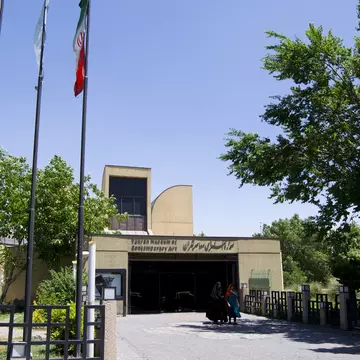
    On the western side of Park-e Laleh, the Tehran Museum of Contemporary Art is in a striking concrete modernist building constructed during the shah’s rush to build modern landmarks in the 1970s. Contrary to preconceptions of Iran, here’s a collection of art (not always modern and rarely contemporary) by Iranian artists and some of the biggest names of the last century. Established during the ’70s under the direction of the progressive Queen Farah Diba, the museum holds arguably the greatest collection of Western art in Asia – worth between US$2 billion and US$5 billion. It includes works by Picasso, Matisse, Van Gogh, Miró, Dali, Bacon, Pollock, Monet and Warhol, among ot…

    reviewed

  22. Advertisement

  23. Hossein Hosseiny

    If you can catch Hossein Hosseiny between buying missions, we found this young man from a family of carpet bazaris to be straight up and offering fair prices on his mainly nomadic carpets. His small store is in the interesting little Serai Parsa bazaar, off Kababihah Alley, with merchants who usually supply to larger shops, so prices can be good - ask for directions.

    The bazaar is an excellent place to shop for carpets, in particular, and buying here usually means you won't have to carry it around. Qalyans are also a good buy in the bazaar, where you'll get the genuine working article rather than the more elaborately decorated and expensive souvenir shop variety.

    reviewed

  24. Q

    Carpet Museum of Iran

    Just north of the Museum of Contemporary Art, the two floors of the Carpet Museum house more than a hundred pieces from all over Iran, dating from the 17th century to the present day; the older carpets are mostly upstairs. The museum itself was designed by Queen Farah Diba and mixes ’70s style with carpet-inspired function – the exterior is meant to resemble threads on a loom, which cool down the main building by casting shadows on its walls. You will often see weavers working on a loom on the ground floor and questions are welcome. Inside, a shop sells postcards and books and there’s a pleasant café. Flash photography is not allowed.

    reviewed

  25. R

    Armenian Club

    The Armenian Club is almost a one-off in Tehran. Because it’s a Christian establishment, women can legally eat or just hang out sans hejab, and if you can get your hands on something harder than Fanta, it’s fine to BYO and drink it with your meal (sorry, no advice on where to find it). The barbecued sturgeon (IR100,000) and beef stroganoff (IR50,000) are both winners, and the range of kababs goes all the way to ‘Mexican’. The club doesn’t advertise its existence – look for a yellow awning and a tiny buzzer – but welcomes guests. Note that Muslims (at the government’s direction) cannot enter.

    reviewed

  26. S

    Khayyam Traditional Restaurant

    Opposite the Imamzadeh Seyyed Nasreddin Mosque (look for the dome), this beautifully decorated restaurant is an oasis amid the chaos of the bazaar area. Originally part of the mosque, the 300-year-old building was separated when Khayyam St intervened. It was restored in 2002. The typically Iranian food (mainly kabab, chicken and fish) is well prepared and plentiful. But on this visit we felt service had dropped and the 15% service charge on top of all the extras you have to pay for is irritating. Still, for tea, qalyan and sweets (IR25,000) after an outing in the bazaar, it’s hard to beat.

    reviewed

  27. White Palace

    What is now called the White Palace was built between 1931 and 1936 and served as the Pahlavi summer residence. The two bronze boots outside are all that remain of a giant statue of Reza Shah – he got the chop after the revolution. The 5000-sq-metre, 54-room palace is no Versailles. Instead it’s a modern building filled with a hodge-podge of extravagant furnishings, paintings and vast made-to-measure carpets. The tiger pelt in the office, among other things, reveals the shah as a man of dubious taste, though in fairness pelts were more in vogue in the 1950s.

    reviewed