Things to do in Gujarat
-
Laxmi Vilas Palace
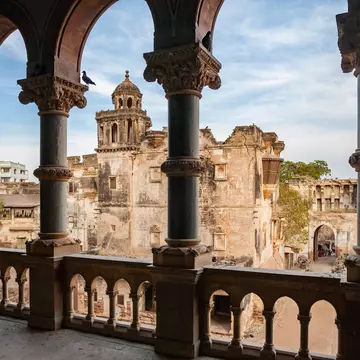
Laxmi Vilas Palace was built in full-throttle 19th-century Indo-Saracenic flourish for Rs6 million. After purchasing your ticket at the Maharaja Fateh Singh Museum head north along Nehru Rd to the second gate (after the entrance to the golf course and before the grand main entrance to the palace). At the palace, pick up an audio guide (included in the admission) and have a leisurely sticky beak at the elaborate interiors of the palace. The Naulakhi Well, a fine step well, is 50m north of the palace.
reviewed
-
A
Havmor
Ahmedabad is famous for its ice cream and the Havmor ice-cream bar, behind Navrangpura bus stop, has tons of flavours.
reviewed
-
B
Toran Dining Hall
Gung-ho staff knock up delicious, never-ending Gujarati thalis to a mostly middle-class crowd.
reviewed
-
C
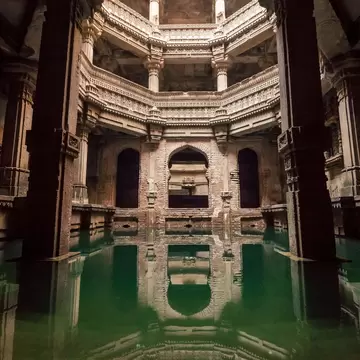
Dada Hari Wav
Dada Hari Wav, built in 1499 by a woman of Sultan Begara’s harem, has steps to lower platforms, terminating at a small, octagonal well. The depths are cool, even on the hottest day. Neglected and often bone dry, it’s a fascinating and eerie place. The best time to visit and photograph the well is between 10am and 11am (earlier in the summer, later in the winter); at other times the sun doesn’t penetrate to the various levels. Bus 34 and 111 (Rs. 5) to Asarwa stops nearby.
reviewed
-
D
Agashiye
This is Ahmedabad’s best dining experience. On the rooftop of one of the city’s finest mansions, the lovely tiled terrace is an oasis of calm and space, candle-lit at night and a world away from the congested streets. The all-veg menu, which changes daily, begins with a rose-and-lemon-flavoured welcoming drink and is a cultural journey around the traditional thali – a multitude of ravishingly tasty vegetable dishes – and finishes with hand-churned ice cream.
reviewed
-
Baroda Museum & Picture Gallery
Within the shady park - Sayaji Bagh, is the Baroda Museum & Picture Gallery, which houses Asian statues and carvings, some rather mangy zoology exhibits and an Egyptian room. The gallery has lovely Mughal miniatures and a motley crew of European masters.
reviewed
-
Tambekar Wada
This wooden multi-storeyed townhouse is a typical Maratha mansion, once the residence of Bhau Tambekar, Diwan of Baroda (1849–54). Inside are some beautiful but decaying 19th-century murals, many featuring Krishna and European subjects.
reviewed
-
Rasoi
This secluded bungalow and garden restaurant – look behind the police post and fig tree beside the Galaxy Cinema – is run by the folks at Tulsi Restaurant. Here you’ll find great unlimited Gujarati thalis, as well as Punjabi and Chinese veg fare.
reviewed
-
Sarkhej Rosa
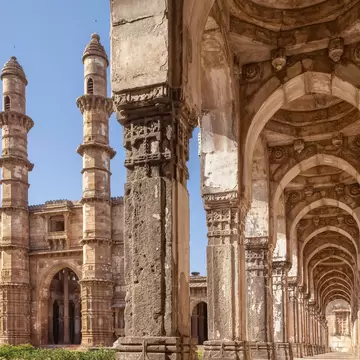
Located 8km south-west of the city, Sarkhej Rosa is a collection of intriguing Islamic buildings. They cluster around a great tank, constructed by Sultan Mahmud Shah I (1458–1511).
reviewed
-
E
Nishat
This place gets packed in the evenings with Muslim men devouring hearty veg and, more often, non-veg tandoori dishes.
reviewed
Advertisement
-
Tulsi Restaurant
Low-lit with plants and understated decor, this cosy place with Punjabi and Chinese veg dishes is rightly popular.
reviewed
-
Mandap
One the best thalis in town, served in a splendidly decorated room with a desert-tent interior.
reviewed
-
Sabarmati Ashram
About 5km from the centre, peacefully set on the river Sabarmati's west bank, this ashram was Gandhi’s headquarters during the long struggle for Indian independence. He founded the ashram in 1915 and it moved to its current site a few years later. It was from here on 12 March 1930 that Gandhi set out on his famous Salt March to the Gulf of Cambay in a symbolic protest. Handicrafts, handmade paper and spinning wheels are still produced on the site. There’s a paper factory over the road that’s worth a look (ask at the ashram for permission). Gandhi’s poignant, spartan living quarters are preserved and there’s a pictorial record of his life. The library contains the lett…
reviewed
-
Sun Temple
The beautiful Sun Temple was built by King Bhimdev I in 1026 and 1027 and resembles the better-known Konark Temple in Orissa, which it pre-dates by 200 years. It was similarly designed so that the dawn sun shone on the image of Surya, the sun god, during the equinox. The main hall and shrine are reached through a pillared pavilion. The temple exterior is intricately carved with demons and deities. As at Somnath, this temple was ruined by Mahmud of Ghazni, but it remains impressive. Fifty-two intricately carved pillars depict scenes from the Ramayana and the Mahabharata. The interior contains a hall with 12 niches representing Surya’s different monthly manifestations. Erot…
reviewed
-
Little Rann Sanctuary
This is not a region for the faint-hearted. The barren, blindingly white land of Little Rann is nature at its harshest and most compelling, and home to India’s last remaining population of khur (Asiatic wild ass). There’s also a huge bird population, and the area is one of the few places in India where flamingos are known to breed naturally. Khurs and flamingos are protected in the 4953-sq-km Little Rann Sanctuary. The area is punctuated by desolate salt farms, where people eke out a living by pumping up ground water and extracting the salt. Heat mirages disturb the vast horizon – bushes and trees seem to hover above the surface.
reviewed
-
Marine National Park
This isolated park stretches 170km along the coast and encompasses 42 islands, 33 of which are ringed by coral reefs. It’s rich in marine and bird life. The best time to visit is from December to March. The Forest Office administers the park, or you can arrange a visit to any of the 42 islands through Hotel President. It takes two hours to reach Pirotan Island (timings are restricted because of tides – you must spend 12 hours on the island to wait for the tide to turn), which is the only offshore route set up for regular visitors. Note that pilgrim boats to Pirotan Island can be dangerously overloaded.
reviewed
-
F
Aina Mahal
Next door to the Prag Mahal is the beautiful Aina Mahal which was built in 1752 at a cost of Rs2 million. It lost its top storey in an earthquake, but the lower floor is open, with a fantastic 15.2m scroll showing a Kutch state procession. The 18th-century elaborately mirrored interior is a demonstration of the fascination with all things European – an inverted mirror of European Orientalism – with blue-and-white Delphi-style tiling and the Hogarth lithograph series The Rake’s Progress. In the bedroom is a bed with solid gold legs (the king apparently auctioned his bed annually).
reviewed
-
Gir Interpretation Zone
Twelve kilometres from Sasan village at Devalia, within the sanctuary precincts, is the Gir Interpretation Zone, better known as simply ‘Devalia’. The 4.12-sq-km fenced off compound is home to a cross section of Gir wildlife. Chances of seeing lions here are good but stage-managed, and you’re only likely to get 30 to 45 minutes looking for wildlife and only from a bus. Vehicles run here from Sasan Gir’s main street for Rs150. Just in case you were thinking about dashing off into the bushes on the way to Devalia, we had a lioness cross the road in front of us, about 1km from the compound.
reviewed
-
Junagadh Zoo
If you don’t make it to Sasan, Junagadh’s zoo at Sakar Bagh, 3.5km from the centre, on the Rajkot road, has Gir lions. The nawab set up the zoo in 1863 to save lions from extinction and, though the concrete enclosures at the front rival much of Asia for sheer cruelty, it has a surprisingly good ‘safari’ park, with an abundance of lions, tigers and leopards. There is also a museum at the zoo with paintings, manuscripts, archaeological finds and other exhibits, including a natural-history section. Take bus 6 (Rs. 5) or an autorickshaw (Rs. 25) to get here.
reviewed
-
Kirti Mandir
This memorial to Gandhi was built in 1950. Reflecting Gandhi’s age when he died, it’s 79ft high and has 79 candle holders; symbols from all the world’s major religions are incorporated. There’s a small bookshop and photographic exhibition (take the stairs by the entrance). Next door is Gandhi’s birthplace – a three-storey, 220-year-old house. He was born here on 2 October 1869 (the very spot is marked on the floor by a swastika), and it was his home till the ripe old age of six. The house is an interesting warren of 22 rooms.
reviewed
Advertisement
-
G
NC Mehta Gallery
In the same building as the Lalbhai Dalpatbhai Museum is the NC Mehta Gallery with an important collection of jewel-like illustrated manuscripts and miniature paintings. Best known is Chaurapanchasika (Fifty Love Lyrics of a Thief), written by Vilhana, an 11th-century Kashmiri poet sentenced to be hanged for loving the king’s daughter. Just before his execution he composed the poems and so impressed the king that there was a lucky turn-around for Vilhana and the king gave his daughter to him in marriage.
reviewed
-
Uperkot Fort
This ancient fort, on Junagadh’s eastern side, is believed to have been built in 319 BC by Chandragupta (ruler of India in the 3rd century BC), though it has been extended many times. An ornate triple gateway forms the entrance, and in places the walls reach 20m high. It’s been besieged 16 times, and legend has it that the fort once withstood a 12-year siege. It’s also said that the fort was abandoned from the 7th to the 10th centuries and, when rediscovered, was completely overgrown by jungle.
reviewed
-
Municipal Corporation
The Municipal Corporation runs fascinating heritage walking tours through the old city. They start from the Swaminarayan Temple in Kalupur at 8am and finish near the Jama Masjid around 10.30am. It’s advisable to book. The tours, through narrow, confusing streets and past dilapidated, carved wooden houses, are an excellent way to get a feel for the city and its pols (gated neighbourhoods). Commentaries are given in English and there’s a brief slide show beforehand.
reviewed
-
Champaner
Champaner was established as the Chauhan Rajput capital in about the 8th century. On a strategic trade route, it was besieged by Sultan Mahmud Begara, who succeeded in taking it in 1484 (the Rajputs committed jauhar – ritual mass suicide – in the face of defeat) and built many religious structures as well as the impressive fort wall on Pavagadh. But the city began to decline from 1535 when the Mughals, led by Humayun, scaled the fort walls and captured both the fort and its city.
reviewed
-
Mayur Patola Art
Rajkot has quickly developed a Patola-weaving industry. This skill comes from Patan, and is a torturous process that involves dyeing each thread before it is woven. However, in Patan both the warp and weft threads are dyed (double ikat ), whereas in Rajkot only the weft is dyed (single ikat ), so the product is more affordable. You can visit workshops that are located in people’s houses in the Sarvoday Society area, including Mayur Patola Art, behind Virani High School.
reviewed