BavariaThings to do

Things to do in Bavaria

‹ Prev

of 32

  1. A

    Deutsches Museum

    You could spend days exploring the Deutsches Museum, said to be the world's largest science and technology collection. This vast museum occupies its own island southeast of Isartor (Isar Gate) and features just about anything ever invented. Interactive displays (including glass blowing and paper making), model coal and salt mines, and wonderful sections on musical instruments, caves, geodesy, micro-electronics and astronomy are just some of the delights on offer. Demonstrations take place throughout the day; a popular one is in the power hall where a staff member is raised in the insulated Faraday Cage and zapped with a 220,000V bolt of lightning. There is also a fascinat…

    reviewed

  2. B

    Bergwolf

    At this favourite pit stop for night owls, the poison of choice is Currywurst, a sliced spicy sausage provocatively dressed in a curried ketchup and best paired with a pile of steamy fries. Hangover prevention at its finest.

    reviewed

  3. C

    Verkehrsmuseum

    Nuremberg's Verkehrsmuseum combines two major exhibits under one roof: the Deutsche Bahn Museum (German Railway Museum) and the Museum für Kommunikation (Museum of Telecommunications). The former explores the origins and history of Germany's legendary railway system; the latter showcases development in telecommunications, including historic telephones dating back over 100 years.

    reviewed

  4. D

    Nuremberg Trials Courthouse

    Nazis were tried for crimes against peace and humanity in the Schwurgerichtssaal 600 (Courtroom 600). The Allies chose Nuremberg for obvious symbolic reasons. The building was also easily accessible and one of few such complexes to survive the war intact. Held between 1945 and 1946, 22 leaders and 150 underlings were convicted; dozens were executed.

    reviewed

  5. E

    Paros

    You'll kick up your heels like Zorba himself after filling your tummy with Greek soul food at this simple yet sophisticated nosh spot. The menu features all the usual suspects (gyros, moussaka, avgolemono soup) but daily specials like veal cutlet grilled on lava rock are worth exploring as well. Opa!

    reviewed

  6. F

    Bar Tapas

    A phalanx of 30 tapas - boquerones (anchovies)to octopus salad to garlic chicken - report to duty behind glass along the bar of this convivial Iberian outpost. Write down the numbers, then sit back with a jug of sangria and wait for your tasty morsels to arrive.

    reviewed

  7. G

    Bratwursthäusle

    Seared over a flaming beech-wood grill, the little links sold at this rustic inn arguably set the standards for Rostbratwürste across the land. You can dine in the timbered restaurant or on the terrace with views of the Hauptmarkt.

    reviewed

  8. H

    Tresznjewski

    Tresznjewski This classy brasserie has daring artworks and waiters in full-length aprons. Its hip clientele come for breakfast and, later, a flexible menu ranging from delectable pastas and sandwiches to burgers and Bratwurst.

    reviewed

  9. I

    Prinz Myschkin

    Considered by many to be Munich's best vegetarian restaurant, this spacious, trendy haunt has an impressive Italian- and Asian-influenced menu, including some macrobiotic choices. The menu is available in English.

    reviewed

  10. J

    Bolero

    About 30 different tapas are the mainstay of this sprawling bodega. Rustic wooden tables and candlelight transport you straight to southern Spain, as does the beer garden's brio.

    reviewed

  11. Advertisement

  12. K

    Dallmayr

    A deep-pocketed gourmet, famous for its coffee but has so much more, including cheeses, ham, truffles, wine, caviar and exotic foods from every corner of the earth.

    reviewed

  13. L

    Bassanese

    Serves authentic Italian gelato, strudels and handmade chocolates to fans in wicker chairs on the cobblestones near the old town hall.

    reviewed

  14. M

    Mama's Kebap Haus

    A döner institution popular with night owls.

    reviewed

  15. Oktoberfest

    Oktoberfest costs around €8, payable with special tokens sold by the tents) More than 6.2 million people guzzled 6.7 million litres of beer during Oktoberfest 2007. Blame it all on the 'Mass'; that towering mug holding a full litre of golden nectar that sets you back about eight euros - and right back on your heels. Oktoberfest is indeed the world's largest drink-a-thon where normally prim and sober citizens from every country in the world lurch around like drunken rats.

    'Tradition' may be everything at the Oktoberfest, but 'convention' gets thrown right out the window.

    It's all eerily disciplined, even quiet, until - at the stroke of noon - the Munich mayor opens the fi…

    reviewed

  16. Reichsparteitagsgelände

    Nuremberg's role during the Third Reich is emblazoned in minds around the world through the images of rapturous Nazi supporters thronging the city's streets to salute their Führer. The rallies at the Reichsparteitagsgelände were part of an orchestrated propaganda campaign that began as early as 1927 to garner support for the NSDAP, which had a strong following in Nuremberg. In 1933, the party planned a ridiculously large purpose-built complex in the southeastern Luitpoldhain suburb.

    In doing this Nazi leaders hoped to establish a metaphorical link between Nuremberg's illustrious past as Reichstagstadt (where parliament met during the Holy Roman Empire) and the Third Rei…

    reviewed

  17. N

    Münchner Stadtmuseum

    You could spend hours roaming through the collections of the rambling Münchner Stadtmuseum, making it a perfect rainy day destination.

    Historical exhibits help you understand how the royal residence evolved into today's modern metropolis, but the main artistic draw is the ensemble of Erasmus Grasser's 10 spritelike Morris Dancers (1480), medieval travelling entertainers who performed at court and on market squares. The late Gothic figures originally adorned the ballroom of the Altes Rathaus.

    Also of special note is the small but powerful section on Munich during the Third Reich that forms an enlightening complement to the nearby Jüdisches Museum (Jewish Museum). Set in a …

    reviewed

  18. O

    Heilig-Geist-Ausstellungsraum

    There may be no vineyards in this neck of the woods but - with a little divine intervention - the Heilig-Geist-Stift-Schenke (Holy Spirit Foundation) has been producing its own wine for centuries. Passau's most historic restaurant is actually part of a former Franciscan monastery. In 1358, a wealthy local family created a foundation here for the poor, where residents lived for free on the condition that they prayed for the family in the adjoining chapel.

    To fund the foundation, the family established vineyards in Krems (then also part of the Habsburg Empire, and now in Austria). Wine was given to residents with meals as a gesture of respect (providing they kept up their p…

    reviewed

  19. P

    Leopoldstrasse

    Grab a table in a street-side café on Leopoldstrasse and watch the world on parade. What do you see? Bronzed lotharios in deep-buttoned white shirts. Faux blondes in tiny tees. Teens in tight premium jeans. Chic mamas walking designer dogs. Yup, no matter what you've heard or read, Schwabing's reputation as a boho stronghold of artists and students is a thing of the past.

    Fact is, Schwabing is thoroughly gentrified, has some of the highest rents in town and is populated by lawyers, editors, professors and trust fund babies in beemers.

    Some live in beautifully restored Jugendstil (Art Nouveau) buildings along such streets as Ainmillerstrasse and Gedonstrasse. Through it a…

    reviewed

  20. Q

    Hauptmarkt

    This bustling square in the heart of the Altstadt is the site of daily markets as well as the famous Christkindlesmarkt. At the eastern end is the ornate Gothic Pfarrkirche Unsere Liebe Frau (1350-58), also known as simply the Frauenkirche. The work of Prague cathedral builder Peter Parler, it's the oldest Gothic hall church in Bavaria and stands on the ground of Nuremberg's first synagogue.

    The western façade is beautifully ornamented and is where, every day at noon, crowds crane their necks to witness a spectacle called Männleinlaufen. It features seven figures, representing electoral princes, parading clockwise three times around Emperor Karl IV to chimed accompanime…

    reviewed

  21. R

    Frauenkirche

    The landmark Frauenkirche is Munich's spiritual heart and the 'Mt Everest' among its churches. No other building in the central city may stand taller than its onion-domed twin towers which reach a lofty 99m. From April to October, you can enjoy panoramic city views from the south tower.

    Bombed to bits in WWII, the reconstruction is a soaring passage of light but otherwise fairly spartan. Of note is the epic cenotaph (empty tomb) of Ludwig the Bavarian just past the entrance and the bronze plaques of Pope Benedict XVI and his predecessor John Paul II affixed to nearby pillars.

    Churches come with legends, and the Frauenkirche has a particularly good one. As you enter the foy…

    reviewed

  22. Advertisement

  23. Surfing

    Munich is famous for beer, sausages and surfing. Yep, you read that right. Just go to the southern tip of the English Garden at Prinzregentenstrasse and you'll see scores of people leaning over a bridge to cheer on wetsuit-clad daredevils as they 'hang 10' on an artificially created wave in the Eisbach. It's only a single wave, but it's a damn fine one. In fact, the surfers are such an attraction, the tourist office even includes them in its brochures.

    But if park director Thomas Köster gets his way, the fun will soon be a thing of the past. You see, surfing or even swimming in the Eisbach is actually verboten. And for good reason. It looks pretty harmless, but the littl…

    reviewed

  24. S

    Marienplatz

    The heart and soul of the Altstadt, Marienplatz, is a popular gathering spot and packs a lot of personality into its relatively small frame. It's anchored by the Mariensäule (Mary's Column), built in 1638 to celebrate victory over Swedish forces during the Thirty Years' War; it's topped by a golden statue of the Virgin Mary balancing on a crescent moon.

    At 11:00 and noon (also 17:00 March to October), the square jams up with tourists craning their necks to take in the animated Glockenspiel (carillon) in the Neues Rathaus (New Town Hall), a neo-Gothic fantasy festooned with gargoyles, statues and a dragon scaling the turrets; the tourist office is on the ground floor. For…

    reviewed

  25. T

    Maximilianstrasse

    It's pricey and pretentious, but no trip to Munich would be complete without a saunter down Maximilianstrasse, one of the city's grandest boulevards. Starting at Max-Joseph-Platz, it's a 1km-long ribbon of style where sample-size fembots browse for Escada and Prada, and suits sip champagne in pavement cafés, with nary a hair out of place. Several of Munich's finest theatrical venues, including the Nationaltheater, the Kammerspiele and the Kleine Komödie am Max II are also here.

    Built between 1852 and 1875, Maximilianstrasse was essentially an ego trip of King Max II. He harnessed the skills of architect Friedrich von Bürklein to create a unique stylistic hotchpotch rang…

    reviewed

  26. U

    Hofgarten

    Office workers catching some rays during their lunch break, stylish moms pushing prams, seniors on bikes, a gaggle of chatty nuns - everybody comes to the Hofgarten. The formal court gardens with fountains, radiant flower beds, lime tree-lined gravel paths and benches galore sits just north of the Residenz. Paths converge at the Dianatempel, a striking octagonal pavilion honouring the Roman goddess of the hunt. In summer it's a favourite spot for classical music recitals.

    Boules players gather by the arcades on the park's north side, where the Deutsches Theatermuseum (German Theatre Museum) trains the spotlight on theatre in German-speaking countries with sets, props, cos…

    reviewed

  27. V

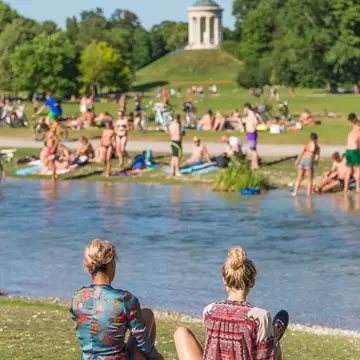
    Englischer Garten

    The sprawling Englischer Garten is among Europe's biggest city parks - bigger than even London's Hyde Park and New York's Central Park and a favourite playground for locals and visitors alike. It stretches north from Prinzregentenstrasse for about 5km and was conceived in 1789 - coincidentally (or perhaps not) the year of the French Revolution - as a 'garden for the people' by Elector Karl Theodor.

    The design job went to Benjamin Thompson, an American-born scientist working as an advisor to the Bavarian government and at one time as its war minister.

    Paths piddle around in dark stands of mature oak and maple before emerging into sunlit meadows of lush grass. Locals are min…

    reviewed