ProvenceThings to do

Things to do in Provence

‹ Prev

of 17

  1. A

    Palais des Papes

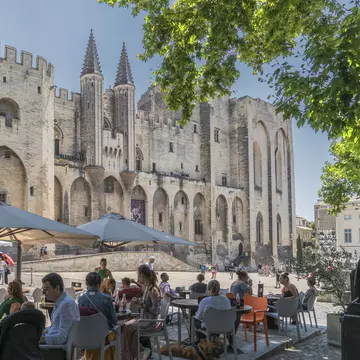
    This Unesco World Heritage Site, the world’s largest Gothic palace, was built when Pope Clement V abandoned Rome in 1309 and settled in Avignon. The immense scale of the palace, with its cavernous stone halls and vast courtyards, testifies to the wealth of the popes; the 3m-thick walls, portcullises and watchtowers emphasise their need for defence.

    Today it takes some imagination to picture the former luxury of these vast bare rooms. You can catch whispering glimpses in the wonderful 14th-century chapel frescos painted by Matteo Giovannetti; in the dark-blue walls of the Pope’s apartment, threaded with dusky red flowers; and in the superb Chambre du Cerf, alive with med…

    reviewed

  2. B

    Le Corbusier’s Unité d’Habitation

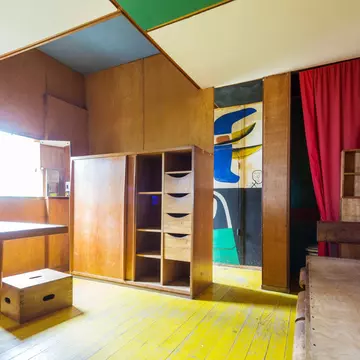
    Visionary architect Le Corbusier redefined urban living in 1952 with the completion of this vertical, 337-apartment ‘garden city’, also known as Cité Radieuse (Radiant City). Along its darkened hallways, primary-coloured downlights create eerie tunnels leading to a mini-supermarket, architectural bookshop and panoramic rooftop ‘desert garden’. However forward-thinking the architecture, it has esoteric appeal: many just see a concrete apartment block.

    For Le Courbusier lovers, stay at Hôtel Le Corbusier, two floors in the middle of the tower. ‘Cabins’ are tiny cells; studios look sharp, particularly those with sea views and Le Corbusier chairs, but for design reas…

    reviewed

  3. City Walls

    Wrapping around the city, Avignon's ramparts were built between 1359 and 1370. They were restored during the 19th century, minus their original moats - though even in the 14th century this defence system was hardly state-of-the-art, lacking machicolations (openings in the parapets for niceties like pouring boiling oil on attackers or shooting arrows at them).Within the walls are a wealth of fine museums - the Avignon Passion booklet lists the whole gamut.

    The Avignon Passion pass entitles you to 20% to 50% discounted entry on your second and subsequent visits to museums and monuments (the equivalent of student prices), as well as reduced prices on the tourist office walki…

    reviewed

  4. C

    Musée de l'Arles et de la Provence Antique

    The fabulous story of Roman Arles takes centre stage at the state-of-the-art showpiece Musée de l'Arles et de la Provence Antiques. Within the triangular structure, which is fronted by a striking cobalt-blue façade, you can trace the area's evolution from 2500 BC through to the end of antiquity in the 6th century AD, or hone in on thematic aspects of trade, the economy and day-to-day life.

    Highlights include Roman statues, artefacts, and a renowned assortment of early Christian sarcophagi from the 4th century.

    reviewed

  5. D

    Cuisine du Dimanche

    Spitfire chef Marie shops every morning at Les Halles to find the freshest ingredients for her earthy flavour-packed cooking, and takes no culinary short cuts. The market-driven menu changes daily, but specialities include scallops and a simple roast chicken with pan gravy. The narrow stone-walled dining room is a mishmash of textures, from contemporary resin chairs to antique crystal goblets, befitting the chef’s eclecticism. Make reservations.

    reviewed

  6. E

    L'Echappée Belle

    For flavours of cumin, saffron and ginger infusing regional produce; or for homemade pastry and tea, Avignon's new restaurant/salon de thé (tearoom) is a treat. Named after the Nicolas Bouvier novel of the same name (which translates as The Beautiful Escape), L'Echappée Belle is a chic yet relaxed spot amid Avignon's architectural and artistic highlights.

    reviewed

  7. F

    Théâtre Antique

    Still regularly used for projections and plays, the Théâtre Antique dates from the end of the 1st century BC. For hundreds of years it was used as a convenient source of construction materials, with workers chipping away at the 102m-diameter structure (the remaining column on the right-hand side near the entrance indicates the height of the original arcade).

    reviewed

  8. G

    St Bénézet's Bridge

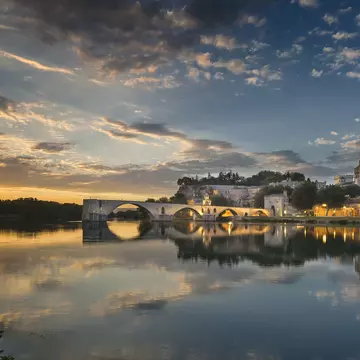
    The fabled Pont St-Bénézet (St Bénézet's Bridge) was completed in 1185, a bridge linking Avignon with the settlement across the Rhône that later became Villeneuve-lès-Avignon. The 900m-long wooden structure was repaired and rebuilt several times before all but four of its 22 spans were washed away in the mid-1600s.

    reviewed

  9. H

    Restaurant Brunel

    Brunel is a local favourite for authentic Provençal dishes such as aïoli , especially at lunch, when there are outstanding deals on main courses (which always include a fish of the day) and desserts. The handful of outdoor tables is hotly contested in warm weather.

    reviewed

  10. I

    Péron

    Perched on the edge of the corniche, with magnificent views of the Château d’If, Péron is one of Marseille’s top tables. The seafood-heavy menu (think marinated tuna, scallops with lemon polenta) is phenomenal; book before dark to watch the sunset.

    reviewed

  11. Advertisement

  12. Calanques and Cassis from Marseille

    Calanques and Cassis from Marseille

    4 hours (Departs Marseille, France)

    by Viator

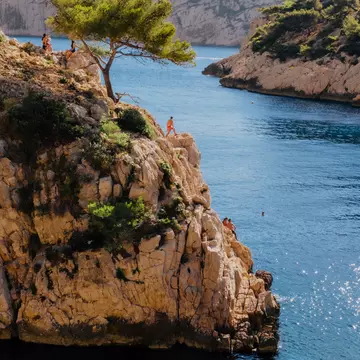
    The Gineste and the Crests road will lead you to the outstanding site of Cap Canaille, from where you can appreciate the exceptional view of the Bay of Cassis a…

    Not LP reviewed

    from USD$87.77
  13. L’Epice and Love

    Tables are cheek by jowl at this tiny bohemian restaurant, decorated with antique kitchenware and mismatched chairs. There’s nothing fancy, just straightforward bistro fare, stews, roasts and other homestyle French dishes. No credit cards.

    reviewed

  14. J

    Trompe l'Œil Portrait

    To peek at Avignon's nine popes in their fashionable garbs of the day, seek out their trompe l'œil portrait on the side of the conseil général (general council) building.

    reviewed

  15. K

    Les Trains Touristiques d'Avignon

    Trundling a 40-minute circuit around town, the little tourist trains Les Trains Touristiques d'Avignon are a winner with kids and adults alike.

    reviewed

  16. L

    Les Deux Garçons

    Cézanne and Zola once lingered in this classic brasserie/café, but it rests on its laurels: best for a drink or small bite.

    reviewed

  17. M

    Food Market

    Pack a picnic basket from the 40-plus outlets filling Les Halles' food market.

    reviewed

  18. Marseille Provence Greeters

    Free walking tours by locals; advance website registration required.

    reviewed

  19. N

    Four des Navettes

    Marseille's iconic boat-shaped, orange-flower Navette biscuits.

    reviewed

  20. The Calanques of Marseilles & Cassis

    The Calanques of Marseilles & Cassis

    8 days (Marseilles)

    by World Expeditions

    Discover on foot dramatic coastal scenery and classic Provençal culture of the Marseilles area.

    Not LP reviewed

    from USD$990
  21. O

    Parc Balnéaire du Prado

    Marseille's main beach area is the 1km-long Parc Balnéaire du Prado ; created from backfill from the excavations for Marseille's metro. Beginning 5km south of the centre, it's split into five beaches (north to south): Plage du Prado Nord (also called Plage du Petit Roucas Blanc), Plage du Prado Sud (also called Plage de David), Plage Borély, Plage Bonneveine and Plage Vieille Chapelle.

    These beaches have public toilets, showers, first-aid posts with coastguards and free lockers to safeguard valuables. Prado du Nord and Sud are wheelchair accessible; Prado du Nord and Borély have a children's playground; and café-clad Borély and Bonneveine have sun-loungers/parasols to r…

    reviewed

  22. Advertisement

  23. Cézanne Sights

    His star may have reached its greatest heights after his death, but the life of local lad Paul Cézanne (1839–1906) is treasured in Aix. To see where he ate, drank, studied and painted, follow the Circuit de Cézanne (Cézanne Trail), marked by footpath-­embedded bronze plaques inscribed with the letter C. An informative English-language guide to the plaques, Cézanne’s Footsteps, is available free from the tourist office.

    Though none of his works hang here, Cézanne’s last studio, Atelier Paul Cézanne, 1.5km north of the tourist office on a hilltop, is a must for any Cézanne fan. It’s painstakingly preserved as it was at the time of his death, strewn with his tools a…

    reviewed

  24. P

    Le Panier

    From the Vieux Port, hike up to this fantastic history-woven quarter, dubbed Marseille’s Montmartre as much for its sloping streets as its artsy ambience. In Greek Massilia it was the site of the agora (marketplace), hence its name, which means ‘the basket’. During WWII the quarter was dynamited and afterwards rebuilt. Today it’s a mishmash of lanes hiding artisan shops, ateliers (workshops) and terraced houses strung with drying washing.

    Create your own tour by scouring out recommended addresses such as Compagnie de Provence for savon de Marseille (soap) and Les Navettes des Accoules for traditional biscuits made from orange flour and shaped like torpedos; Place a…

    reviewed

  25. Q

    Parc National du Mercantour

    The Mercantour National Park is Provence at its most majestic. Europe's highest mountain pass, Col de Restefond la Bonette (2802m/9190ft), strides through the Vallée de l'Ubaye, the park's most northern and wildest area. Come winter, the Ubaye and its southern sisters, the Vallées du Haut Verdon and de la Tinée, offer fine skiing.

    The Vallées de la Vésubie, des Merveilles and de la Roya offer a heady mix of gorges, ageless rocks and white waters, all within easy reach of the Côte d'Azur. The park is home to a dazzling array of birds, including the golden eagle and the bearded vulture. Its higher-altitude plains shelter marmot, mouflon and chamois (a mountain antelop…

    reviewed

  26. R

    Église St-Trophime

    Arles was an archbishopric from the 4th century until 1790, and this Romanesque-style church was once a cathedral. Built in the late 11th and 12th centuries on the site of several earlier churches, it’s named after St Trophime, a late 2nd- or early 3rd-century bishop of Arles. If you look on the far right of the left-hand side of the western portal, you’ll see an intricately sculpted facade of biblical scenes (more spectacular than the interior), with St Trophime holding a spiral staff in his right hand. Inside the austere church, the most fascinating feature is the treasury, containing bone fragments of Arles’ bishops who were later canonised. Many of the statues inside …

    reviewed

  27. S

    Les Arènes

    Arles' remarkable Roman amphitheatre, Les Arènes, was built around the late first or early second century AD. With a slightly smaller capacity but marginally larger dimensions than its counterpart in Nîmes, it was the venue of choice for chariot races and gladiatorial displays where slaves and criminals met their demise before jubilant crowds.

    During the Arab invasions of early medieval times, Les Arènes became a fortress. Three of the four defensive towers still stand (one of which is accessible). Parts of Les Arènes are undergoing restoration, creating community debate about whether the structure should remain in its original condition. But the amphitheatre is far fro…

    reviewed