MarseilleThings to do

Things to do in Marseille

‹ Prev

of 7

  1. A

    Le Corbusier’s Unité d’Habitation

    Visionary architect Le Corbusier redefined urban living in 1952 with the completion of this vertical, 337-apartment ‘garden city’, also known as Cité Radieuse (Radiant City). Along its darkened hallways, primary-coloured downlights create eerie tunnels leading to a mini-supermarket, architectural bookshop and panoramic rooftop ‘desert garden’. However forward-thinking the architecture, it has esoteric appeal: many just see a concrete apartment block.

    For Le Courbusier lovers, stay at Hôtel Le Corbusier, two floors in the middle of the tower. ‘Cabins’ are tiny cells; studios look sharp, particularly those with sea views and Le Corbusier chairs, but for design reas…

    reviewed

  2. B

    Péron

    Perched on the edge of the corniche, with magnificent views of the Château d’If, Péron is one of Marseille’s top tables. The seafood-heavy menu (think marinated tuna, scallops with lemon polenta) is phenomenal; book before dark to watch the sunset.

    reviewed

  3. Calanques and Cassis from Marseille

    Calanques and Cassis from Marseille

    4 hours (Departs Marseille, France)

    by Viator

    The Gineste and the Crests road will lead you to the outstanding site of Cap Canaille, from where you can appreciate the exceptional view of the Bay of Cassis a…

    Not LP reviewed

    from USD$87.77
  4. Marseille Provence Greeters

    Free walking tours by locals; advance website registration required.

    reviewed

  5. C

    Four des Navettes

    Marseille's iconic boat-shaped, orange-flower Navette biscuits.

    reviewed

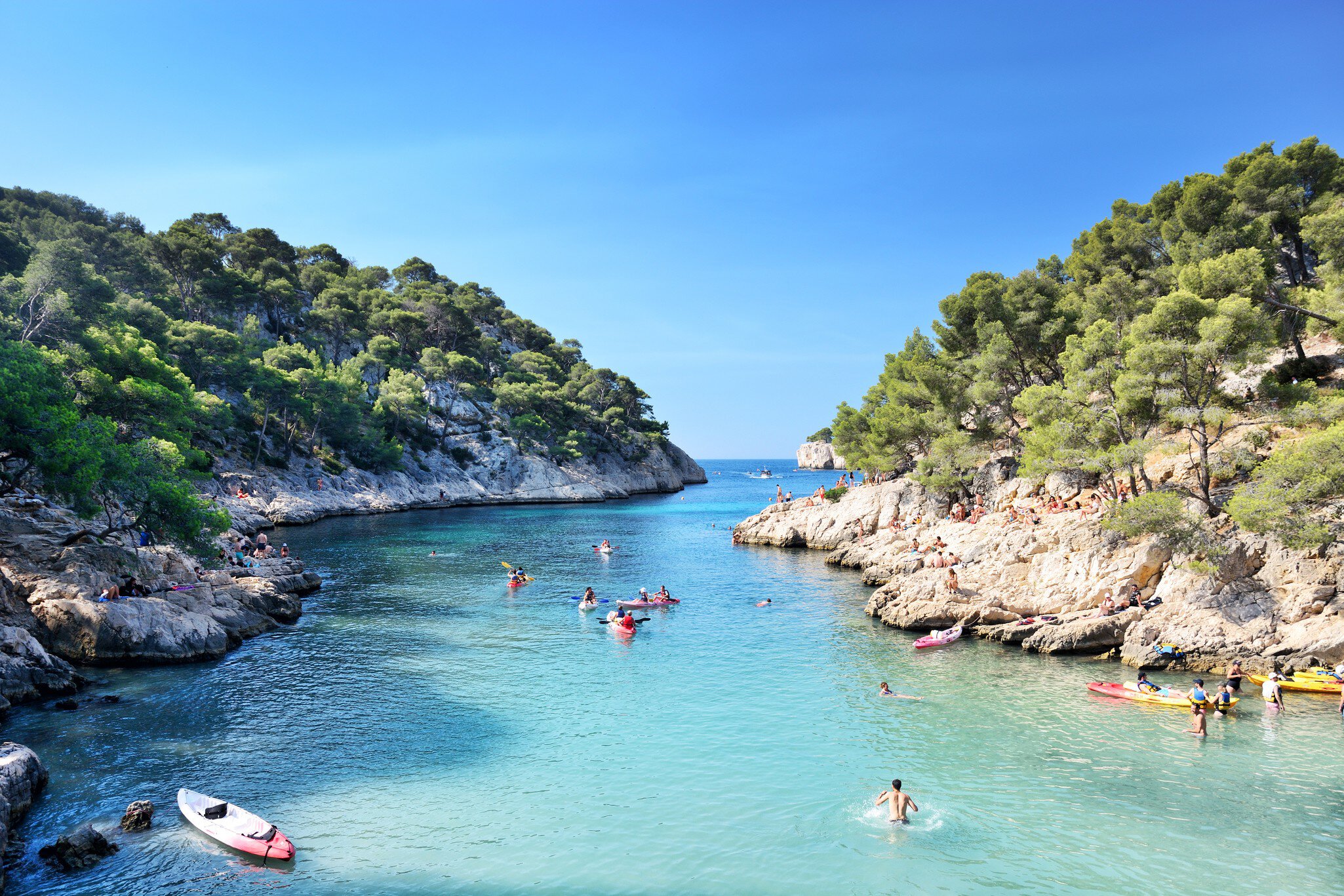
  6. The Calanques of Marseilles & Cassis

    The Calanques of Marseilles & Cassis

    8 days (Marseilles)

    by World Expeditions

    Discover on foot dramatic coastal scenery and classic Provençal culture of the Marseilles area.

    Not LP reviewed

    from USD$990
  7. D

    Parc Balnéaire du Prado

    Marseille's main beach area is the 1km-long Parc Balnéaire du Prado ; created from backfill from the excavations for Marseille's metro. Beginning 5km south of the centre, it's split into five beaches (north to south): Plage du Prado Nord (also called Plage du Petit Roucas Blanc), Plage du Prado Sud (also called Plage de David), Plage Borély, Plage Bonneveine and Plage Vieille Chapelle.

    These beaches have public toilets, showers, first-aid posts with coastguards and free lockers to safeguard valuables. Prado du Nord and Sud are wheelchair accessible; Prado du Nord and Borély have a children's playground; and café-clad Borély and Bonneveine have sun-loungers/parasols to r…

    reviewed

  8. E

    Le Panier

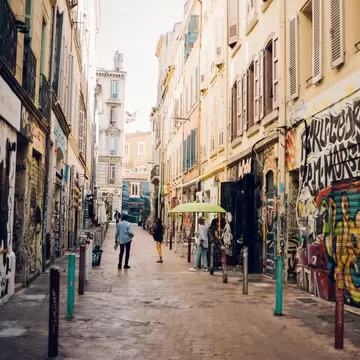
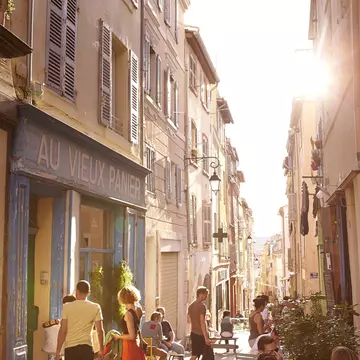
    From the Vieux Port, hike up to this fantastic history-woven quarter, dubbed Marseille’s Montmartre as much for its sloping streets as its artsy ambience. In Greek Massilia it was the site of the agora (marketplace), hence its name, which means ‘the basket’. During WWII the quarter was dynamited and afterwards rebuilt. Today it’s a mishmash of lanes hiding artisan shops, ateliers (workshops) and terraced houses strung with drying washing.

    Create your own tour by scouring out recommended addresses such as Compagnie de Provence for savon de Marseille (soap) and Les Navettes des Accoules for traditional biscuits made from orange flour and shaped like torpedos; Place a…

    reviewed

  9. Vieil Aix

    Art, culture and architecture abound in Aix and is a stroller’s paradise, especially the mostly pedestrian old city, Vieil Aix.

    The graceful cours Mirabeau is the heart of Aix. Cafés spill onto the sidewalks on the sunny northern side. The southern side shelters a string of elegant Renaissance hôtels particuliers (private mansions). The mossy fontaine d’Eau Thermale, at the intersection of cours Mirabeau and rue du 4 Septembre, spouts 34°C water, a pleasant hint of what awaits at the Thermes Sextius.

    South of cours Mirabeau, Quartier Mazarin was laid out in the 17th century, and is home to some of Aix’ finest buildings. Further south still is the peaceful parc Jour…

    reviewed

  10. F

    Basilique Notre Dame de la Garde

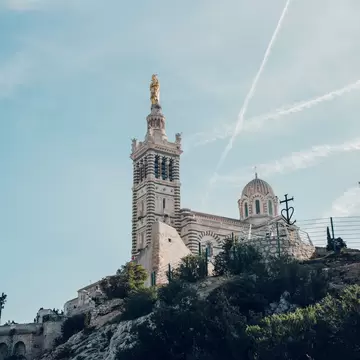
    The opulent, domed 19th-century Romano-Byzantine basilica occupies Marseille’s highest point, lording it over the city skyline. Built from 1853 to 1864, it’s ornamented with coloured marble, murals depicting the safe passage of sailing vessels and intricate gold-laid mosaics superbly restored in 2006. Crowning the bell tower, a 9.7m-tall gilded statue of the Virgin Mary stands atop a 12m-high pedestal. Bullet marks and shrapnel scars on the northern facade evidence the fierce fighting of Marseille’s Battle of Liberation (15–25 August 1944).

    Bus 60 links the Vieux Port with the basilica. Or, the ‘little train’ departs from the port and remains for 20 minutes before…

    reviewed

  11. Advertisement

  12. G

    Unité d'Habitation

    Visionary architect Le Corbusier redefined urban living in 1952 with the completion of his vertical, 337-apartment ‘garden city', Unité d'Habitation , also known as Cité Radieuse (Radiant City). Along its darkened hallways, primary-coloured downlights create eerie tunnels leading to a minisupermarket, architectural bookshop and panoramic rooftop ‘desert garden'.

    Even if you're not staying at the onsite Hôtel Le Corbusier, you can arrange to visit this tour de force, including its private apartments, or dine at its restaurant, with sweeping views of the Mediterranean - and of the proliferation of high-rises that Le Corbusier inspired. Catch bus 83 or 21 to the Le Cor…

    reviewed

  13. Îles du Frioul

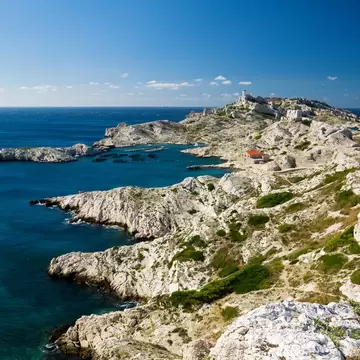
    A few hundred metres west of the Château d’If are the Ratonneauand Pomègues. The tiny islands (each about 2.5km long) were linked by a dyke in the 1820s. From the 17th to 19th centuries they were used to quarantine those suspected of carrying plague or cholera: the city was ravaged by plague in 1720, when a merchant vessel carrying the disease broke quarantine to avoid losing its shipment. The resultant epidemics killed around 50,000 of the city’s 90,000 inhabitants. The island of Ratonneau has ruins of the old yellow-fever quarantine hospital. Seabirds and rare plants thrive on the islands, which also have uncrowded beaches.

    Boats to Château d’If also serve the Île…

    reviewed

  14. H

    Centre de la Vieille Charité

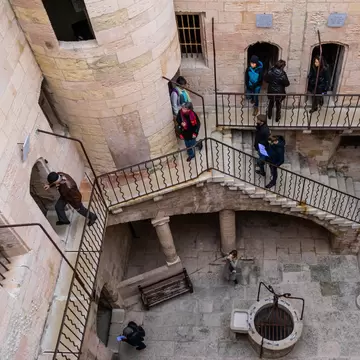
    Marseille architect and sculptor Pierre Puget (1620–94) was born in the house opposite 10 rue du Petit Puits, and designed the arcaded courtyard of the Centre de la Vieille Charité, initially built as a charity shelter for the town’s poor, the stunning arched pink-stone courtyard now houses Marseille’s beautiful Musée d’Archéologie Méditerranéenne (Museum of Mediterranean Archeology) and Musée d’Arts Africains, Océaniens & Amérindiens (Museum of African, Oceanic & American Indian Art). The latter contains a striking collection of masks from the Americas, Africa and the Pacific.

    reviewed

  15. I

    Pizzaria Étienne

    This old Marseillais haunt has the best pizza in town as well as succulent pavé de boeuf (beef steak) and scrumptious supions frits (pan-fried squid with garlic and parsley), but it's not just the food that packs the place out. Because Pizzaria Étienne is a convivial meeting point for the entire neighbourhood, you'll need to pop in beforehand to reserve in person (there's no phone), though you will get a free aperitif while you wait for a table. Credit cards aren't accepted.

    From rue de la République, cut down passage de Lorette and walk up the staircase.

    reviewed

  16. J

    Centre de la Vieille Charité

    Marseille architect and sculptor Pierre Puget (1620–94) was born in the house opposite 10 rue du Petit Puits, and designed the arcaded courtyard of the Centre de la Vieille Charité. Initially built as a charity shelter for the town’s poor, the stunning arched pink-stone courtyard now houses Marseille’s beautiful Musée d’Archéologie Méditerranéenne (Museum of Mediterranean Archeology) and Musée d’Arts Africains, Océaniens & Amérindiens (Museum of African, Oceanic & American Indian Art). The latter contains a striking collection of masks from the Americas, Africa and the Pacific.

    reviewed

  17. OMTV

    In town, match tickets, and shirts, scarves and other paraphernalia in the club's 'sky (blue) and white' colours are sold at OM's Boutique Officielle and L'OM Café, with soccer balls suspended from the ceiling and press clippings and posters plastering the walls.

    The bar - and especially its outdoor terrace - hosts a giant party when it screens every OM game. If you can't make it here, OM has its own pay TV channel, OMTV , which broadcasts daily from 17:00 to 21:00.

    reviewed

  18. K

    Musée d'Arts Africains, Océaniens & Amérindiens

    Initially built as a charity shelter for the town's poor, the stunning arched pink-stone courtyard of the Centre de la Vieille Charité now houses Marseille's beautiful Musée d'Archéologie Méditerranéenne and Musée d'Arts Africains, Océaniens & Amérindiens . The latter houses a diverse and often striking collection, including masks from the Americas, Africa and the Pacific.

    reviewed

  19. L

    Château d’If

    Immortalised in Alexandre Dumas’ classic 1840s novel Le Comte de Monte Cristo (The Count of Monte Cristo), the 16th-century fortress-turned-prison Château d’If sits on a 3-hectare island 3.5km west of the Vieux Port. Political prisoners were incarcerated here, along with hundreds of Protestants (many of whom perished in the dungeons), the Revolutionary hero Mirabeau (who didn’t fare so badly, once he’d seduced the cook) and the Communards of 1871.

    reviewed

  20. M

    Le Café Parisien

    Le Café Parisien's sculpted plaster walls have been a theatrical backdrop for Marseillais diners for over a century. The brasserie's once-faded glamour has recently been restored to its former heyday splendour, serving elegant fare such as squid drizzled in olive oil and a richer-than-rich risotto. Post-repas, play boules on the café's indoor pitch downstairs, or have a pastis at the adjacent underground bar.

    reviewed

  21. N

    Metal Café

    Another one of Marseille's 'in' choices, Metal Café sits at the foot of the staircase linking cours Honoré d'Estienne d'Orves with rue Sainte. Look for the suitably steely grey door and expect an equally chic-industrial interior. The only thing that's not metal, thankfully, is the music.

    Look for the steely grey door at the foot of the staircase linking cours Honoré d'Estienne d'Orves with rue Sainte.

    reviewed

  22. Advertisement

  23. O

    Palais de Longchamp

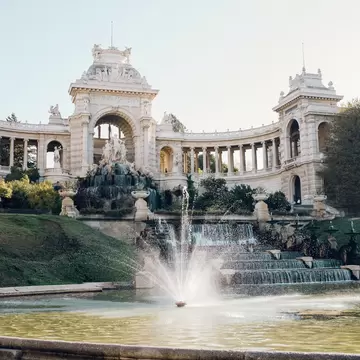
    The colonnaded Palais de Longchamp and its spectacular fountains were constructed in the 1860s, in part to disguise a water tower at the terminus of an aqueduct from the River Durance. The northern wing houses Marseille’s oldest museum, the Musée des Beaux-Arts, undergoing renovations at research time and slated to reopen in 2012. The shaded park is one of the city centre’s few green spaces, popular with local families.

    reviewed

  24. P

    Le Dock de Suez

    Le Panier's western fringe flows into the commercial port area (metro Joliette, 8e), where dining spots at the London-docks-like complex, Les Docks, include the voluminous Le Dock de Suez. Business high flyers rub shoulders as chef Richard Tucita greases the wheeling and dealing with sophisticated dishes such as supions à la Provençale (squid with garlic and tomatoes) and braised ox cheek.

    reviewed

  25. Q

    Ardamone

    Avocado and salmon sushi, green chicken curry with fragrant rice, and tofu and carrots marinaded in ginger are among the world-influenced dishes at Marseille's only bio resto (organic restaurant). A couple of vegan dishes are included on the strictly organic menu which also features scrumptious desserts such as chocolate and split-almond brownies and blueberry crumble with raspberry coulis.

    reviewed

  26. R

    Au Bord de l'Eau

    Au Bord de l'Eau (‘At the water's edge') is the kind of place Marseillais cherish: easy on the frills, heavy on outdoor space, steady on the price and artistic on the plate. The menus (fixed-price menus) have the usual pizza, pasta and fresh fish. Catch bus 83 along the coast to av du Prado (by the statue of David), then take bus 19 further south along the coast.

    reviewed

  27. S

    Musée du Santon

    One of Provence’s most enduring, and endearing, Christmas traditions are its santons, plaster-moulded, kiln-fired nativity figures, first created by Marseillais artisan Jean-Louis Lagnel (1764–1822). The tiny museum displays a private collection of 18th- and 19th-century santons. At adjoining ateliers, watch the figures being crafted, or buy them at the boutique.

    reviewed