-
50 Moganshan Road Art Centre
Chinese contemporary art has been the hottest thing in the art world for the last few years and there's no sign of the boom ending, with collectors paying record prices for the work of top artists. Traditionally Běijīng dominates the art scene in China. But Shanghai has its own thriving artistic community, centred on this complex of industrial buildings down dusty Moganshan Rd and edging up Suzhou Creek in the north of town.
-
Art Scene China
Contemporary Chinese art is exhibited over two floors in this lovingly restored 1930s villa. Hidden away in a quiet alley off West Fuxing Rd, the white-painted house's French Concession interior is simple and uncluttered, with a pleasant garden and an absorbing range of contemporary Chinese art work.
-
Aura Gallery
This old warehouse space houses changing exhibits by young contemporary Chinese artists and is worth a stop en route to or from the Jewish area. Check magazine listings to see what's on. While you're at it, check to see what's exhibiting at the 3rd-floor DDM Warehouse.
-
Baiyun Temple
Relocated from southwest of the Old Town, the port-red Taoist Baiyun (White Cloud) Temple stands separated from Dajing Pavilion by Dajing Lane and fronted by a twin-eaved entrance. Though nowhere near as big as its Běijīng namesake, the temple is worth a peek for its colossal effigy of the Jade Emperor (Yùhuáng Dàdì) up the steps in the Xiaobao Hall (Xiāobǎo Diàn), seated between two walls studded with smaller deities.
-
Bibliotheca Zi-Ka-Wei
Established in 1847 by the local Jesuit mission, the imposing St Ignatius Catholic Library (Bibliotheca Zi-Ka-Wei) shelves 560,000 volumes in Greek, Latin and other languages. The reading room upstairs in the adjacent four-storey building (the one with the verandas) is a blissful oasis of quiet amidst the consumer frenzy of the surrounding area.
-
Bund Museum
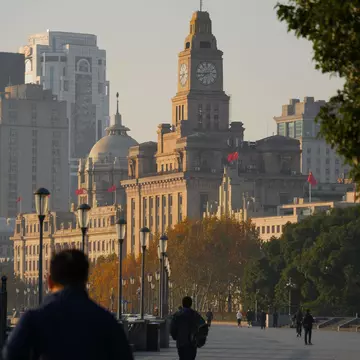
The modest museum at the Meteorological Signal Tower (外滩信号台; also called the Gutzlaff Signal Tower) only contains a small scattering of ground-floor historical photographs. Originally a wooden tower, this version was built in 1907 as a meteorological relay station set up by the tireless Shanghai Jesuits. The tower (外滩信号台; Wàitān Xìnhào Tái) was moved southeast by 22.4m in the mid 1990s.
-
Bund Sightseeing Tunnel
A 647m voyage with entertainment from budget effects, garish lighting and surreal props, the Bund Sightseeing Tunnel is a transport mode that guarantees to get you to Pǔdōng in an altered state. Stepping from the trains at the terminus, visitors are visibly nonplussed, their disbelief surpassed only by those with return tickets. A combined ticket includes the excellent China Sex Culture Museum and other attractions Pǔdōng-side.
-
Century Park
Shanghai's largest park at the end of Century Ave in the east is strong on hard edges and synthetic lines, but there's a great central lake with boat hire, and bicycle hire for getting around all the paths. Children will enjoy themselves, and the spacious paved area between the Science and Technology Museum and the park is great for flying kites (for sale from hawkers) and rollerblading.
-
Changfeng Ocean World
Adults may not list this subterranean aquarium at the top of their Shanghai experiences, but the little people will adore the clownfish and shark tunnel.
-
Chenxiangge Nunnery
Sheltering a community of around 40 dark-brown clothed nuns from the chénhǎi (Sea of Dust) - what Buddhists call the mortal world, but which could equally refer to Shanghai's murky atmosphere - this gorgeous yellow-walled temple is a tranquil portal to a devout existence far from the city's frantic temporal realm.
-
Advertisement
-
China Sex Culture Museum
A fascinating foray into the little-understood realm of Chinese sexuality and erotica. Among the mating tortoises, copulating beasts and graphic jade phalluses, search out the knife that raised eunuchs' voices to the correct register, the horrifying donkey saddle with the wooden penis (used to punish 'licentious' women), and the special coins once used as quid pro quo in China's brothels of yore.
-
Community Church
Shanghai's largest and most popular church, this non-denominational ivy-cloaked church was flung up in 1924. There are no cheesy Chinese Catholic frills and the church lawn is a gorgeous expanse of green, while the lush tangle of plant life adds to the sense of pleasant refuge. Services are held regularly ( & on Sundays).
-
Confucian Temple
Most historic Chinese towns worth their salt boast a temple dedicated to Confucius, although the iconoclastic spasms of the Cultural Revolution left many battered and bruised. A modest and pretty retreat, this well-tended temple to the dictum-coining sage is cultivated with acers, pines, magnolias and birdsong.
-
Dajing Pavilion
Dating from 1815, this pavilion contains the only preserved section of the 5km-long city walls which were erected in 1553 but felled in 1912. A Chinese-language only exhibition on the history of the Old Town is on the ground floor along with an interesting scale model depicting the walled district during the reign of Qing emperor Tongzhi.
-
Dino Beach
Way down south in Minhang district, this popular summer place has a beach, a wave pool, water slides and tube hire to beat the Shanghai summer heat and keeps going late. But it's absolutely heaving at weekends.
-
Dongjiadu Cathedral
Just outside the Old Town, this magnificent and now restored cathedral is Shanghai's oldest church, built by Spanish Jesuits in 1853. A splendid sight, the church was located within a famously Catholic area of Shanghai and is generally open if you want to view the interior.
-
Duolun Road Cultural Street
This nicely restored, if a little twee, street of fine old houses, just off North Sichuan Rd, was once home to several of China's most famous writers (as well as several Kuomintang generals), when the road was known as Doulean Rd. Today it is lined with art supply stores, curio shops, galleries, teahouses and cafés, as well as statues of the writers Lu Xun and Guo Moruo.
-
Fazangjiang Temple
This simple, recently restored but active temple is curiously accessed from the west rather than the south, where the entrance to Buddhist temples usually lies. The main hall, restored with new doors, encloses a large modern statue of Sakyamuni, seated lily-top between two walls glinting with gilded luóhàn (arhat).
-
Formula One Grand Prix Off
Every October, the Formula 1 circus comes to this impressive, state-of-the-art circuit 40 minutes northwest of the city centre. It's one of the most glamorous events on the Shanghai calendar and tickets, from around Y380 to around Y4000 , get snapped up very quickly. Book ahead through the website, or visit a friendly ticket tout.
-
Fuxing Park
This leafy park, laid out by the French in 1909 and later used by the Japanese as a parade ground in the late 1930s, remains one of the city's more pleasant. Heavily shaded by big-leafed wutong trees, it's an excellent place to take a seat and escape the summer sun and there's a popular kiddies playground. Wreathed in the laughter of children, the huge stony-faced busts of Karl Marx and Friedrich Engels gaze out from a seemingly redundant epoch.
-
Advertisement
-
Gongqing Forest Park
Most of Shanghai's synthetic parks can leave one cold, but this vast expanse of forested parkland on the western shore of the Huangpu River is a leafy, wooded and tranquil slice of countryside in town. This is about as wild as you get in Pǔxī, with nary a skyscraper in sight. Aim to spend half if not the whole day picnicking and wandering around this huge area, or hop into one of the buggies for express tours around the grounds.
-
Guilin Park
This park probably isn't worth a special visit but it's a pleasant enough place. It's famous for its spring blossoms, gardens and because it houses the former residence (1932) of the gangster 'Pockmarked' Huang Jinrong. It's now a teahouse.
-
Huangpu Park
Shanghai's - indeed China's - very first public park was laid out in 1886 by a Scottish gardener shipped out to Shanghai especially for that purpose. Originally called the Public Gardens, the park today is famously deformed by its anachronistic Monument to the People's Heroes (人民英雄纪念塔; Rénmín Yīngxióng Jìniàntǎ), underneath which is the Bund History Museum (外滩历史纪念馆; Wàitān Lìshǐ Jìniànguǎn).
-
Huangpu River Cruise
The Huangpu River offers staggering views of the Bund and riverfront activity. Most tour boats depart from the docks on the south end of the Bund, near East Jinling Rd, where tickets can be purchased; popular 30-minute cruises also depart hourly from the Pearl Dock (Míngzhū Mǎtoú; 1 Century Ave) in Lùjiāzuǐ.
-
Jade Buddha Temple
Built between 1911 and 1918 in Song dynasty style, this active place of worship is one of Shanghai's few Buddhist temples. But the large numbers of tourists it attracts make contemplation difficult. The centrepiece of the temple is its 1.9m-high pale-green jade Buddha