Sights in Québec
-
A
Jardin Botanique
Montréal’s Jardin Botanique is the third-largest in the world, after London’s Kew Gardens and Berlin’s Botanischer Garten. Since its 1931 opening, the 75-hectare garden has grown to include tens of thousands of species in 30 thematic gardens, and its wealth of flowering plants is carefully managed to bloom in stages. The rose beds in particular are a sight in summer. Climate-controlled greenhouses house cacti, banana trees and 700 species of orchid. Bird-watchers should bring their binoculars. A popular draw is the landscaped Japanese Garden with traditional pavilions, tearoom and art gallery; the bonsai ‘forest’ is the largest outside Asia. The twinning of Montréa…
reviewed
-
B
Artillery Park
The French chose this location for their army barracks because of its strategic view of the plateau west of the city and the St Charles River, both of which could feed enemy soldiers into Québec City. English soldiers moved in after the British conquest of New France. The English soldiers left in 1871 and it was changed into an ammunition factory for the Canadian army. The factory operated until 1964 and thousands of Canadians worked there during the World Wars. Now you can visit the Officers’ Quarters and the Dauphine Redoubt where guides greet you in character (ie the garrison’s cook) and give you the scoop on life in the barracks. There’s also a huge model of Québec…
reviewed
-
C
Biodôme
At this captivating, kid-friendly exhibit you can amble through a rainforest, the Arctic Circle, rolling woodlands or along the raw Atlantic oceanfront – all without ever leaving the building. Be sure to dress in layers for the temperature swings. The four ecosystems house many thousands of animal and plant species; follow the self-guided circuit and you will see everything. Penguins frolic in the pools a few feet away from groups of goggle-eyed children; the tropical chamber is a cross-section of Amazonia with mischievous little monkeys teasing alligators in the murky waters below. The Gulf of St Lawrence has an underwater observatory where you can watch cod feeding alon…
reviewed
-
D
Morgan Arboretum
This arboretum holds the country’s largest grouping of native trees: fragrant junipers, cedars and yews but also exotic species like ginkgo, cork and yellowwood. There’s a wonderful trail map and the area is perfect for a long hike in the woods, strolling through magnolia blossoms or having a family picnic. Spring and fall offer the best colors. The grounds of the arboretum serve as an educational facility for McGill’s MacDonald agricultural school. There are several species of wildlife and reptile, and it’s also a stop for 170 species of wintering or migratory birds, making it a thrill for bird-watchers. In winter, this is a beautiful location for cross-country skiing. L…
reviewed
-
E
Parc des Rapides
This space on the St Lawrence is the spot to view the Lachine Rapids (and the jet boats that ride them). The park attracts hikers, anglers and cyclists who pedal the riverside trail, and it’s a renowned bird sanctuary –located on a small peninsula, with what’s said to be Québec’s largest heron colony. The 30-hectare sanctuary is an important site for migratory birds, with some 225 species passing through each year. Some information displays relate the history of the rapids and of the old hydroelectric plant on the grounds. You can rent kayaks and sign up for classes where you’ll learn to surf or kayak the Lachine Rapids – scaredy-cats need not apply. Kayak Sa…
reviewed
-
F
Centre Canadien d’Architecture
A must for architecture fans, this center is equal parts museum and research institute. The building incorporates the Shaughnessy House, a 19th-century grey limestone treasure. Highlights in this section include the conservatory and an ornate sitting room with intricate woodwork and a massive stone fireplace. There’s also a busy, well-stocked bookstore. The exhibition galleries focus on remarkable architectural works of both local and international scope, with a particular focus on urban design. The CCA’s sculpture garden is located on a grassy lot overlooking south Montréal, but separated from the main grounds by busy Blvd René-Lévesque.
reviewed
-
G
Musée du Fort
Not really a museum at all, the Musée du Fort houses a 30-minute multimedia show on the many attempts over the centuries to take Québec City. It’s all played out on a model/diorama that lights up in the middle of a minitheater. The breathless narration and anemic smoke-puffs that pass for special effects are a bit hokey but it does give a quick, enjoyable, easy-to-grasp audiovisual survey of the city’s battles and history, making a good introduction to it. English-language shows are held on the hour (French-language versions on the half-hour).
reviewed
-
H
Westmount Park & Library
The lovely Westmount Park encompasses pathways, streams and concealed nooks that recall the whimsical nature of English public gardens. At the western boundary the Westmount Public Library stands stolid, with its Romanesque brickwork, leaded glass and delightful bas-reliefs dedicated to wisdom. Two fine buildings are attached: the Westmount Conservatory (a Victorian greenhouse) and the Victoria Jubilee Hall, fronted by a beautiful floral clock. Both can be visited during business hours.
reviewed
-
I
La Ronde Amusement Park
Québec’s largest amusement park, La Ronde has a battery of impressive rides, including Le Monstre, the world’s highest wooden roller coaster; and Le Vampire, a corkscrew roller coaster with gut-wrenching turns. For a more peaceful experience, there’s a Ferris wheel and a gentle minirail that offers views of the river and city. Concerts and shows are held throughout the summer, and fireworks explode overhead on weekend evenings (when the park stays open later).
reviewed
-
Basilique Ste-Anne-de-Beaupré
The village of Ste-Anne-de-Beaupré is known for the Goliath-sized Basilique Ste-Anne-de-Beaupré and its role as a shrine. Churches were built at this location since the mid-1600s but were frequently destroyed by fire. The awe-inspiring basilica of today was constructed after a devastating blaze in 1922 and has been open since 1934.
reviewed
Advertisement
-
J
La Citadelle
This massive, star-shaped fort towers above the St Lawrence River on Cap Diamant. French forces started construction here in the late 1750s leaving a gunpowder building and a redoubt, the beginnings of a defensive structure. But the Citadelle we know today was actually built by the British, who feared two things: an American invasion of the colony and a possible revolt by the local French-speaking population (that’s why the cannons point not only at the river, but at Québec City itself). However, by the time the Citadelle was completed (construction began in 1820 and was finished about 30 years later) things were calming down. Twenty years later, in 1871, the Treaty of Wa…
reviewed
-
K
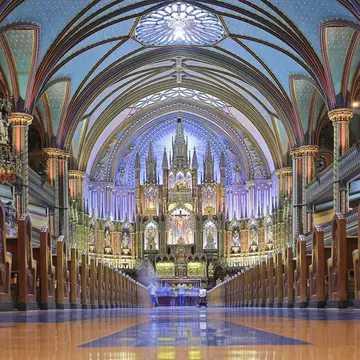
Basilique Notre-Dame
The grand dame of Montréal’s ecclesiastical treasures, this basilica is a must-see when exploring the city. The looming neo-Gothic church can hold up to 3000 worshippers and houses a collection of finely crafted artworks, including an elaborately carved altarpiece, vibrant stained-glass windows and an intricate pulpit. The Sulpicians had an ever-growing congregation and no one in the soon-to-be Canadian colonies schooled in neo-Gothic architecture. So they commissioned James O’Donnell, a New York architect and Irish Protestant, to design what would be the largest church north of Mexico. Such was O’Donnell’s dedication to the project that he converted to Catholicism so he…
reviewed
-
L
Musée National des Beaux-Arts du Québec
Anyone curious about Québec art needs to carve out at least half a day for a visit to this museum, one of the best in the province. There are expert permanent exhibitions that range from art and artists in the early French colonies to Québec’s abstract artists. There are also individual halls devoted entirely to the province’s artistic giants of the last century. The do-not-miss permanent exhibitions include one devoted to Jean-Paul Lemieux (1904–90) and another to Jean-Paul Riopelle (1923–2002), which includes L’hommage à Rosa Luxemburg (Tribute to Rosa Luxemburg; 1986), his largest work. The Brousseau Inuit Art Collection of 2639 pieces spanning 50 years wa…
reviewed
-
M
Musée des Beaux-Arts
Montréal's Museum of Fine Arts, the oldest in the country and the city's largest, is housed in two buildings: the classical, marble-covered Michal and Renata Hornstein Pavilion, and the modern annex across the street, the Jean-Noël Desmarais Pavilion. The latter plays host to works by European and Canadian masters but also ancient artifacts from Egypt, Greece, Rome and the Far East; Islamic art and works from Africa and Oceania.
The Old Masters collection has paintings from the Middle Ages stretching through the Renaissance and classical eras up to contemporary works. Exhibitions change but some great painters (such as Rembrandt, Picasso or Matisse) and sculptors (Henry…
reviewed
-
N
Hôtel du Parlement
The National Assembly building is a Second Empire structure completed in 1886. It’s home to the Provincial Legislature. Free tours are given in English and French year-round. The 30-minute visits get you into the National Assembly Chamber, the Legislative Council Chamber and the Speakers’ Gallery. The facade of the building is decorated with 23 bronze statues of significant provincial historical figures, including explorer Samuel de Champlain (1570–1635), early New France governor Louis de Buade Frontenac (1622–98) and battle heroes like James Wolfe (1727–59) and Louis-Joseph Montcalm (1712–59), the English and French generals who met, fought and received mortal wound…
reviewed
-
O
Oratoire St-Joseph
The gigantic oratory honors St Joseph, Canada’s patron saint. The largest shrine ever built in honor of Jesus’ father, this Renaissance-style building was completed in 1960 and commands fine views of the northern slope of Mont-Royal. The oratory dome is visible from anywhere in this part of town. The oratory is also a tribute to the work of Brother André, the determined monk who first built a little chapel here in 1904. André was said to have healing powers and as word spread, a larger shrine was needed so the church began gathering funds to build one. Rows of discarded crutches and walking sticks in a votive chapel testify to this belief and the shrine is warmed by hundr…
reviewed
-
Vignoble l'Orpailleur
Ice wine was discovered in Germany by accident, when growers found that pressing wine grapes after they froze on the vine left a sweet, highly concentrated juice. Ice wine results when this juice is left on the vine to ferment, creating one of the most coveted dessert wines on the market; it’s so expensive because of the amount of grapes that need to be pressed for enough juice to be extracted. Ontario-produced varieties are the out-and-out stars of this luxury sweet-treat, but the Québec-produced kinds are starting to give them a run for their money. If you’re doing the winery tour in the Eastern Townships, you’ll come across many, fascinating local varieties. In Dunham,…
reviewed
-
P
Musée Ferroviaire Canadien
The Canadian Railway Museum contains more than 150 historic vehicles, ranging from locomotives, steam engines, Old Montréal streetcars and passenger cars to snow plows. It’s widely acknowledged as one of North America’s most outstanding collections. Not particularly well known by Montrealers, this museum gets raves from those who make the trek, especially families, and many claim it’s the best museum in the Montréal area. The aerodynamic steam engine Dominion of Canada broke the world speed record in 1939 by clocking over 200km/h. A special sight is Montréal’s famous Golden Chariot, an open-air streetcar with tiers of ornate seats and gilt ironwork. Another goo…
reviewed
-
Q
Musée d'Archéologie et d'Histoire Pointe-à-Callière
Built on the very spot where European settlers set up their first camp, the Pointe-à-Callière Museum of Archaeology & History provides a good overview of Montréal's beginnings. Visitors should start with Montreal, Tales of a City a 20-minute multimedia show that illustrates the centuries with the aid of film, hologram characters and real drizzle.
For the most part the museum is underground. Head to the archeological crypt in the basement where you can explore the remains of the city's ancient sewage and river system and the foundations of its first buildings and first public square. Interactive exhibits include video monitors that allow visitors to ask questions of the…
reviewed
-
TOHU
If you decide to take a jaunt to Montréal’s circus mecca in its working-class St-Michel district, be prepared to be wowed. This innovative complex TOHU (which comes from the French expression tohu-bohu, for hustle and bustle), includes an arena designed only with the circus arts in mind, Cirque du Soleil’s international headquarters and artists’ residence and the National Circus School. Moreover, it was built on the sight of North America’s second largest waste dump and the whole complex is now powered completely by methane gas from the landfill garbage beneath it.
You can visit the complex on your own (via guided audio tour), or on a guided 90-minute tour. TOHU …
reviewed
Advertisement
-
R
Parc Nature du Cap-St-Jacques
Arguably the most diverse of Montréal’s nature parks, Cap-St-Jacques has a huge beach, 27km of trails for hiking and skiing, a farm and even a summer camp. The maple and mixed deciduous forest in the interior is a great patch for a ramble, and in spring a horse-drawn carriage brings visitors to a sugar shack to watch the maple sap boil. On the north shore there’s the Eco-Farm, a working farm with two barns and horses, pigs and chickens, as well as a large greenhouse for viewing. Picnic tables abound and a restaurant serves the farm’s produce. The beach is a comfortably wide stretch of fine white sand, and the shallow water is wonderful for splashing with kids, but …
reviewed
-
S
Cathedral of the Holy Trinity
Built from 1800 to 1804, this cathedral was designed by two officers from the British army’s military engineering corps and modeled on St Martin-in-the-Fields Church in London, England. This elegantly handsome Anglican cathedral was the first ever built outside the British Isles, with oak imported from Windsor Castle’s Royal Forest just to make the pews. Upon its completion, King George III sent the cathedral a treasure trove of objects, including candlesticks, chalices and silver trays. The elaborateness of the gifts heading toward the New World sent London’s chattering classes atwitter. The royal box for the reigning monarch or her representative is located in the upper…
reviewed
-
T
Place-D’armes
This square is framed by some of the finest buildings in Old Montréal, including its oldest bank, first skyscraper and Basilique Notre-Dame. The square’s name references the bloody battles that took place here as religious settlers and First Nations tribes thrashed out control of what would become Montréal. At its center stands the Monument Maisonneuve, dedicated to city founder Paul de Chomedey, sieur de Maisonneuve. The red sandstone building on the east side of the square is the New York Life Insurance Building, Montréal’s first skyscraper (1888). It’s said to be built with the blocks used for ballast on ships bringing goods to Montréal. Next door, the Aldred…
reviewed
-
Rue St-Jacques
Known as the Wall Street of Canada into the 1930s, Rue St-Jacques was lined with the head offices of insurance companies and banks that proclaimed Montréal’s prosperity for the best part of a century. In those days it was known as St James Street.
Some great edifices are veritable temples to capitalism. The 1902 Guardian Insurance Building has helmeted women guarding the entrance while lions and mermaids watch over on the 2nd floor. The Molson Bank Building looks more like a royal residence; heads of founder William and his two sons grace the doorway.
The most glamorous of the lot is the Royal Bank Building, the city’s tallest building (22 stories) when it was built in…
reviewed
-
U
Musée des Ursulines
The fascinating story of the Ursuline nuns’ lives and their influence in the 17th and 18th centuries is told in this thoughtful, well-set-out museum. The sisters established the first girls’ school on the continent in 1641, educating both aboriginal and French girls. Marie de l’Incarnation, the founder, was one of the most intriguing figures from the order. Leaving a young son in France after she was widowed, she joined the Ursulines and moved to New France and lived well into old age. She taught herself aboriginal languages and her frequent and eloquent letters to her son back in France are held by historians to be some of the richest and most valuable material available…
reviewed