Sights in Siem Reap
- Sort by:
- Popular
-
Ta Prohm
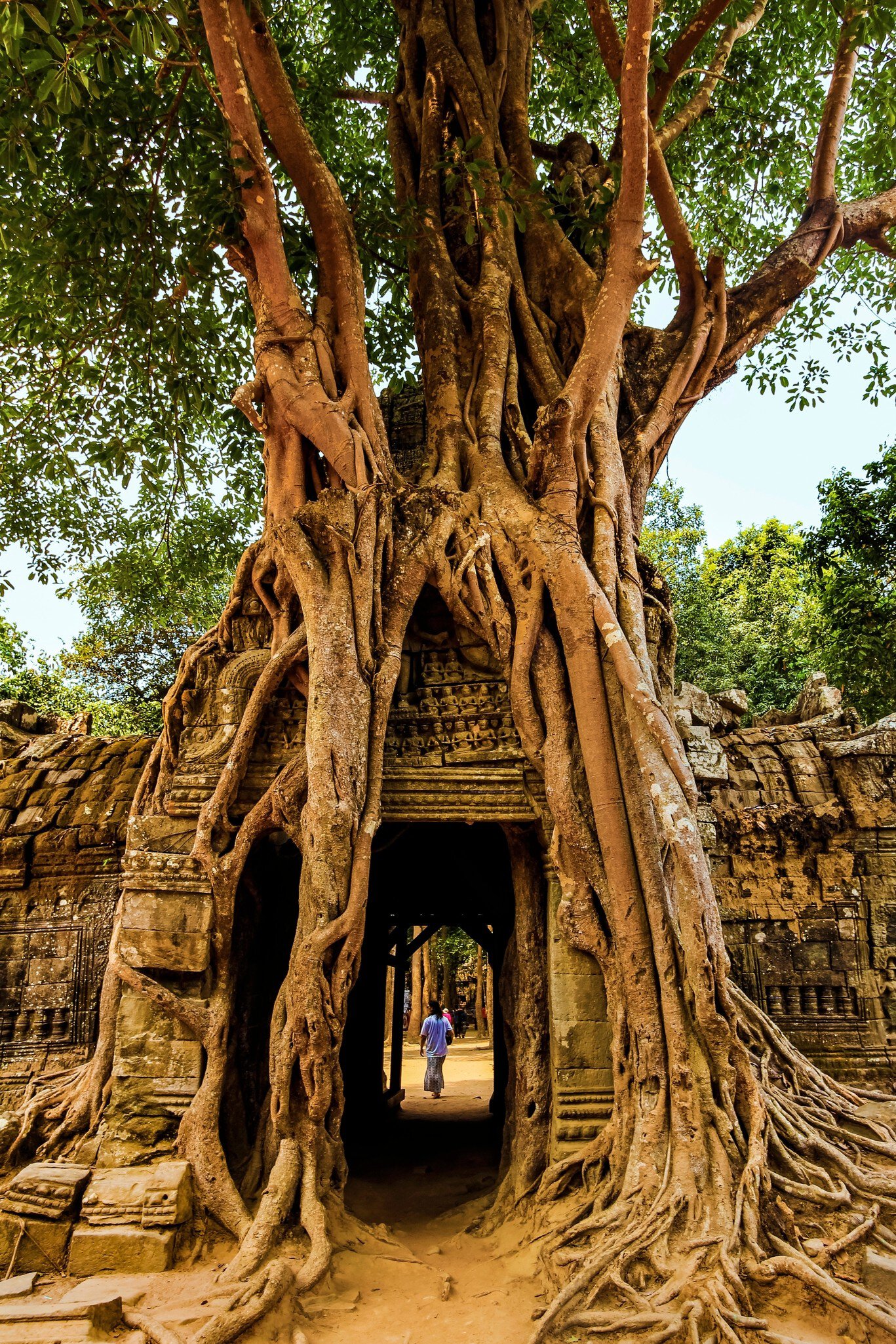
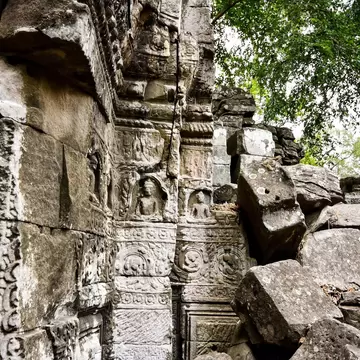
Ta Prohm is as seductive as Lara Croft. The site of some of her cinematic adventures, it is a series of dark galleries and pillars held hostage under the iron clasp of gigantic roots. The walls are decorated with carvings of sensuous celestial nymphs with smaller roots crawling across them like a rash.
Built in AD 1186 by King Jayavarman VII, the temple was dedicated to his mother. In its prime it was a holy trunk of great treasures. According to the Sanskrit inscriptions on the walls, the temple held thousands of pearls, precious stones and golden dishes weighting more than 500kg.
reviewed
-
Beng Mealea
Visitors to Beng Mealea are confronted with a mass of ruins half devoured by a ravenous jungle. The temple's abandoned stones lie like forgotten jewels swathed in lichen and its temple complex strangled by ivy and vines. Brought to you by the same man who built Angkor Wat, King Suryavarman II, it is similar in style to his later effort but receives only a fraction of the guests.
Beng Mealea is 70km northeast of Siem Reap on a sealed private road. You can get there in a chartered taxi.
reviewed
-
Banteay Srei
This 'Citadel of Women' dedicated to Shiva, is a stunning tour de force of classical art and the most ornate of all of the temples. Though it is relatively tiny in size compared to its mammoth counterparts, it has the most intricate carvings and is believed to be the instigator of the Khmer art movement. The detail is astounding and each doorway, each lintel and every wall is a masterpiece.
reviewed
-
A
McDermott Gallery
This photography gallery is home to John McDermott’s striking sepia-style images of the temples. For a preview of the temples in a different light, check out his online collection.
reviewed
-
Angkor Thom
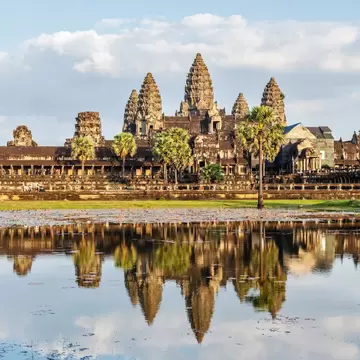
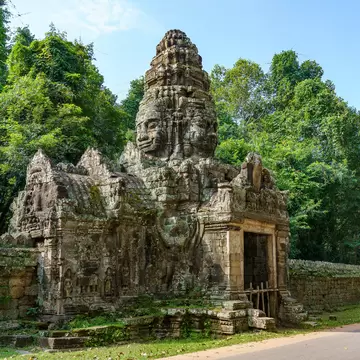
From Angkor Wat, the bridge leading to the south gate of Angkor Thom has two incredible balustrades of giants handling nagas (mythical serpents, often multiheaded), an incredible first impression made only more dreamlike by the elephants plodding out of the arched entrance topped by the four enormous faces of Avalokiteshvara (the Buddha of Compassion). Angkor Thom is a walled compound bordered by a 100m wide moat. It was built by the great King Jayavarman VII (r 1181-1219) as his royal palace.
The complex has five gateways, each with double portals. Four of the gateways point to each side of the compass, while the fifth is a Victory Gateway.
Behind the 8m walls lie some of…
reviewed
-
Phnom Kulen
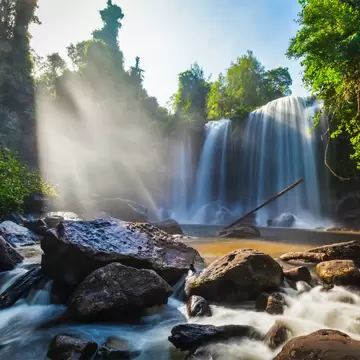
From a lofty height of 20m, the Phnom Kulen waterfall cascades off the mountain where King Jayavarman II announced independence from Java and proclaimed himself god-king. The river here also runs over lingas and is an attractive sight for modern-day pilgrims. There is also an 8m-long reclining Buddha and a small temple nearby.
There is also a little explored unnamed set of ruins at the foot of the mountain that is gaining mythical status among locals. Not many know how to get there, though they know of its existence. Would-be explorers are challenged to find it!
reviewed
-
Cambodia Land Mine Museum
Established by DIY de-miner Aki Ra, this museum has eye-opening displays on the curse of land mines in Cambodia. The collection includes mines, mortars, guns and weaponry, and there is a mock minefield where visitors can attempt to locate the deactivated mines. Proceeds from the museum are ploughed into mine-awareness campaigns. The museum is about 25km from Siem Reap, near Banteay Srei.
reviewed
-
Wat Athvea
Wat Athvea is a pretty pagoda set on the site of an ancient sandstone temple that sees far fewer visitors than Angkor. It‘s south of the city centre, on the road to Tonlé Sap lake.
reviewed
-
Phnom Bakheng
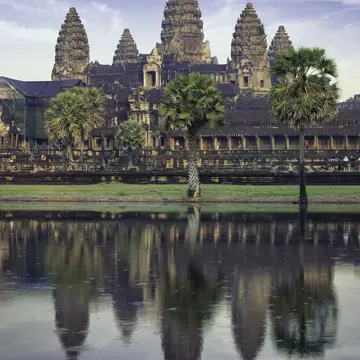
When King Yasovarman I (r 889-910) moved the capital to Angkor proper, he built Phnom Bakheng as his capital. The temple, a 65m five-tiered pyramid, is a study of Hindu numerology. At the summit, five towers form a quincunx to echo the five peaks of the heavenly mountain. At its most magnificent, the pyramid was surrounded by 108 towers representing the 27 days of four lunar cycles.
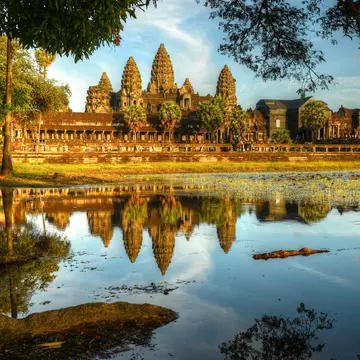
An ascending temple of towers, this is a great place to view the rise and fall of the sun over the distant Angkor Wat. However, a gazillion others try to do the same so it can be rather frustrating to get that money shot.
reviewed
-
Temples of Roluos
The very first site of the ancient Khmer civilisation was here in Roluos, then known as Hariharalaya. The temples of Roluos were built by King Indravarman I (r 877-89). The first was Preah Ko (Sacred Bull) named after the Nandin statue found on site. Preah Ko has six brick towers each dedicated to his parents, maternal grandparents and to King Jayavarman II and his wife.
Next came Bakong, a terrestrial version of the celestial Mount Meru. It is a five-tiered pyramid-temple and was the inspiration for many of the temples that followed.
reviewed
Advertisement
-
Preah Khan
Where all faiths collide, Preah Khan is a Buddhist complex with parts dedicated to Vishnu and other sections to Shiva. Part of King Jayavarman VII's impressive portfolio, Preah Khan was dedicated to his father, the multisyllable Dharanindravarman. It was originally a Buddhist complex housing more than 1000 Buddhist teachers. Covering 56 hectares, it is also another compound where temples and trees intertwine, evoking the conquistador feeling of discovering ancient secrets.
reviewed
-
Kbal Spean
In the midst of the jungle, cool water rushes over a skilfully carved river bed, known as Kbal Spean or the 'River of a Thousand Lingas'. The phallic symbols of fertility have been shaped into the rocks along with some deities that recline under a set of rapids. It takes about 1½ hours to get here from Banteay Srei on a sandy track. From the entrance, it is another 30-minute walk. The trip out here is best combined with a visit to Banteay Srei.
reviewed
-
B
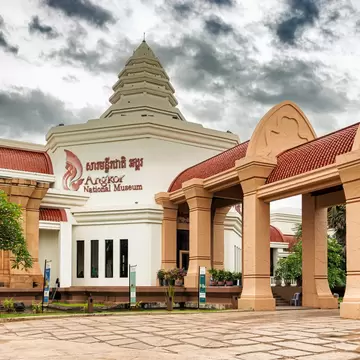
Angkor National Museum
A state-of-the-art showcase for the Khmer civilisation and the majesty of Angkor, with displays themed by era, religion and royalty. Presentations include touchscreen video and epic commentary, but for all the technology there seems to be a scarcity of sculpture – a triumph of style over substance. It seems a touch overpriced, but remains a useful initiation for first-time visitors to put the story of the Khmer empire in context.
reviewed
-
C
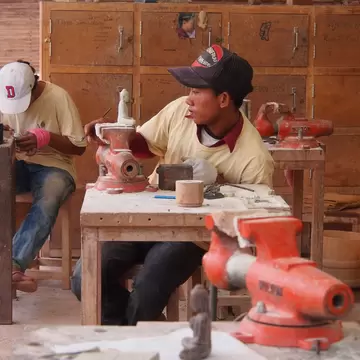
Artisans d’Angkor
Siem Reap is the epicentre of the drive to revitalise Cambodian culture, which was dealt such a harsh blow by the Khmer Rouge. Les Chantiers Écoles runs this school specialising in teaching wood- and stone-carving techniques to impoverished youngsters. Tours are available daily. The site includes a shop, selling reproduction carvings, lacquerware and exquisite silks, and profits from sales go back into funding the school.
reviewed
-
D
Miniature Replicas of Angkor’s Temples
Can’t afford the helicopter ride over Angkor? Don’t fancy the balloon? For the bluffer’s way to get that aerial shot of Angkor Wat, visit the garden of a local master sculptor, which houses miniature replicas of Angkor Wat, the Bayon, Banteay Srei and other temples. Astute observers might question the presence of oversized insects in the shot, and it doesn’t quite deliver the authentic sunrise over Angkor.
reviewed
-
Prasat Neak Pean
An island temple, the Prasat Neak Pean is believed to celebrate Buddha's achievement of Nirvana. Sitting pretty in the middle of the Jayatataka reservoir (Northern Baray) it acted as a sacred shrine where pilgrims came to swim in the surrounding waters. The four fountains take four forms: elephant, human, lion and horse sprouted holy water that could cure the pilgrims of their ailments.
reviewed
-
E
Cambodian Cultural Village
It may be kitsch, it may be kooky, but it is very popular with Cambodians and provides a diversion for families travelling with children. The visit begins with a wax museum and includes traditional homes of ethnic groups and miniature replicas of landmark Cambodian buildings. There are also dance shows and performances throughout the day.
reviewed
-
Land Mine Museum
Set up by local de-miner Aki Ra, the Land Mine Museum is very popular with travellers for its informative displays on the curse of land mines in Cambodia. The museum includes extensive details about the types of mines used during the civil war in Cambodia. It compares favourably with the new War Museum that has opened near the airport.
reviewed
-
F
Wat Dam Nak
This pretty compound was formerly a royal palace during the reign of King Sisowath, hence the name dam nak (palace). Today it is home to the Centre for Khmer Studies, an independent institution promoting a greater understanding of Khmer culture with a drop-in library on site.
reviewed
-
National Centre of the Khmer Ceramics Revival
Dedicated to reviving the Khmer tradition of pottery, the centre has re-created an ancient Khmer kiln, which is helping to breathe new life into this old art. It’s possible to try your hand at the potters wheel, and there are plenty of elegant items on sale. It’s located near the airport.
reviewed
Advertisement
-
G
Wat Bo
Wat Bo is one of the town’s oldest temples. It has a collection of well-preserved wall paintings from the late-19th century, depicting the Reamker, Cambodia’s interpretation of the Ramayana. Look out for the stunning roof of the main pagoda, a classical Khmer design.
reviewed
-
H
Wat Thmei
Wat Thmei is a modern pagoda concealing a dark past, with a memorial stupa containing the bones of victims of the Khmer Rouge. There are plenty of young monks keen to practise their English here. It’s located on the left fork of the road to Angkor Wat.
reviewed
-
Gecko Centre
Visitors should check out Gecko Centre, an informative place located in the floating village of Chong Kneas. It has displays on flora and fauna of the area, as well as information on communities living around the lake.
reviewed
-
Wat Preah Inkosei
Many modern pagodas were consecrated on the sacred ground of ancient temples. Wat Preah Inkosei is built on the site of an early Angkorian brick temple north of town; the older structure still stands at the rear of the compound.
reviewed
-
I
McDermott Gallery
This photography gallery is home to John McDermott’s striking sepia-style images of the temples. For a preview of the temples in a different light, check out his online collection.
reviewed