Showing 1-16 of 16 results
-
Art Gallery
If you're ever so slightly interested in art, swing by the Art Gallery and be inspired by the designs and boldness of its modern art. Local artists show their work here.
-
Catholic Church
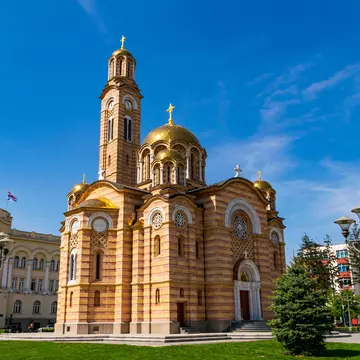
As a measure of their tolerant and multicultural history, Sarajevans are proud to point out that four religions and their places of worship share one city block. Close together are the neo-Gothic 1889 Catholic Church and the old synagogue (1581, last rebuilt in 1821), which is now the Jewish Museum.
-
Central Post Office
The Central Post Office should be visited for its splendid imperial interior and its big hanging brass clock. Almost opposite across the river is the stunningly graceful Academy of Fine Arts, which is now an art school.
-
Eternal Flame
At the western end of the city centre is the Eternal flame, which commemorates the sacrifices of WWII.
-
Gazi-Husrevbey Mosque
The nearby Gazi-Husrevbey Mosque was built by masons from Dubrovnik in 1531. There are some superb internal decorations employing line, pattern and calligraphy in pastel colours to delineate every separate architectural feature.
-
History Museum
Adjacent to the National Museum, the History Museum is essentially one room of archive material, mostly photographs, covering WWII up to the Srebrenica massacre.
-
Jewish Museum
The Jewish Museum has revealing explanations of a Jewish society in Sarajevo that almost ended with the genocides of WWII.
-
Latin Bridge
Austrian Archduke Franz Ferdinand and his wife Sophie paused at the National Library (then the town hall) on that fateful day in 1914. Despite an earlier unsuccessful assassination attempt that day, they rode west along the riverside in an open car to the Latin Bridge. It was here that Gavrilo Princip stepped forward to fire his pistol, killing them both and sparking off war between Austria-Hungary and Serbia. Thanks to a series of European alliances, this escalated into WWI.
-
Morića Han
Morića Han was a tavern when Sarajevo was a caravan stopover on the ancient trading route between East and West. Wicker chairs for coffee drinkers have now replaced plain benches for weary travellers and a carpet shop with waist-high stacks of rugs fills the former stables. The han (tavern) has been burnt down several times, with the latest reincarnation dating from the 1970s.
-
National Library
The stylish Austro-Hungarian National Library, decorated with Moorish flourishes, was targeted by the Serbs as a repository of Bosnian books and manuscripts, and therefore an entire people's culture. An incendiary shell on 25 August 1992 wiped out a heritage; restoration work is slow and many books may be irreplaceable.
-
Advertisement
-
National Museum
The best exhibition in the National Museum is the Ethnology section with its fine display on Bosnian music and instruments, well explained in English. The Natural History section has its share of stuffed birds and beasts but the Prehistory section is empty due to impending building repairs.
-
Orthodox Church
In the same road as the Jewish Museum and Catholic Church is the old Orthodox Church, which is medieval (last rebuilt in 1740) and predates the yellow-and-brown Orthodox cathedral in Zelenih Beretki. Inside the church don't miss the museum, which showcases Russian, Greek and local icons, as well as tapestries and old manuscripts.
-
Sarajevo Roses
Look for the infamous Sarajevo roses on the pavements in central Sarajevo. These are flower shape indentations where a shell has exploded and some have been symbolically filled in with red cement.
-
Sebilj
This fountain, looking more like an enclosed Oriental gazebo, is not the original and only dates from 1891. From the square a series of parallel lanes, cross alleys and open courtyards strike off in all directions to a boundary of the National Library in the east and Gazi-Husrevbey Mosque in the west.
-
Svrzo House
Closed at the time of research, Svrzo House shows the lifestyle of a well-to-do, 18th-century Muslim family. It may well have opened by the time you read this.
-
Tunnel Museum
The tunnel that saved Sarajevo! Most of the 800m-stretch under the airport has collapsed, but the Tunnel Museum, on the southwestern side of the airport, gives visitors just a glimpse of its hopes and horrors: the hopes of people surviving with the food it brought in and of the injured it took out, and the horrors from the pounding overhead artillery and sniper fire during the long hours of waiting to go through.
Showing 1-16 of 16 results