Things to do in Belgium
-
A
Grand Place
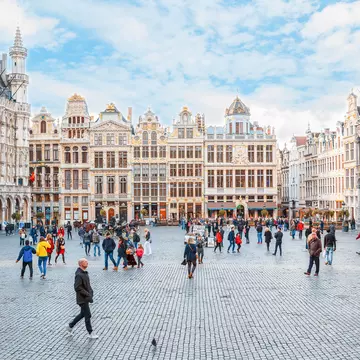
For one of Europe's finest urban views, head straight to Brussels' magnificent central square, Grand Place. It boasts the country's best baroque guildhalls, the beautiful Hôtel de Ville (Town Hall), museums, pavement cafés, chocolate shops and intimate cellar restaurants - a combination that lures visitors in droves. Hidden at the very core of the old town, it's revealed as you enter from one of six narrow side alleys (Rue des Harengs is the best) - a discreet positioning that adds charm.
The square dates from the 12th century and rose on a site that was once marshland. By the early 15th century, Brussels was booming through the cloth trade and the patronage of the…
reviewed
-
B
Musée Magritte
A completely anonymous, suburban yellow-brick house: that's the façade of the Musée Magritte, and the façade that René Magritte, Belgium's most famous surrealist artist, showed the outside world. This museum in Jette occupies the house where Magritte and his wife Georgette lived from 1930 to 1954. Its appeal comes from its incredibly ordinary nature. It's odd to think the man responsible for some of the 20th century's most enduring images spent 24 years of his life in this bourgeois backstreet.
The museum opened in 1999 as the private initiative of a friend of the widow Magritte. With scandalously little support from the Belgian state, the curators assembled hundreds…
reviewed
-
C
Rue des Bouchers
Leading off Galeries St Hubert in a lively little quarter known as Ilôt Sacré is the famous Rue des Bouchers. Whether you decide to eat at one of the many seafood restaurants here or not, this pedestrianised cobbled street is a spectacle not to be missed. Both sides of the street are packed with tables for dining throughout the year - overhead heaters keep frostbite at bay in winter. Waiters entice diners with iced displays of marine delicacies and the odd novelty (expect dancing plastic fish). Many of the restaurants are not recommended but there are exceptions, including Chez Léon.
reviewed
-
D
Koninklijk Museum voor Schone Kunsten
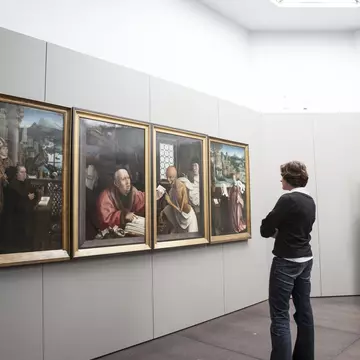
The Koninklijk Museum voor Schone Kunsten is a monumental neoclassical edifice built at the end of the 19th century. Its stately rooms house an impressive collection of paintings dating from the 14th century to contemporary times and includes works by Flemish masters.
The size of the museum's collection means that paintings are sometimes rotated. To find the highlights you'll need to pick up a museum plan and audio headset (both free) from reception.
The Flemish Primitives are represented by Jan Van Eyck, Hans Memling, Rogier Van der Weyden and Gerard David. Highlights include Van Eyck's unusual, almost monotone Saint Barbara (1437), Memling's rich Christ among Angels…
reviewed
-
E
Musée d'Art Ancien
To view the collections of the Royal Museums of Fine Arts chronologically, start with the Musée d'Art Ancien. Begin with the Flemish Primitives, including works by Rogier Van der Weyden, Dirk Bouts, Hans Memling and Gerard David. Move onto Quinten Matsijs, whose paintings demonstrate a turning point in Flemish art as traditional realistic scenes were superseded by the more flamboyant Renaissance style imported from Italy.
The Breugel family, in particular Pieter Breugel the Elder, comes next. The mysterious Fall of Icarus is one of his most famous works, although De Volkstelling (The Census at Bethlehem, painted in 1566) is more typical of his distinctive peasant scenes.…
reviewed
-
F
't Velootje
Push through the heavy, unmarked door and take care not to trip over old bikes, or whack your head on the kero lamps cluttering this tiny, darkened garage as you take a seat at a low wooden picnic table. Lieven De Vos has turned his bicycle workshop into an informal bar, of sorts - ask for a beer and Lieven will bring out whatever he selects; his opening hours are 'whenever I feel like opening until it closes down' (try after 21:00).
There are plans to expand the pub to accommodate Lieven's collection of antique bikes; the expansion is scheduled to be complete in 2010, Het Velootje's 25-year anniversary.
To find the pub, walk north along Oudburg until you see a pile of…
reviewed
-
G
Kokob
Meals at this airy Ethiopian bar/restaurant/cultural centre are based around small, shared dishes, like spiced eggplant or finely ground spinach and cheese, spooned onto a central injera (pancake), with more pancakes provided for you to rip apart and use to scoop up your meal. If you order a pot of Ethiopian coffee (€8), be prepared to wait 15 minutes while the beans are roasted, and to be wired all night.
reviewed
-
De Gekroonde Hoofden
Spare ribs (in honey, natural, and the house version, sweet and sour) are the speciality of this large, airy restaurant situated footsteps from Ghent's castle. You can fill up on them à la carte (from around €15) or as part of all-you-can-eat menus (around €24.20 to around €37.70), finished off with chocolate mousse. Staff are welcoming and genuine.
reviewed
-
H
Museum aan de Stroom
The purpose-built multistorey Museum aan de Stroom is located between two docks - Bonapartedok and Willemdok - in the flourishing 't Eilandje district. Architecturally it's a big draw, designed like a modern spiral tower with a panorama platform offering city views. It brings together exhibits of the city's history from its earliest beginnings to recent times.
reviewed
-
I
Musée Royale de l’Armée et d’Histoire Militaire
One for military buffs, this museum houses an extensive array of weaponry, uniforms, vehicles, warships and documentation dating from the Middle Ages through to Belgian independence and the mid-20th century. There’s a panoramic view of the park’s triumphal arch (built in 1880), the Arcade du Cinquantenaire, from the top floor.
reviewed
Advertisement
-
J
Mode Museum
Fashion followers must start with Antwerp's mode museum, MoMu. It's located in the much-celebrated ModeNatie complex, home also to both the Flanders Fashion Institute and the fashion department of the Royal Academy of Fine Arts. Sticking firmly to avant-garde, MoMu changes its exhibits every six months.
reviewed
-
K
The Adoration of the Mystic Lamb
Formidable queues form to see The Adoration of the Mystic Lamb (De Aanbidding van het Lams God), a lavish representation of medieval religious thinking that is one of the earliest-known oil paintings. Completed in 1432, it was painted as an altarpiece by Flemish Primitive artist Jan Van Eyck, and has 20 panels (originally the interior panels were displayed only on important religious occasions, but these days they're always open to view).
The work represents an allegorical glorification of Christ's death: on the upper tier sits God the Father flanked by the Virgin and John the Baptist and on the outer panels are the nude Adam and Eve. The lower tier centres on the lamb,…
reviewed
-
L
Parc du Cinquantenaire
Parc du Cinquantenaire was built during Léopold II's reign. It's best known for its cluster of museums - art, history, military and motor vehicles - that house an incredible 350,000 artefacts from all continents. We love the fine jewellery and cult of the dead funerary gifts from the Merovingian civilization. There is also the massive Arcade du Cinquantenaire, a triumphal arch built in 1880 to celebrate 50 years of Belgian independence. In summer, this area is put to good use with a popular drive-in cinema.
The Royal Art and History Museums in the southern wing of the Cinquantenaire buildings are chock-a-block with antiquities from all over the world.
Autoworld, in the…
reviewed
-
Place Flagey
When Bruxellois say something is ‘hype’, they don’t mean overhyped but hipper-than-hip. Fitting that description is Place Flagey, a revitalised square near the Étangs d’Ixelles (Ixelles Ponds). The square’s focal point is the restored, ocean-liner-like Flagey building, constructed in 1938 as the Belgian broadcasting flagship. It now houses a concert venue, a cinema, an international restaurant, and a fabulous brasserie and bar. On the square, the Frites Flagey caravan serves up what many consider to be Brussels’ best fries. For amazing pizza, try Mamma Roma. A stroll south of the ponds will bring you to the leafy Bois de la Cambre.
reviewed
-
M
Musée d'Art Moderne
The Musée d'Art Moderne houses 19th- and 20th-century art and occupies a subterranean gallery that meanders for six levels below ground. Due to the opening of the new Magritte Museum here, some of the collection has been moved to the Dexia Art Centre in Rue de l'Écuyer. Whether here or there, earlier highlights to look out for include sculptures by Constantin Meunier, Ensor's macabre fighting skeletons, and many paintings by Paul Delvaux.
Other national artists include Léon Spilliaert and Rik Wouters, both of whom belonged to the Fauve group of painters. The international scene is much less extensive but look out for Francis Bacon's delightful Le Pape aux Hiboux (Pope…
reviewed
-
Koninklijk Museum voor Midden-Afrika
Preserved insects, stuffed animals (including a huge elephant), masks, musical instruments, jewellery and a 22m-long pirogue (canoe) crafted by the Lengola people are among the mind-boggling displays at the extraordinary Koninklijk Museum voor Midden-Afrika, housing the world’s largest collection of such artefacts outside Africa. Most artefacts were plundered during King Léopold II’s exploitation of the Congo in the 19th century, something that is, finally, being increasingly addressed through the museum’s displays. The on-site café serves African dishes, along with African beer, which you can walk off on the paths through the adjoining Park van Tervuren.
reviewed
-
N
Grote Markt
As in every great Flemish city, life in Antwerp radiates out from the Grote Markt, a vast, pedestrianised, triangular market square presided over by the impressive Renaissance-style stadhuis.
The Grote Markt is lined on two sides by Renaissance-style guildhalls, most of which were reconstructed in the 19th century. The tallest and most impressive is No 7, topped by a gilded statue of St George astride a rearing horse as he spears a dragon.
The voluptuous, baroque Brabo Fountain rises from a rough pile of rocks in the centre of the Grote Markt. Crafted in 1887 by Jef Lambeaux (who lived at Grote Markt 44), it depicts the legend of Antwerp's name.
reviewed
-
O
Begijnhof
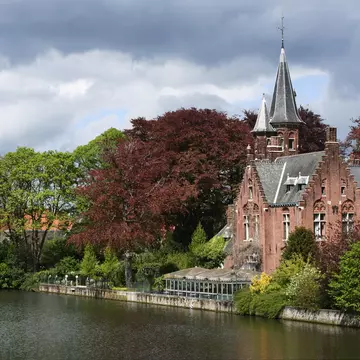
Surrounded by protective walls, these whitewashed cottages - clustered around a central garden carpeted by daffodils in springtime - have an air of tranquil purity. Established as homes for a Catholic order of single and widowed women, there were around 1500 of these begijnhoven (or beguinages) in Belgium in the early 20th century, but only 22 remain. Dating from the 13th century, this is one of the best preserved, and home today to Benedictine nuns. The tiny on-site 't Begijnhuisje museum gives you an insight into a typical cottage. Afterwards, prolong the serenity with a stroll in the swan-filled Minnewater park nearby.
reviewed
-
P
Centraal Station
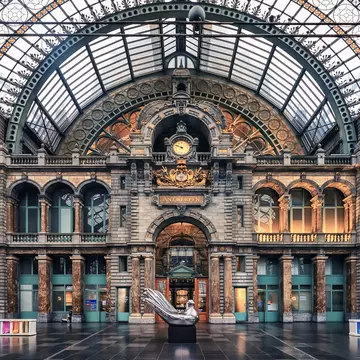
One of the city's premier landmarks is the extraordinary Centraal Station, designed by Louis Delacenserie at the start of the 20th century in a harmonious blend of styles. Steps lead from the main hall with its enormous dome up to the glass-covered train platforms above. The station and adjoining Koningin Astridplein have been undergoing massive works for years to accommodate the Eurostar and Thalys fast trains, thus directly linking the city to London and the rest of Europe. .
The station is also diamond central, with many shops selling diamonds inside the station, and the Diamond District immediately south-west of it.
reviewed
-
Q
Openluchtmuseum voor Beeldhouwkunst Middelheim
Some 4km south of the city centre is a large, landscaped park known as the Openluchtmuseum voor Beeldhouwkunst Middelheim. It contains more than 300 works by sculptors, including notable nationals (Rik Wouters) and influential internationals (Auguste Rodin and Henry Moore).
Don't deny yourself the opportunity to ask a randomly selected passerby how to get to the (take a deep breath now) Openluchtmuseum voor Beeldhouwkunst Middelheim (Middelheim Open-Air Statuary Museum), a large park 4km (2.5mi) south of the centre that is scenically littered with over 300 sculptures, including carvings by Rik Wouters and Auguste Rodin.
reviewed
Advertisement
-
R
Mini-Europe
Over 350 miniature scale models (all 1:25) depict some of Europe's best-known architectural highlights, such as the cathedral of Santiago de Compostela (which took 24,000 man-hours to create), London's Big Ben, Lisbon's Torre de Belem and Paris' Pompidou Centre; with various moving features like little railways, and even a cross-section of the Chunnel.
It's a fun way for kids (and kids-at-heart) to brush up on European geography, and the models are true works of art. On some weekend nights in summer Mini-Europe opens to midnight and has musical fireworks displays; call for dates.
reviewed
-
S
Lombardia
A legendary health-food shop and café located at the heart of the pedestrianised Quartier Latin shopping district. It's run by a hip crew, the décor's way out and the food's all bio (organic). Sells a bit of everything, has English-language newspapers, snappy service and a few tables for diners (plus a huge summer terrace under a shady tree). Bio milkshakes (either beastie or vegan), fresh juices, and there's a range of salads, vegetable pies and sandwiches.
The sign above the counter asks that customers 'Do not spit' - now that's health conscious.
reviewed
-
Citadelle De Namur
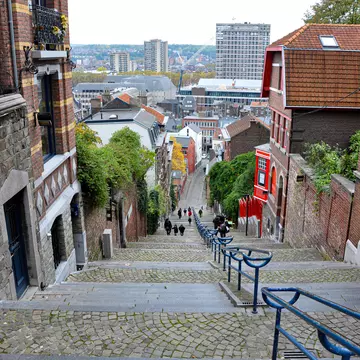
What remains of Namur's once-mighty Citadelle De Namur is slung high above the town on a rocky outcrop. Due to centuries of military expansion, it covers a huge area, though only towers, tunnels and much of the outer walls exist today. Visitors are free to wander around, and access is possible by car, bike, foot or minibus. The latter depart regularly from the tourist office and stop at Terra Nova.
To reach the citadel on foot, head up from the path on Pl St Hilaire; by car or bike follow the Rte Merveilleuse.
reviewed
-
T
Dansing Chocola
Things get loose at this old-fashioned café, with staff grooving behind the bar or vaulting Tarzan-like up to the wrought-iron mezzanine railing to take orders from upper-level tables, while busking violinists serenade diners. Dishes - Belgian and a few international options like spicy Thai soup - are simple and incredibly filling (go for the 'small' portions unless you're ravenous), and there are sensational fries (around €3 for a bowlful). The kitchen closes at 22:00.
reviewed
-
U
Am Sweet
Spiralling over two floors and several rooms, this charming salon de thé/confiserie on a village-like street resembles a Parisian apartment, with small metal tables, chairs in striped calico slip-covers, shelves of well-thumbed books, and framed watercolours resting against the walls. Not only is it a delightful spot for brunch or a fragrant tea, but the ground floor stocks an enticing array of sweets, including Laurent Gerbaud chocolates.
reviewed