Things to do in Brussels
-
A
Grand Place
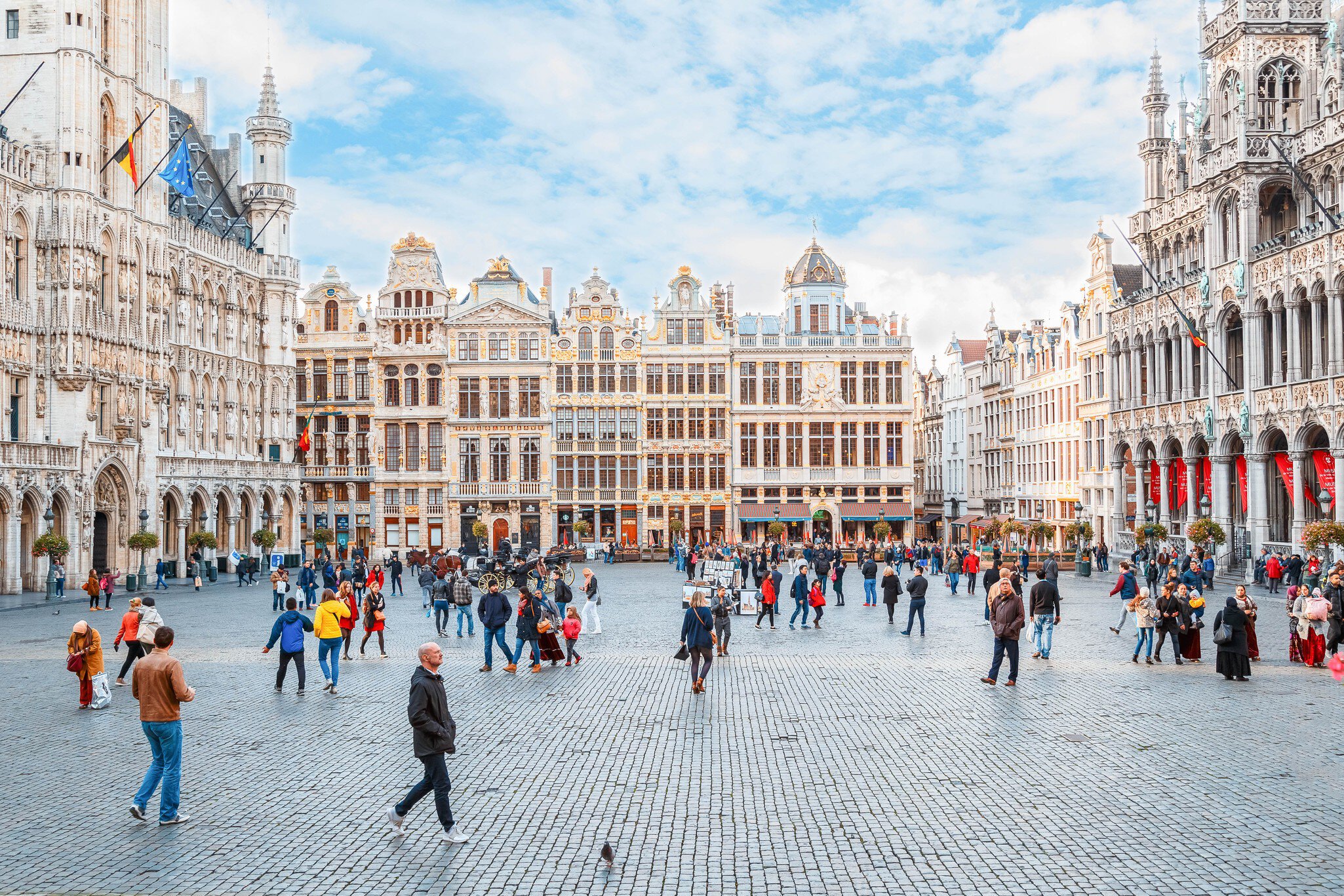
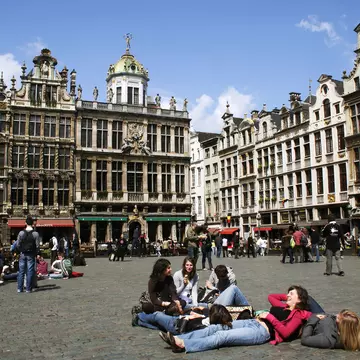
For one of Europe's finest urban views, head straight to Brussels' magnificent central square, Grand Place. It boasts the country's best baroque guildhalls, the beautiful Hôtel de Ville (Town Hall), museums, pavement cafés, chocolate shops and intimate cellar restaurants - a combination that lures visitors in droves. Hidden at the very core of the old town, it's revealed as you enter from one of six narrow side alleys (Rue des Harengs is the best) - a discreet positioning that adds charm.
The square dates from the 12th century and rose on a site that was once marshland. By the early 15th century, Brussels was booming through the cloth trade and the patronage of the duke…
reviewed
-
B
Rue des Bouchers
Leading off Galeries St Hubert in a lively little quarter known as Ilôt Sacré is the famous Rue des Bouchers. Whether you decide to eat at one of the many seafood restaurants here or not, this pedestrianised cobbled street is a spectacle not to be missed. Both sides of the street are packed with tables for dining throughout the year - overhead heaters keep frostbite at bay in winter. Waiters entice diners with iced displays of marine delicacies and the odd novelty (expect dancing plastic fish). Many of the restaurants are not recommended but there are exceptions, including Chez Léon.
reviewed
-
C
Musée d'Art Ancien
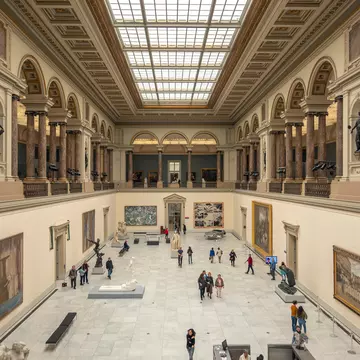
To view the collections of the Royal Museums of Fine Arts chronologically, start with the Musée d'Art Ancien. Begin with the Flemish Primitives, including works by Rogier Van der Weyden, Dirk Bouts, Hans Memling and Gerard David. Move onto Quinten Matsijs, whose paintings demonstrate a turning point in Flemish art as traditional realistic scenes were superseded by the more flamboyant Renaissance style imported from Italy.
The Breugel family, in particular Pieter Breugel the Elder, comes next. The mysterious Fall of Icarus is one of his most famous works, although De Volkstelling (The Census at Bethlehem, painted in 1566) is more typical of his distinctive peasant scenes.…
reviewed
-
D
Musée Magritte
A completely anonymous, suburban yellow-brick house: that's the façade of the Musée Magritte, and the façade that René Magritte, Belgium's most famous surrealist artist, showed the outside world. This museum in Jette occupies the house where Magritte and his wife Georgette lived from 1930 to 1954. Its appeal comes from its incredibly ordinary nature. It's odd to think the man responsible for some of the 20th century's most enduring images spent 24 years of his life in this bourgeois backstreet.
The museum opened in 1999 as the private initiative of a friend of the widow Magritte. With scandalously little support from the Belgian state, the curators assembled hundreds …
reviewed
-
E
Kokob
Meals at this airy Ethiopian bar/restaurant/cultural centre are based around small, shared dishes, like spiced eggplant or finely ground spinach and cheese, spooned onto a central injera (pancake), with more pancakes provided for you to rip apart and use to scoop up your meal. If you order a pot of Ethiopian coffee (€8), be prepared to wait 15 minutes while the beans are roasted, and to be wired all night.
reviewed
-
F
Musée Royale de l’Armée et d’Histoire Militaire
One for military buffs, this museum houses an extensive array of weaponry, uniforms, vehicles, warships and documentation dating from the Middle Ages through to Belgian independence and the mid-20th century. There’s a panoramic view of the park’s triumphal arch (built in 1880), the Arcade du Cinquantenaire, from the top floor.
reviewed
-
G
Parc du Cinquantenaire
Parc du Cinquantenaire was built during Léopold II's reign. It's best known for its cluster of museums - art, history, military and motor vehicles - that house an incredible 350,000 artefacts from all continents. We love the fine jewellery and cult of the dead funerary gifts from the Merovingian civilization. There is also the massive Arcade du Cinquantenaire, a triumphal arch built in 1880 to celebrate 50 years of Belgian independence. In summer, this area is put to good use with a popular drive-in cinema.
The Royal Art and History Museums in the southern wing of the Cinquantenaire buildings are chock-a-block with antiquities from all over the world.
Autoworld, in the n…
reviewed
-
H
Musée d'Art Moderne
The Musée d'Art Moderne houses 19th- and 20th-century art and occupies a subterranean gallery that meanders for six levels below ground. Due to the opening of the new Magritte Museum here, some of the collection has been moved to the Dexia Art Centre in Rue de l'Écuyer. Whether here or there, earlier highlights to look out for include sculptures by Constantin Meunier, Ensor's macabre fighting skeletons, and many paintings by Paul Delvaux.
Other national artists include Léon Spilliaert and Rik Wouters, both of whom belonged to the Fauve group of painters. The international scene is much less extensive but look out for Francis Bacon's delightful Le Pape aux Hiboux (Pope …
reviewed
-
I
Mini-Europe
Over 350 miniature scale models (all 1:25) depict some of Europe's best-known architectural highlights, such as the cathedral of Santiago de Compostela (which took 24,000 man-hours to create), London's Big Ben, Lisbon's Torre de Belem and Paris' Pompidou Centre; with various moving features like little railways, and even a cross-section of the Chunnel.
It's a fun way for kids (and kids-at-heart) to brush up on European geography, and the models are true works of art. On some weekend nights in summer Mini-Europe opens to midnight and has musical fireworks displays; call for dates.
reviewed
-
J
Am Sweet
Spiralling over two floors and several rooms, this charming salon de thé/confiserie on a village-like street resembles a Parisian apartment, with small metal tables, chairs in striped calico slip-covers, shelves of well-thumbed books, and framed watercolours resting against the walls. Not only is it a delightful spot for brunch or a fragrant tea, but the ground floor stocks an enticing array of sweets, including Laurent Gerbaud chocolates.
reviewed
Advertisement
-
K
Pierre Marcolini
Brussels-born Marcolini is the wunderkind of Belgian chocolate-makers, whose pralines include melt-in-your-mouth ganaches (cream-filled chocolate) made from exotic teas. Other Marcolini innovations include quirky bunny-eared Easter eggs. Make your selection from the glass counter then head to the back room to pick up your order. There’s talk of a tea room opening soon upstairs.
reviewed
-
L
Piscine Victor Boin
Belgium isn't much of a swimming nation but those interested in unusual pools might want a dip at Piscine Victor Boin in St Gilles. This covered Art Deco pool has a bain turc (Turkish bath) at the rear, which is reserved for women on Tuesday and Friday; it's reserved for men Monday, Thursday and Saturday. A single pool ticket costs around €2.
reviewed
-
M
Comocomo
At this much buzzed-about spot, pintxos (Basque tapas) such as octopus or bite-sized ham sandwiches, glide past on an 80m-long sushi-train-style conveyor belt, and are colour-coded for easy identification (purple for pork, blue for fish and so on). But most diners’ eyes remain fixed on the passing fashion parade outside the big picture-windows.
reviewed
-
N
Belga Queen
The Belga Queen is Brussels' queen of indulgence. Generous opening hours, a fabulous restaurant with an equally fab crowd, a lustrous ecailler (oyster bar) and a cigar bar leave you no excuses for not visiting. The main menu (split between meat and fish) even has a vegetarian section and low-calorie options for visiting supermodels.
reviewed
-
O
Au Stekerlapatte
The grungy façade hides a cavernous bistro where the approach is casual, the menu extensive and the portions large. Meat, fish and fowl - cooked in traditional Belgian ways - are the staples. Well hidden but definitely known.
reviewed
-
P
La Quincaillerie
The gleaming brass interior gives a clue to this brasserie's former life as an ironmonger's shop. It woos with seafood specialities.
reviewed
-
Q
Dr Vinyl
Not just a music shop, you can also check out what's happening in the nightclub scene at Dr Vinyl.
reviewed
-
R
Grand Place Guildhalls
The splendour of the Grand Place is due largely to the antique frame of Grand Place guildhalls. Each merchant guild erected its own building, which is named (no street numbers back then) and adorned with gilded statues and elaborate symbols related to its trade. When the guildhalls were obliterated in the 1695 bombardment, the guilds rallied and rebuilt their headquarters using stone (rather than partial timber as before) for the façades and adding fanciful baroque touches to the gables.
Some of the highlights:
Maison du Roi (King's House- Opposite the Hôtel de Ville, this dark, brooding building was never home to royalty, despite the name. These days it houses the Musée…
reviewed
-
S
Musées Royaux des Beaux-Arts de Belgique
This museum houses Belgium's premier collections of ancient and modern art and is particularly well endowed with works by Pieter Breugel the Elder, Rubens and the Belgian surrealists. Both sections are large and you'll need a good day here if you want to do them justice.
Highlights of the Museum of Ancient Art are paintings from the 15th and 16th centuries, including Flemish primitives, Hans Memling, Rogier Van der Weydan, Dirk Bouts, and a whole room dedicated to Hieronymus Bosch.
Rubens dominates the 17th- and 18th-century collection, including the magnificent Adoration of the Magi, although you'll also get to appreciate fantastic pieces by Brueghel the Elder and Anthon…
reviewed
-
Ghent and Bruges Day Trip from Brussels
9.5 hours (Departs Brussels, Belgium)
by Viator
Discover two of Flanders' special gems on a full day trip to Ghent and Bruges. No visit to Belgium is complete without a visit to these two beautiful cities, ju…
Not LP reviewed
from USD$54.05 Advertisement
-
T
Bruparck
The theme park, Bruparck, incorporates a water fun park, Océade, the giant Kinepolis cinema with a multiplex and an IMAX, and the highlight, Mini-Europe. In the latter, over 350 miniature scale models (all 1:25) depict some of Europe’s best-known architectural highlights, such as the cathedral of Santiago de Compostela (which took 24,000 man-hours to create), London’s Big Ben, Lisbon’s Torre de Belem and Paris’ Pompidou Centre; with various moving features like little railways, and even a cross-section of the Chunnel. It’s a fun way for kids (and kids-at-heart) to brush up on European geography, and the models are true works of art. On some weekend nights in summer Mini-…
reviewed
-
U
René
Deep in the heart of Anderlecht, overlooking a tree-lined square and the local gemeentehuis (town hall), is Brussels' most authentic family friterie-restaurant. It's the Dirk and Dorine Piolon show. Dad, Mum, offspring and in-laws, frying and refrying the frites, preparing a succulent filet américain and dishing up steaming cauldrons of mussels and other Belgian specialities to an appreciative local audience.
Turn up here at lunchtime on Saturday, as the market vendors on the facing square pack up their wares, and you'll find it's full house - only the rickety green metal tables decorating the footpath are unoccupied. For that quintessential Belgian experience, and not a…
reviewed
-
Place Flagey
When Bruxellois say something is ‘hype’, they don’t mean overhyped but hipper-than-hip. Fitting that description is Place Flagey, a revitalised square near the Étangs d’Ixelles (Ixelles Ponds). The square’s focal point is the restored, ocean-liner-like Flagey building, constructed in 1938 as the Belgian broadcasting flagship. It now houses a concert venue, a cinema, an international restaurant, and a fabulous brasserie and bar. On the square, the Frites Flagey caravan serves up what many consider to be Brussels’ best fries. For amazing pizza, try Mamma Roma. A stroll south of the ponds will bring you to the leafy Bois de la Cambre.
reviewed
-
V
Taverne du Passage
Consistently keen service and faithful Belgian meals are the pivotal points of this Brussels institution. Located in the sublime Galeries St Hubert, it has been around since 1928 and stepping through the draped doorway is like zapping away a century. An all-male middle-aged crew strut their stuff in slightly crumpled penguin uniforms, serving ample portions of Belgian classics such as moules-frites (mussels and chips) and waterzooi (cream-based chicken or fish stew).
With some daring, this could be the place to try filet américain (raw minced beef). No matter how busy it gets, the blokes are unfailingly friendly. In summer, tables line up in the gallery outside, and kid…
reviewed
-
Koninklijk Museum voor Midden-Afrika
Preserved insects, stuffed animals (including a huge elephant), masks, musical instruments, jewellery and a 22m-long pirogue (canoe) crafted by the Lengola people are among the mind-boggling displays at the extraordinary Koninklijk Museum voor Midden-Afrika, housing the world’s largest collection of such artefacts outside Africa. Most artefacts were plundered during King Léopold II’s exploitation of the Congo in the 19th century, something that is, finally, being increasingly addressed through the museum’s displays. The on-site café serves African dishes, along with African beer, which you can walk off on the paths through the adjoining Park van Tervuren.
reviewed