Things to do in Sibiu
-
A
Grand Plaza
Not far from the train station, this simple and busy Romanian restaurant passes on the gimmicks and focuses on tasty Romanian food, which the locals file in for.
reviewed
-
B
Crama Sibiul Vechi
This popular, evocative brick-cellar spot off the main crawl reels in locals for its tasty Transylvanian armoury of mutton, sausages and beef and fish. There's live music most nights.
reviewed
-
C
Gothic Evangelical Church
On Piaţa Huet, you'll find the Gothic Evangelical Church, built between 1300 and 1520, its great five-pointed tower visible from afar. Don't miss the four magnificent baroque funerary monuments on the upper nave on the north wall, and the 1772 organ with 6002 pipes (it's Romania's largest).
The tomb of Mihnea Vodă cel Rău (Prince Mihnea the Bad), son of a certain Vlad Ţepeş, is in the closed-off section behind the organ (ask for entry; it's the first of 67 tombstones). This prince, who ruled Wallachia from 1507 to 1510, was murdered on the square in front of the church after attending a service in March 1510. You can climb the church tower - ask for entry at Casa Luxembu…
reviewed
-
Museum of Traditional Folk Civilisation
Sibiu's top highlight is some 5km from the centre. The large Museum of Traditional Folk Civilisation is a sprawling open-air museum with 120 traditional dwellings, mills and churches brought from around the country. Many are signed in English, with maps showing where they came from; they're situated in a lovely forest around a lake. There's also a nice gift shop and restaurant with creek-side bench seats.
Trolleybus 1 from the train station goes there (get off at the last stop and keep walking for under 1km, or take the hourly Răşinari tram for a couple of stops), though it's an easy and pleasant bike ride there too.
reviewed
-
D
Pharmaceutical Museum
Housed in nearby Piaţa Mică pharmacy (opened in 1600), the Pharmaceutical Museum is a three-room collection packed with pills and powders, old microscopes and scary medical instruments (such as a 17th-century bone saw). Some exhibits highlight Samuel Hahnemann, a founder of homeopathy in the 1770s (Romania was one of Europe's first countries to legitimise the use of giving small doses of a disease's symptoms in order to fight the disease itself).
reviewed
-
E
Brukenthal Museum
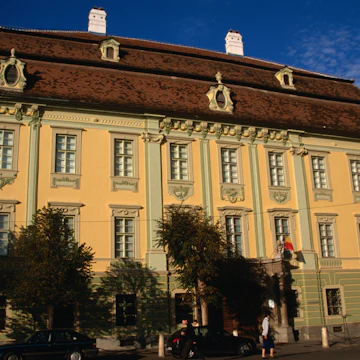
The Brukenthal Museum is the oldest (and likely) finest art gallery in Romania. Founded in 1817, the museum is in the baroque palace (1785) of Baron Samuel Brukenthal (1721-1803), former Austrian governor. There are excellent collections of 16th and 17th-century Flemish, Italian, Dutch and Austrian paintings, including a giant painting of Sibiu from 1808. The floor filled with folk-art, Romanian art and silverware was under renovation at research time.
reviewed
-
Railway Museum
The so-called Railway Museum is an open-air collection of a couple of dozen old trains right off the tracks. Don't pay any more than the posted around €1.45 ticket price. Alternatively, the friendly depot worker in the hut next door happily explains (in limited English) how trains are managed and maintained; sit with him and chat a while. Get there by walking south from the train station; it's across the tracks, 300m south.
reviewed
-
F
Natural History Museum
South of Piaţa Mare, Str Cetăţii lines a section of the old city walls, constructed during the 16th century. As in Braşov, different guilds protected each of the 39 towers. Walk north up Str Cetăţii past a couple - the Potters Tower (Turnul Olarilor) and Carpenters Tower (Turnul Dulgherilor) - to reach the Natural History Museum , an average collection of stuffed animals that dates from 1849.
reviewed
-
G
Council Tower
The centre of the old walled city, the expansive Piaţa Mare is a good start for exploring Sibiu. Climb to the top of the former Council Tower, which links Piaţa Mare with its smaller sister square, Piaţa Mică. Clock clanks inside the white tower add to the views. It was originally built in 1370, but collapsed during a 1586 earthquake (killing a mural painter).
reviewed
-
H
Franz Binder Museum of World Ethnology
Named for a 19th-century collector from Sibiu, the great Franz Binder Museum of World Ethnology has an unexpectedly rich collection of North and Central African pieces (including a 2000-year-old mummy), picked up by Franz during his 10-year stay in Egypt and Sudan. Temporary exhibits include displays of Inuit art from Nunavut, Canada.
reviewed
Advertisement
-
I
Memorandumists Plaque
The Memorandumists plaque honours the Transylvanian leaders of the Romanian National Party who addressed a memorandum to the emperor Franz Joseph in Vienna in 1892, calling for an end to discrimination against Romanians. In an apt response, 29 of their members were convicted of agitating against the state and imprisoned.
reviewed
-
J
Chill Out
Local students hightail it to this fun, loud, enigmatic spot with a well-lit room and a dark one, where themed nights and DJs rule the roost (one time it was pitch dark, with smooching couples dancing and a guy flashing a torch on the scene - now that's entertainment).
reviewed
-
K
Art Café
Saxon intellects and goofing teens discuss the world at side-by-side tables in this small café (coffee, beer, mixed drinks), which sometimes stages jazz and dance events. It has a very open vibe.
reviewed
-
L
La Piazzetta
Facing the square, this pizzeria is livelier than most, with smokers and passive smokers eating sizey pizzas at red-chequered tables in the peach-walled interior or outside when the weather's nice.
reviewed
-
City History Museum
Just west of Piaţa Mare is the lovely Primăriă Municipiului (1470), now the City History Museum, which was closed at research time but planned to re-open by mid-2007.
reviewed
-
Sibiu Jazz Festival
In 2005 Sibiu resurrected its week-long jazz festival which died, along with its first founder, in the early 1990s. it is held annually in May. Check website for details.
reviewed
-
M
Radu Stancu State Theatre
Plays are usually in Romanian, with occasional productions in German on Wednesday. It hosts the International Theatre Festival in May/June.
reviewed
-
N
Philharmonic
Founded in 1949, this has played a key role in maintaining Sibiu's prestige as a main cultural centre of Transylvania.
reviewed
-
O
Explorer Sport
This sport shop rents bikes (about around €5 a day), skis in winter, sells packs and boots, and repairs bikes.
reviewed
-
National Festival of Folk Traditions
Displays of craft traditions at Astra (aka Museum of Traditional Folk Civilisation), which holds many summer events
reviewed
Advertisement
-
P
Sandwich & More
This window spot serves fresh veggie sandwiches and Asian-style pastas. It's by far Sibiu's best fast-food option.
reviewed
-
Q
Go In
The Go In is a traditional-style bar with lots of twentysomething couples sharing tables over beer and cocktails.
reviewed
-
R
Studionul Astra
This place screens alternative art films; it also hosts the annual International Astra Film Festival in October.
reviewed
-
Mayfest
Sibiu's remaining 5500 German-speaking Saxons flock to Dumbrava forest for pagan frolicking and beer bingeing.
reviewed
-
S
Kulturkafe
Kulturkafe has the best table spots on the square, and is slightly more adult- than student-oriented inside.
reviewed