Bhaktapur Sights

Sights in Bhaktapur

‹ Prev

of 2

  1. A

    Golden Gate & 55 Window Palace

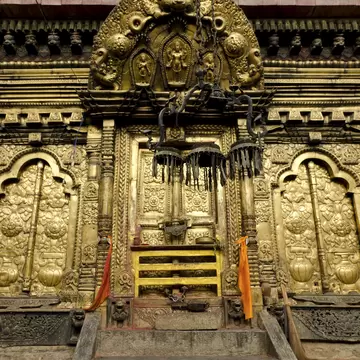
    The Golden Gate is generally agreed to be the single most important piece of art in the whole valley. The gate and palace were built by King Bhupatindra Malla, but were not completed until 1754 during the reign of Jaya Ranjit Malla, the last of the Bhaktapur Malla kings. The magnificent Golden Gate, or Sun Dhoka, and the entrance to the 55 Window Palace ( M0463) adjoin the National Art Gallery.

    A Garuda, the vehicle of Vishnu, tops the torana (the carved pediment above the temple door) and is shown here disposing of a number of serpents, which are the Garuda's sworn enemies. The four-headed and 10-armed figure of the goddess Taleju Bhawani is featured directly over the do…

    reviewed

  2. B

    Nyatapola Temple

    The five-storey, 30m-high Nyatapola Temple ( M0458) is not only the highest temple in Nepal, but also one of the best examples of traditional Newari temple architecture. The temple appears to soar above Bhaktapur's rooftops, with the snow-capped Himalaya as a dramatic backdrop.

    Built during the reign of King Bhupatindra Malla in 1702, its design and construction were so solid that the 1934 earthquake caused only minor damage. The stairway leading up to the temple is flanked by guardian figures at each plinth level. The bottom plinth has the legendary Rajput wrestlers Jayamel and Phattu, said to have the strength of 10 men. On the plinths above are two elephants, then two …

    reviewed

  3. C

    Bhairabnath Temple

    The well-restored, triple-roofed Bhairabnath Temple (also known as the Kasi Vishwanath or Akash Bhairab; M045A) has an unusual rectangular plan and a somewhat chequered history. It was originally built as a one-storey temple in the early 17th century, but was rebuilt with two storeys by King Bhupatindra Malla in 1717. The 1934 earthquake caused great damage to the temple and it was completely rebuilt and a third floor added.

    Casually stacked by the north wall of the temple are the enormous wheels and temple chariot runner on which the image of Bhairab (a fearsome form of Shiva) is conveyed around town during the Bisket festival in mid-April. Bhaktapur celebrates Bisket Ja…

    reviewed

  4. D

    Til Mahadev Narayan Temple

    It's easy to miss Taumadhi Tole's third interesting temple, as it is hidden away behind the buildings on the southern side of the square. You can enter the temple's courtyard through a narrow entrance through those buildings, or through an arched entrance facing west, just to the south of the square.

    This double-roofed Vishnu temple has a Garuda kneeling on a high pillar in front, flanked by pillars bearing Vishnu's sankha and chakra symbols. Some of the temple's struts also depict Garudas. A lingam in a yoni (female equivalent of the phallic symbol) stands inside a grilled structure in front and to one side of the temple. A plaque to the lower right of the door depicts t…

    reviewed

  5. E

    Potters' Sq

    On the northern side of the square a small hillock is topped by a Ganesh shrine and a shady pipal tree. There are fine views over the river to the hills south of Bhaktapur. The square itself has two small temples: a solid-brick central Vishnu Temple and the double-roofed Jeth Ganesh Temple. The latter is an indicator of how long the activity all around the square has been going on - a wealthy potter donated the temple in 1646 and to this day its priest is chosen from the potter caste.

    Pottery is very clearly what this square is all about; the southern side of the square is lined with clay stores and potters' wheels, and the square (and other parts of town) is often filled…

    reviewed

  6. F

    Dattatreya Temple

    The tall, square Dattatreya Temple was originally built in 1427, but alterations were made in 1458. Like some other important structures in the valley it is said to have been built using the timber from a single tree.

    The temple is dedicated to Dattatreya, a blending of Brahma, Vishnu and Shiva, although the Garuda-topped pillar and the traditional weapons of Vishnu (conch and a disc) on their pillars indicate the strong influence of Vishnu. The temple is important to Shaivites, Vaishnavites and Buddhists.

    The three-storey temple is raised well above the ground on its base, the sides of which are carved with some erotic scenes. The front section, which was a later additio…

    reviewed

  7. G

    Pujari Math

    There are 10 buildings around the square that were originally used as maths (Hindu monasteries).The best known was the Pujari Math. It was originally constructed in the 15th century during the reign of King Yaksha Malla, but was rebuilt in 1763. German experts renovated the building in 1979 as a wedding gift for the then King Birendra. Until the 20th century, an annual caravan brought tributes to the monastery from Tibet.

    The Pujari Math is principally famed for the superb 15th-century peacock window, 30m down a small alley on the right-hand side. It is reputed to be the finest carved window in the valley and is the subject of countless postcards and photographs. The shop…

    reviewed

  8. H

    Vatsala Durga Temple & Taleju Bell

    The stone Vatsala Durga Temple ( M0460), which was built by King Jagat Prakash Malla in 1672 (some sources say 1727), sits beside King Bhupatindra Malla's statue and directly in front of the Royal Palace. The shikhara-style temple has some similarities to the Krishna Mandir in Patan. In front of the temple is the large Taleju Bell, which was erected by King Jaya Ranjit Malla in 1737 to mark morning and evening prayers at the Taleju Temple.

    A second, smaller bell stands on the temple's plinth and is popularly known as 'the barking bell'. It was erected by King Bhupatindra Malla in 1721, supposedly to counteract a vision he had in a dream, and to this day dogs are said to b…

    reviewed

  9. I

    Tadhunchen Bahal

    The Tadhunchen Bahal , or Chatur Varna Mahavihara, dates from 1491 and is noteworthy as the place where the cult of the Kumari, Nepal's living goddesses, originally started. Bhaktapur actually has three Kumaris but they lack the political importance of Kathmandu's.

    In the inner courtyard the roof struts on the eastern side have some highly unusual carvings showing the tortures of the damned. In one a snake is wrapped around a man, another shows two rams butting an unfortunate's head from opposite sides, while a third strut shows a nasty tooth extraction being performed with a large pair of pliers! You may see copper chasing going on in the courtyard.

    reviewed

  10. J

    Siddhi Lakshmi Temple

    By the southeastern corner of Bhaktapur's Royal Palace stands the stone Siddhi Lakshmi Temple also known as the Lohan Dega, or Stone Temple. The steps up to the temple are flanked by male and female attendants, each leading a rather reluctant child and a rather eager-looking dog. On successive levels the stairs are flanked by horses, rhinos, man-lions and camels.

    The 17th-century temple marks the dividing line between the main and secondary parts of Durbar Sq. Behind the temple is another Vatsala Temple, while to one side of it are two rather lost-looking curly-haired stone lions, standing by themselves out in the middle of the square.

    reviewed

  11. Advertisement

  12. K

    Pashupatinath Temple

    This temple ( M0465) is dedicated to Shiva as Pashupati and is a replica of the main shrine at Pashupatinath. Originally built by King Yaksha Malla in 1475 (or 1482), it is the oldest temple in the square and is sometimes called the Yaksheswor Mahadev Temple.

    For adults only, the roof struts depict some of the rudest erotic art in the valley. Unexpected humour is provided by one bored-looking woman who multitasks by washing her hair while pleasuring her husband at the same time. Don't even ask what the dwarf with the bowl is doing…

    reviewed

  13. Char Dham

    Four less significant temples crowd the western end of Durbar Sq. Together they are called the Char Dham, after the four Hindu pilgrimage sites of the same name, to provide a place of worship for those unable to make the pilgrimage to the real sites.They include the lopsided Rameshwar Temple dedicated to Shiva and the Bhadri Temple dedicated to Vishnu as Narayan.

    In front of them is an impressive, larger Krishna Temple and just beyond that is a brick shikhara-style Shiva Temple erected by King Jitamitra Malla in 1674.

    reviewed

  14. L

    Fasidega Temple

    The large, white, rather ugly Fasidega Temple is dedicated to Shiva and stands in the centre of the secondary part of Durbar Sq. There are various viewpoints around the valley - the Changu Narayan Temple is one of them - from where you can study Bhaktapur at a distance. In each case the white bulk of the Fasidega is always an easy landmark to pick out. The temple sits on a six-level plinth with elephant guardians at the bottom of the steps, and with lions and cows above them.

    reviewed

  15. M

    Woodcarving Museum

    The Pujari Math houses the small Woodcarving Museum, with some fine examples of Bhaktapur woodcarving displayed in dark, creaky rooms. There isn’t enough light to justify paying the camera fee, but it’s worth a visit, not least for the extravagantly carved windows in the inner courtyard. Head upstairs to see the mechanism that operates the window shutters. The same ticket covers entry to the nearby Brass & Bronze Museum and the National Art Gallery.

    reviewed

  16. N

    Durbar Square

    Bhaktapur's Durbar Sq is larger than Kathmandu's, much less crowded with temples than Patan's and less vibrant than either. It wasn't planned that way: Victorian-era illustrations show the square packed with temples and buildings, but the disastrous earthquake of 1934 destroyed many of them, and today empty plinths mark where temples once stood.

    Durbar Sq is the one place where you'll be approached by a string of tiresome guides and thangka painting school touts.

    reviewed

  17. O

    Jaya Varahi Temple

    This the red-brick temple has elaborately carved wooden toranas over the central door and the window above it. At the eastern end of the temple is the entrance to the upper floor, flanked by stone lions and banners. The two ornate windows, on either side of the upper torana, have recently been repainted their original gold. Nearby is a small Ganesh shrine, jutting out into the street and covered in bathroom tiles.

    reviewed

  18. P

    Erotic Elephants Temple

    Just before you enter the square, pause for a little bit of Newari humour. On your right, perhaps 70m before the main Durbar Sq entrance gate, is a tiny double-roofed Shiva Parvati temple ( M045E) with some erotic carvings on its temple struts. Among the series of copulating animals are elephants in the missionary position with their trunks entwined in pleasure! It's a hathi (elephant) Kamasutra.

    reviewed

  19. Q

    National Art Gallery

    The western end of the palace contains Nepal’s National Art Gallery, the best of the three museums in Bhaktapur. The entrance to the gallery is flanked by two huge guardian lions, one male and one female (with almost human breasts). Beside the lions are some imposing 17th-century statues of Hanuman the monkey god, in his four-armed Tantric form, and Vishnu, as the gut-ripping Narsingha.

    reviewed

  20. R

    King Bhupatindra Malla's Column

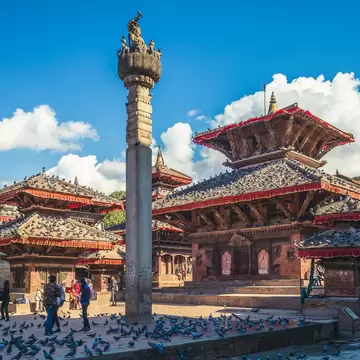
    King Bhupatindra Malla was the best known of the Malla kings of Bhaktapur and had a great influence on the art and architecture of the town. Like the similar column in Patan's Durbar Sq, this one (built in 1699) was based on the original in Kathmandu but remains the most beautiful of the three. The king sits with folded arms, studying the magnificent golden gate to his palace.

    reviewed

  21. S

    Taumadhi Tole

    A short walk from Potters' Sq or Durbar Sq reveals the second great square of Bhaktapur, the Taumadhi Tole ( M0456). Here you'll find Nyatapola Temple, the highest temple in the valley and also the Café Nyatapola, where the balconies provide a great view over the square. The latter was renovated for its new purpose in 1977 and it has some finely carved roof struts.

    reviewed

  22. Advertisement

  23. T

    Bhaktapur's Royal Palace

    Bhaktapur's Royal Palace was founded by Yaksha Malla (1428-82) and was added to by successive kings, particularly Bhupatindra Malla. As with the old palaces of Kathmandu and Patan, visitors are restricted to certain areas. The palace suffered great damage in the terrible 1934 earthquake and only half a dozen of the original 99 courtyards survived.

    reviewed

  24. U

    Bhimsen Temple

    The two-storey Bhimsen Temple, variously dated to 1605, 1645, 1655 or 1657, is squat, rectangular and open on the ground floor. It's fronted by a platform with a small double-roofed Vishnu/Narayan Temple and a pillar topped by a brass lion with his right paw raised. Steps lead down behind it to the deeply sunken Bhimsen Pokhari.

    reviewed

  25. V

    Jeth Ganesh Temple

    This is one of two small temples in Potters' Sq - the other being the solid-brick central Vishnu Temple - and is an indicator of how long the activity around the square has been going on. A wealthy potter donated the temple in 1646 and to this day its priest is chosen from the potter caste.

    reviewed

  26. W

    Lun Bahal

    The Lun Bahal was originally a 16th-century Buddhist monastery that was converted into a Hindu shrine with the addition of a stone statue of Bhimsen. If you look into the sanctum, in the inner courtyard, you can see the statue, dating from 1592, complete with a ferocious-looking brass mask.

    reviewed

  27. X

    Salan Ganesh Temple

    On the north side of Tachupal Tole is another open area, with the small Salan Ganesh Temple, dating from 1654. The open temple is ornately decorated, but the image is just a rock with only the vaguest elephant-head shape. To one side of the temple is the Ganesh Pokhari, a large tank.

    reviewed