go to content go to search box go to global site navigation

Dublin

Things to do in Dublin

‹ Prev

of 30

  1. A

    Guinness Storehouse

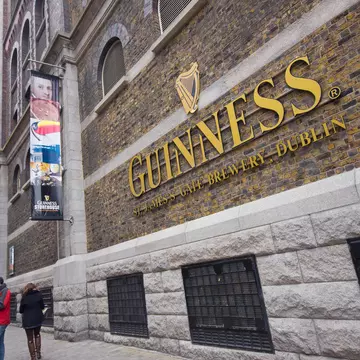
    ; St James's) The most popular visit in town is the beer-lover's Disneyland, a multimedia bells-and-whistles homage to the country's most famous export and the city's most enduring symbol. The old grain storehouse, the only part of the massive, 26-hectare St James's Gate Brewery open to the public, is a suitable cathedral in which to worship the black gold; shaped like a giant pint of Guinness, it rises seven impressive storeys high around a stunning central atrium. At the top is the head, represented by the Gravity Bar, with a panoramic view of Dublin.

    From the time Arthur Guinness (1725–1803) founded the brewery in 1759, the operation has expanded down to the Liffey and…

    reviewed

  2. B

    Old Library

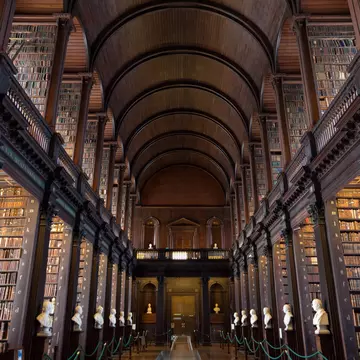
    To the south of the square is the Old Library, built in a rather severe style by Thomas Burgh between 1712 and 1732. Despite Ireland’s independence, the Library Act of 1801 still entitles Trinity College Library, along with four libraries in Britain, to a free copy of every book published in the UK. Housing this bounty requires nearly another 1km of shelving every year and the collection amounts to around 4.5 million books. Of course, these cannot all be kept at the college library, so there are now additional library storage facilities dotted around Dublin.

    reviewed

  3. C

    Sixty6

    This swanky New York–style brasserie is one of the most popular party-dinner spots in town – the kind of place at which you’d want to celebrate your birthday with friends. It does a mean rotisserie chicken, four different ways at any given time. Besides its signature dish, the meat-heavy menu features things like lamb shank and a particularly good bit of liver. For that special occasion, there’s a whole roast pig, but you need to order seven days in advance and be in a group of eight.

    reviewed

  4. D

    St Stephen's Green

    As you watch the assorted groups of friends, lovers and individuals escaping the confines of the office, splaying themselves across the nine elegantly landscaped hectares of St Stephen’s Green and looking to catch a few rays of precious sun, consider that those same hectares once formed a common for public whippings, burnings and hanging. These days, the harshest treatment you’ll get at Dublin’s favourite lunchtime escape is the warden chucking you off the green for playing football or Frisbee.

    The buildings around the square date mainly from the mid-18th century, when the green was landscaped and became the centrepiece of Georgian Dublin. The northern side was…

    reviewed

  5. Newgrange

    From the surface, Newgrange is a somewhat disappointing flattened, grass-covered mound, about 80m in diameter and 13m high. Underneath, however, lies the finest Stone Age passage tomb in Ireland and one of the most remarkable prehistoric sites in Europe. It dates from around 3200 BC, predating the great pyramids of Egypt by some six centuries. The purpose for which it was constructed remains uncertain. It may have been a burial place for kings or a centre for ritual – although the alignment with the sun at the time of the winter solstice also suggests it was designed to act as a calendar. The name Newgrange derives from ‘new granary’ (the tomb did in fact serve as a…

    reviewed

  6. E

    Café en Seine

    The wildly extravagant art-nouveau style of this huge bar has been a massive hit since it first opened in 1995, and while it may not be the 'in' place it once was, it is still very popular with suburbanites, the after-work crowd and out-of-towners. Maybe it's the glass panelling, or the real 12m-high trees; but most likely it's the beautiful people propping up the wood-and-marble bar.

    reviewed

  7. F

    Dublin Castle

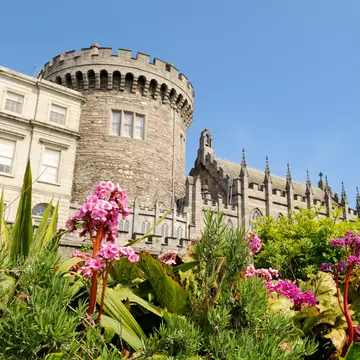
    The centre of British power in Ireland for most of 800 years, Dublin Castle sits atop Cork Hill, behind City Hall. It was originally built on the orders of King John in 1204, but it’s more higgledy-piggledy palace than castle. Only the Record Tower, completed in 1258, survives from the original Norman construction. Parts of the castle’s foundations remain and a visit to the excavations is the most interesting part of the castle tour. The moats, now completely covered by more modern developments, were once filled by the River Poddle. The castle is also home to one of Dublin’s best museums, the Chester Beatty Library.

    reviewed

  8. G

    Christ Church Cathedral

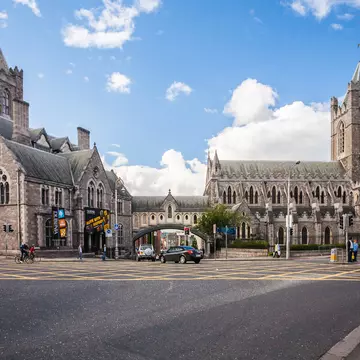
    Its hilltop location and eye-catching flying buttresses make this the most photogenic by far of Dublin's three cathedrals as well as one of the capital's most recognisable symbols.

    It was founded in 1030 on what was then the southern edge of Dublin's Viking settlement. It was later smack in the middle of medieval Dublin: Dublin Castle, the Tholsel (Town Hall; demolished in 1809) and the original Four Courts (demolished in 1796) were all close by. Nearby, on Back Lane, is the only remaining guildhall in Dublin. The 1706 Tailors Hall was due for demolition in the 1960s, but survived to become the office of An Taisce (National Trust for Ireland).

    The original wooden church in…

    reviewed

  9. H

    Gravediggers (aka Kavanagh’s)

    The gravediggers from the adjacent Glasnevin Cemetery had a secret serving hatch so that they could drink on the job – hence the pub’s nickname. Founded in 1833 by one John Kavanagh and still in the family, this pub is one of the best in Ireland, virtually unchanged in 150 years. In summer time the green of the square is full of drinkers basking in the sun, while inside the hardened locals ensure that ne’er a hint of sunshine disturbs some of the best Guinness in town. An absolute classic.

    reviewed

  10. I

    Yamamori Sushi

    Sushi arrives on the north side and immediately proves successful, but that’s hardly surprising considering that its south side sister has been doing the Japanese thang with great aplomb for a very long time. The menus in both are largely the same, but we prefer this newer location – right on the river – because it’s just that little bit more airy and spacious. The bento boxes are a popular choice – especially at lunchtime – but we really just can’t get enough of the nami moriawase.

    reviewed

  11. Advertisement

  12. J

    St Patrick's Cathedral

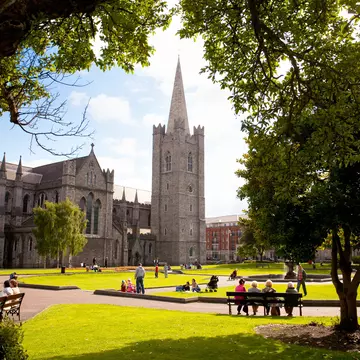
    It was at this cathedral, reputedly, that St Paddy himself dunked the Irish heathens into the waters of a well, so the church that bears his name stands on one of the earliest Christian sites in the city and a pretty sacred piece of turf. Although there's been a church here since the 5th century, the present building dates from 1190 or 1225 (opinions differ) and it has been altered several times, most notably in 1864 when the flying buttresses were added, thanks to the neo-Gothic craze that swept the nation. St Patrick's Park, the expanse of green beside the cathedral, was a crowded slum until it was cleared and its residents evicted in the early 20th century.

    Like Christ…

    reviewed

  13. K

    Diep le Shaker

    Diep le Shaker is a modern, light-filled space tucked down an alley off prestigious Pembroke St. It is popular with the local business crowd, establishment movers and shakers, and people generally consumed by their own self-importance. The predominantly Thai grub is inventive and excellent, but you get the impression you’re paying for the company and it ain’t worth it.

    reviewed

  14. L

    Kilmainham Gaol

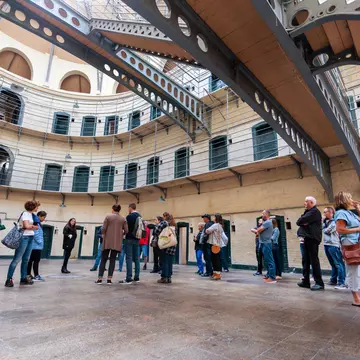
    If you have any desire to understand Irish history – especially the juicy bits about resistance to English rule – then a visit to this former prison is an absolute must. This threatening grey building, built between 1792 and 1795, has played a role in virtually every act of Ireland's painful path to independence.

    The uprisings of 1798, 1803, 1848, 1867 and 1916 ended with the leaders' confinement here. Robert Emmet, Thomas Francis Meagher, Charles Stewart Parnell and the 1916 Easter Rising leaders were all visitors, but it was the executions in 1916 that most deeply etched the jail's name into the Irish consciousness. Of the 15 executions that took place between 3 May…

    reviewed

  15. M

    Winding Stair

    This Dublin institution has simple décor and warm atmosphere along with an excellent wine list and wonderful Irish menu – creamy fish pie, bacon and organic cabbage, steamed mussels or Irish farmyard cheeses – all prepared with much TLC.

    reviewed

  16. N

    National Museum of Ireland – Decorative Arts & History

    No wonder the British army were so reluctant to pull out of Ireland, when they were occupying this magnificent space, the oldest army barracks in Europe. The building – the museum bit can wait – was completed in 1704 according to the design of Thomas Burgh, whose CV also includes the Old Library in Trinity College and St Michan’s Church. Its central square held six entire regiments and is a truly awesome space, surrounded by arcaded colonnades and blocks linked by walking bridges. Following the handover to the new Irish government in 1922, the barracks was renamed to honour Michael Collins, a hero of the struggle for independence, who was killed that year in the…

    reviewed

  17. O

    Tea Rooms

    Mathieu Melin is performing small miracles in this elegant restaurant, its soaring ceiling and double-height windows designed to resemble a church. There are few places in all of Dublin where you'll get such superb fare – an ambitious marriage of classic French cuisine and typically Irish produce – at such reasonable prices.

    reviewed

  18. P

    Trinity College

    On a summer’s evening, when the bustling crowds have gone for the day, there’s hardly a more delightful place in Dublin than the grounds of Ireland’s most prestigious university, a masterpiece of architecture and landscaping beautifully preserved in Georgian aspic. Not only is it Dublin’s most attractive bit of historical real estate, but it’s also home to one of the world’s most famous – and most beautiful – books, the gloriously illuminated Book of Kells. There is no charge to wander around the gardens on your own between 8am and 10pm.

    reviewed

  19. Fry Model Railway

    Ireland’s biggest model railway is 240 sq metres, and authentically displays much of Ireland’s rail and public transport system, including the DART line and Irish Sea ferry services, in O-gauge (32mm track width). A separate room features model trains and other memorabilia. Unfortunately the operators suffer from the overseriousness of some grown men with complicated toys; rather than let you simply look and admire, they herd you into the control room in groups for demonstrations.

    reviewed

  20. Q

    Trinity College

    The country’s most famous university is an oasis of Victorian tranquillity in the middle of the city. Founded by Elizabeth I in 1592, most of the stunning buildings and landscaped squares date from the 18th and 19th centuries, but the campus’ single biggest attraction is much, much older – queue up to gape at the Book of Kells, one of the world’s most extraordinary illuminated manuscripts. Thirty-minute walking tours are available, see website for details.

    reviewed

  21. R

    Jo’burger

    A playful, kids-in-the-70s theme (the menus are pasted into children’s almanacs), DJs playing great music loud enough to hear but not too loud to be annoying, and a sensational burger menu make this the coolest, hippest, best burger joint in the city. The organic burgers – beef, lamb, fish, veggie – come in a variety of options, all with funky names. The mapetla has beetroot salad, rocket and relish; the zondi comes with green thai curry mayo, coriander and chilli.

    reviewed

  22. Advertisement

  23. S

    Chester Beatty Library

    The world-famous library, in the grounds of Dublin Castle, houses the collection of mining engineer Sir Alfred Chester Beatty (1875–1968), bequeathed to the Irish State on his death. And we're immensely grateful for Chester's patronage: spread over two floors, the breathtaking collection includes more than 20,000 manuscripts, rare books, miniature paintings, clay tablets, costumes and other objects of artistic, historical and aesthetic importance. The library runs tours at 1pm on Wednesdays and at 3pm and 4pm on Sundays.

    The Artistic Traditions Gallery on the 1st floor begins with memorabilia from Beatty's life, before embarking on an exploration of the art of Mughal…

    reviewed

  24. T

    Dublinia & the Viking World

    A must for the kids, the old Synod Hall attached to Christ Church Cathedral is home to this seemingly perennial exhibit on medieval Dublin, complete with models, music, streetscapes and interactive displays. The newly added Viking World tells the story of Dublin’s 9th- and 10th-century Scandinavian invaders and the city they built in their wake. Finally, you can climb neighbouring St Michael’s Tower for views over the city to the Dublin Hills.

    reviewed

  25. U

    Hugh Lane Gallery

    Whatever reputation Dublin has a repository of world-class art has a lot to do with the simply stunning collection at the Hugh Lane Gallery, which is not only home to works by some of the brightest stars in the modern and contemporary art world both foreign and domestic, but is also where you’ll find one of the most singular exhibitions to be seen anywhere: the actual studio of one of the 20th century’s truly iconic artists, Francis Bacon.

    reviewed

  26. V

    Melt

    A full range of massage techniques – from Swedish to shiatsu and many more in between – are doled out by expert practitioners at Melt, aka the Temple Bar Healing Centre. Also available are a host of other left-of-centre healing techniques, including acupuncture, Reiki and polarity therapy. It's all very alternative, but the touchy-feely vibe never obscures the fact that these folks really know what they're doing. They have also set up shop in the Westin

    reviewed

  27. W

    Number 29

    Built in 1794 for the widow of a wine merchant, Number 29 reconstructs genteel Dublin home life from 1790 to 1820. Discover how Georgians bathed twice yearly and how ladies used a latter-day mini gym, the leather exercise horse. See the discreet dining-room mirrors that allowed servants to respond to orders without listening in to round-table gossip. The 30-minute tour is a fascinating taste of the city’s social history.

    reviewed