BogotáThings to do

Things to do in Bogotá

‹ Prev

of 8

  1. A

    Crepes & Waffles

    This chain of restaurants serves, obviously, crepes and waffles, plus salads and a range of desserts. It's a professional operation with a good philosophy - they only hire single mothers and women in need.

    reviewed

  2. B

    La Puerta Falsa

    This is Bogotá’s most famous snack shop – with displayed multicolored candies beckoning you into the tiny spot that’s been in business since 1816. Grab a sticky breva candy, eggs or tamales for breakfast, or sit with chocolate completo (hot chocolate with cheese, buttered bread and a biscuit; COP$4000).

    reviewed

  3. C

    Salto de Ángel

    Parque 93’s best location – a raised restaurant with cavernous rooms topped with bamboo poles and huge windows overlooking the park – the ‘Angel Falls’ is often full. It’s probably just as good for its setting and drinks (or an excellent slushy cantaloupe juice, COP$4000) as it is for its typical fare: steaks, salads, sandwiches, fajitas.

    reviewed

  4. D

    Donostia

    This hip restaurant run by five boyhood friends puts a Mediterranean twist on Colombian food - adding spices to lighten up its meals. Meat lovers will enjoy the chuleta de cerdo BBQ (pork ribs grilled with a special recipe native to Mompós). You can hear live music here on Wednesday.

    reviewed

  5. E

    Restaurante Fulanitos

    Fulanitos is a beautifully arranged, informal place which offers food typical of the Valle del Cauca in southern Colombia. It has excellent views.

    reviewed

  6. F

    Museo Histórico Policia

    The surprisingly worthwhile Museo Histórico Policia not only gets you inside the lovely ex-HQ (built in 1923) of Bogotá’s police force, but gives you 45 minutes or so of contact time with 18-year-old, English-speaking local guides who are serving a one-year compulsory service with the police (interesting tales to be heard). The best parts otherwise follow cocaine-kingpin Pablo Escobar’s demise in 1993 – with a model dummy of his bullet-ridden corpse – or the surreal juxtaposition of a Neanderthal-fight mural before cases and cases of more modern means of killing each other (pistols and rifles).

    reviewed

  7. G

    Plaza de Bolívar

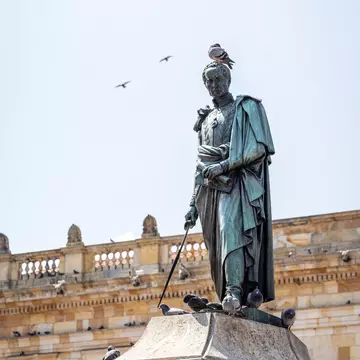
    The usual place to start discovering Bogotá is Plaza de Bolívar, the heart of the original town. In the middle of the square is a bronze statue of Simón Bolívar (cast in 1846), the work of an Italian artist, Pietro Tenerani. This was the first public monument erected in the city.

    In the center, beside the 1846 bronze statue of Bolívar (of course), are flocks of pigeons that dive-bomb anyone within 50m of the square - a hat is a good idea.

    reviewed

  8. H

    Museo Nacional

    Museo Nacional, Centro Internacional's principal attraction, is housed in the expansive, Greek cross–shaped building called El Panóptico, designed as a prison by English architect Thomas Reed in 1874. Walking through the (more or less) chronological display of Colombia’s past, you pass iron-bar doors into white-walled halls.

    reviewed

  9. Centro Cultural Gabriel García Márquez

    Opened in 2008 and a modern addition to La Candelaria, this expansive new complex pays homage to Colombia’s most famous author in name, but its events span the cultural spectrum way past literature. There’s also a giant bookstore (with a few English titles), a hamburger restaurant and cafe.

    reviewed

  10. I

    Pastelería Florida

    Those needing a bit of pomp or history with their chocolate santafereño should make the hike to this classic snack shop/restaurant (a legendary spot for hot chocolate since 1936), with uniformed waiters serving up a variety of cakes.

    reviewed

  11. Advertisement

  12. Tapas Macarena

    Run by a Dutch/Colombian couple, this cool corner spot is tiny with a play on the usual tapas, including sautéed beef with Indonesian peanut sauce, and Dutch cheese plates. Plenty of Belgian beers too.

    reviewed

  13. J

    Comida Mexican al Pastor

    One of the few low-priced restaurants in Zona Rosa, this Mexican place with a bright yellow facade serves up nachos, quesadillas and tacos to hungry partygoers.

    reviewed

  14. K

    L’ Jaim

    This little bit of Israel transported to Bogotá serves great shawarma (chopped meat and veggies served with pita and hummus) plus felafel and baklava.

    reviewed

  15. L

    Quinua y Amaranto

    This sweet spot – run by ladies in the open-front kitchen – goes all vegetarian, with tasty quinoa-based lunches and empanadas, salads and coffee later on.

    reviewed

  16. M

    Restaurante Wok

    One of the better Asian restaurants in the north.

    reviewed

  17. N

    Catedral Primada

    The Plaza de Bolívar's dominating building, facing from the northeast corner, is the neoclassical Catedral Primada, which stands on the site where the first mass may have been celebrated after Bogotá had been founded in 1538 (some historians argue it happened at Plazoleta del Chorro de Quevedo, just east). Either way, it’s Bogotá’s largest. The original simple thatched chapel was replaced by a more substantial building in 1556–65, which later collapsed due to poor foundations. In 1572 the third church went up, but the earthquake of 1785 reduced it to ruins. Only in 1807 was the massive building – that stands to this day – initiated and it was successfully completed by 18…

    reviewed

  18. O

    Museo Botero

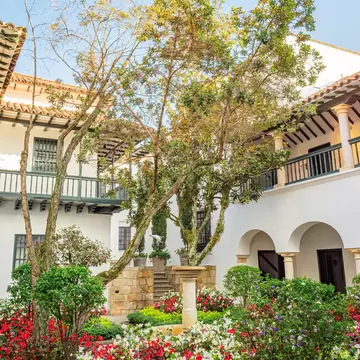
    Past a fountain-filled courtyard and small store of Botero-themed wares is the location’s highlight, the Museo Botero. Set over two floors at the front of the building here are several halls dedicated to all things chubby: hands, oranges, women, mustached men, children, birds, violins, Fuerzas Armadas Revolucionarias de Colombia (FARC) leaders – all, of course, the robust paintings and sculptures of Colombia’s most famous artist, Fernando Botero. (Botero himself donated these works.) The collection also includes several works by Picasso, Chagall, Renoir, Monet, Pissarro and Miró, and hilarious sculptures by Dalí and Max Ernst.

    reviewed

  19. Experience Colombia

    Experience Colombia

    9 days (ex Bogota)

    by Intrepid

    Take a guided walk through Bogota's colonial heart, Enjoy the mild weather in magical Medellin, Wander beneath floral balconies in Cartagena, Bliss out beachsid…

    Not LP reviewed

    from USD$1,530
  20. P

    Museo de Arte Colonial

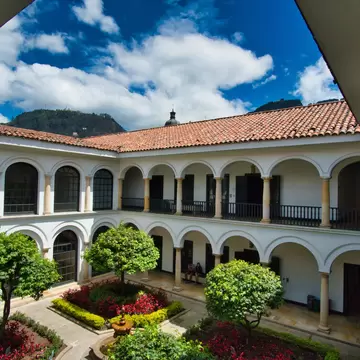
    Around the corner at Carrera 6, the Museo de Arte Colonial occupies a one-time Jesuit college and does a nice job of tracing the evolution of how religious and portrait art pieces are made, particularly by Colombia’s favorite Baroque artist Gregorio Vásquez de Arce y Ceballos (1638–1711). Its upstairs exhibits begin with a messy gallery space (eg trial sketches on walls) and lead into a hall with sketch pieces and a couple of dozen (finished) Vásquez works from the museum’s collection of nearly 200 by the artist. Downstairs exhibits focus on religious artifacts.

    reviewed

  21. Q

    Museo del Siglo XIX

    Nearby the observatory, the fun Museo del Siglo XIX offers a look inside something other than Spanish colonial Bogotá. The museum fills a former Repúblicano-style home built intentionally in English and French styles in two swoops (in 1850 and 1880). A visit takes in a sample of 19th-century capital life, with a refashioned pharmacy, corsets galore, and an alldecked-out parlor with a secret chamber and porcelain spit jars. Don’t miss the 3000-piece toy doll collection, the culmination of six decades of collection by a couple of local señoras.

    reviewed

  22. Advertisement

  23. R

    Iglesia Museo de Santa Clara

    Facing the palace from the west (on Carrera 8) is one of Bogotá’s most richly decorated churches, the Iglesia Museo de Santa Clara, now run by the government as a museum. Considering all the other same-era churches that can be seen for free, many visitors pass on this one, but it is a stunner. Built between 1629 and 1674, the single-nave construction features a barrel vault coated in golden floral motifs looking down over walls entirely covered in paintings (98 not including the closed-off loft, by our count) and statues of saints.

    reviewed

  24. Andrés Carne de Res

    Hang onto your hats. This legendary steakhouse blows everyone away – even repeat visitors – for its all-out-fun atmosphere with decent steaks and all sorts of surreal decor and designed gimmicks such as menus retracting from the rafters. For most, it’s more than a meal – but a leave-the-watch-at-home expanse of late-night rumba. Staff will get you on the floor if you resist joining in. The catch is that it’s out of town – in Chía, 23km north towards Zipaquirá. A taxi from Bogotá costs about COP$25,000 to COP$40,000.

    reviewed

  25. S

    Palacio de Justicia

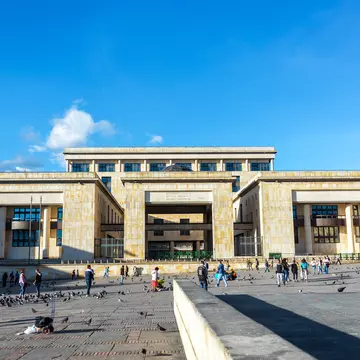
    the Palacio de Justicia is a massive, rather styleless edifice serving as the seat of the Supreme Court. The Palace of Justice has had quite a tragic history. The first court building, erected in 1921 on the corner of Calle 11 and Carrera 6, was burnt down by a mob during El Bogotazo in April 1948. A modern building was then constructed on Plaza de Bolívar, but in 1985 it was taken by M-19 guerrillas and gutted by fire in a fierce 28-hour offensive by the army in an attempt to reclaim it.

    reviewed

  26. T

    San Andresito

    One of Bogotá’s biggest shopping areas is San Andresito, which spreads over several city blocks. It’s packed with a couple of thousand stalls that have almost everything that can be bought in Colombia. It is one of the cheapest places to buy video, hi-fi and TV equipment, computers, film and photographic gear, watches, cassettes and CDs, and clothing and footwear. Urban buses and busetas go there from the center – you can catch them on Calle 19.

    reviewed

  27. U

    Church of San Francisco

    Built between 1557 and 1621, the Church of San Francisco, just west of the Gold Museum, is Bogotá’s oldest surviving church. Of particular interest is the extraordinary 17th-century gilded main altarpiece, which is Bogotá’s largest and most elaborate piece of art of its kind. It’s hard to get a close look, as masses run nearly hourly all day. It’s less intrusive to look up at the green-and-gold Mudejar ornamentation of the ceiling under the organ loft.

    reviewed