Top Choice

Via Appia Antica

The ancient Appian Way (Via Appia Antica) lined with stone and pine trees near Rome, Italy

UNESCO-listed since 2024, Via Appia Antica is an extraordinary Roman road heading south out of the city through emerald-green, tree-shaded countryside.

The Via Appia Antica was built to enable the swift movement of Roman troops and is lined by grandiose tombs, with the underground riddled by catacombs. A protected area, it's a glorious, evocative place for a walk or a cycle.

Chiesa del Domine Quo Vadis

The modest Chiesa del Domine Quo Vadis marks the spot where St Peter, fleeing Rome, met a vision of Jesus going the other way. When Peter asked, ‘Domine, quo vadis?’ (Lord, where are you going?), Jesus replied, ‘Venio Roman iterum crucifigi’ (I am coming to Rome to be crucified again). Reluctantly deciding to join him, Peter tramped back into town where he was arrested and executed. In the aisle are copies of Christ’s footprints; the originals are in the Basilica di San Sebastiano.

Cycling along a cobbled section of the Via Appia Antica in Rome.
Cycling along the Via Appia Antica in Rome. Martin Moos for Lonely Planet Martin Moos for Lonely Planet

Catacombe di San Callisto

Descending into the Catacombe di San Callisto(catacombe.roma.it), Rome's largest and most visited catacombs, is to explore a mysterious underworld. In ancient times, the dead were buried outside the city walls to prevent the spread of disease. These catacombs were excavated at the end of the 2nd century and are named after Pope Calixtus I. They thus became the official cemetery of the newly established Roman Church. In the 20km of tunnels explored to date, archaeologists have found the tombs of 16 popes, 63 martyrs and thousands upon thousands of Christians.

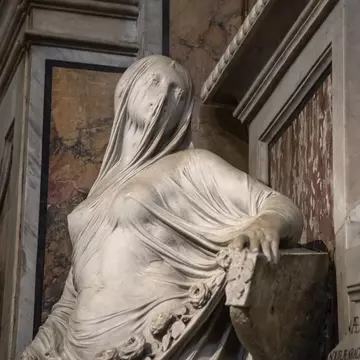
The patron saint of music, St Cecilia, was also buried here, though her body was later moved to the Basilica di Santa Cecilia in Trastevere. When her body was exhumed in 1599, more than a thousand years after her death, it was apparently perfectly preserved, as depicted in Stefano Maderno’s softly contoured sculpture – a replica is here. You have to join a tour (about 45 minutes; in English and many other languages) to explore the catacombs; guides explain the rituals and vivid details of early Christian life. Tours give a good idea of the seemingly endless corridors stretching underground.

People cycle through an iron gate that opens into a garden area.
Cycle to the Catacombe di San Callisto. Sun_Shine/Shutterstock Sun_Shine/Shutterstock

To reach the catacombs, use the nearly 1km access road (8.30am to 6pm Thursday to Tuesday) in lieu of the parallel stretch of the Via Appia Antica. It's much quieter, with shady trees and sweeping views. The catacombs are closed mid-January to mid-February, and on Wednesdays.

Catacombe di Santa Domitilla

Among Rome’s largest and oldest catacombs, the amazing Catacombe di Santa Domitilla(domitilla.info) stretches for about 17km. This network was established on the private burial ground of Flavia Domitilla, niece of emperor Domitian and a member of the wealthy Flavian family. These are special because of their well-preserved Christian wall paintings and the partly underground 4th-century CE Chiesa di SS Nereus e Achilleus – a graceful space with high ceilings, lined by columns. It's dedicated to two Roman soldiers martyred by Diocletian. The catacombs are closed Tuesdays and from mid-December to mid-January.

Exterior of the Basilica di San Sebastiano,  located along Via Appia Antica in Rome, Italy.
Exterior of the Basilica di San Sebastiano, located along Via Appia Antica in Rome, Italy. Marco Rubino/Shutterstock

Catacombe di San Sebastiano

Extending beneath the Basilica di San Sebastiano, the Catacombe di San Sebastiano (catacombe.org; adult/child €10/7) were the first to be called catacombs – the name was derived from the Greek kata (near) and kymbas (cavity), because they were located near a quarry. Entombments occurred here from the 1st century (including the Apostles Peter and Paul), with mausoleums added in the 2nd century and catacombs in the 3rd century. You'll see graffiti from early pilgrims to the tombs. Tours (around 45 minutes) are offered in several languages, with moderate stair climbing.

Path leading to the Villa di Massenzio on the Via Appia Antica in Rome, Italy.
Path leading to the Villa di Massenzio on the Via Appia Antica in Rome, Italy. mjols84/Shutterstock

Villa di Massenzio

In ancient Rome, this was a popular place for its most illustrious citizens to build expansive villas, as there was more space here than in the city center. One of these was Villa di Massenzio(villadimassenzio.it), the once enormous 4th-century palace of emperor Maxentius. The greenfield complex is centered on three main constructions: the villa itself, a mausoleum and a lozenge-shaped circus. Most impressive are the well-preserved remains of the 10,000-seat chariot racetrack, Circo di Massenzio. Nearby Mausoleo di Romolo, within the grounds of Villa di Massenzio, was built for Maxentius’ 17-year-old son, Romulus. Thought to have resembled a small Pantheon, this huge mausoleum was originally crowned with a large dome and surrounded by an imposing colonnade, in part still visible. Bizarrely, there's an 18th-century house grafted onto the side, built by the Torlonia family, who once owned this whole area, including Villa dei Quintili, as part of their country estate. They had made a mint administering Vatican finances.

Cyclist riding past the Mausoleo di Cecilia Metella on Via Appia Antica in Rome, Italy.
Cyclist riding past the Mausoleo di Cecilia Metella on Via Appia Antica in Rome, Italy. Lottie Davies/Lonely Planet

Mausoleo di Cecilia Metella

The turret-like 1st-century-BCE Mausoleo di Cecilia Metella (parcoarcheologicoappiaantica.it; adult/reduced €8/2, incl Villa dei Quintili) towers over the road. It encloses a now-roofless burial chamber. In the 14th century, it was converted into a fort by the Caetani family, who were related to Pope Boniface VIII, and used to frighten passing traffic into paying a toll. Inside their former palace is a collection of artifacts found along the road; look for the 64–66 CE coin with Nero's head.

The tomb was built for the daughter of consul Quintus Metellus Creticus. Cecilia Metella was significant as she joined two important families by marriage – she was also the daughter-in-law of Crassus, Julius Caesar's banker. The walls are made of travertine and the interior is decorated with a sculpted frieze featuring Gaelic shields, ox skulls and festoons.

Capo di Bove

Discovered when excavating the grounds of a private villa for a swimming pool, the remains of this Roman villa, Capo di Bove(parcoarcheologicoappiaantica.it; free) – which means "head of the ox" after the carvings on Cecilia Metella's nearby tomb – give a sense of how a gracious ancient Roman life was lived, with mosaics and the remains of its private bath house set amid the countryside of the Appia Antica Regional Park. Don't miss the photo exhibition detailing the encroachment of the modern age on the Appian Way and efforts to preserve it.

Ruins of the Villa dei Quintili on the Via Appia Antica in Rome, Italy.
Ruins of the Villa dei Quintili on the Via Appia Antica in Rome, Italy. anyaivanova/iStock

Villa dei Quintili

Towering over green fields, 2nd-century Villa dei Quintili is one of Rome's unsung splendors, the ruins of a complex the size of a town. It was the luxurious abode of two consuls, the Quintili brothers, but its splendor was their downfall. It caught the eye of megalomaniac emperor Commodus, who had them both killed, moving in himself. The emperor added to the complex, and the ruins are fabulously impressive, even though only a small portion has been excavated. The highlight is the well-preserved baths complex with a pool, caldarium (hot bath) and frigidarium (cold bath). The nymphaeum, the tower closest to the Via Appia, was converted into a castle for the counts of Tusculum in the Middle Ages, who were then the rulers of Lazio. The flooring of the site's Antiquarium hints at the grandeur of this estate, as do impressive sculptures found during excavation, including a magnificent Zeus.

People walking by archeological ruins on the Via Appia Antica in Rome, Italy.
People walking by archeological ruins on the Via Appia Antica in Rome, Italy. ValerioMei/Shutterstock

Access to the entire Villa dei Quintili site is possible from Via Appia Antica and all the way east along Via Appia Nuova, which has decent bus service.

Book popular activities

Lonely Planet may earn a commission from affiliate links on our site. All recommendations and reviews reflect our own independent opinions.


Must-see attractions