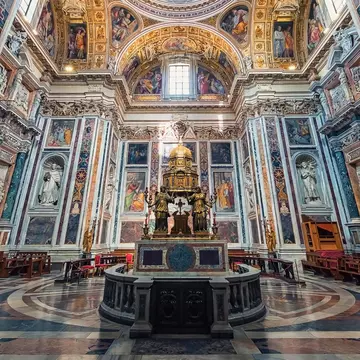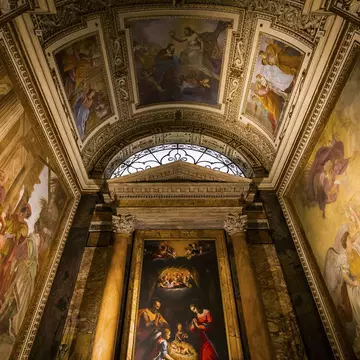
The Sistine Chapel is undoubtedly the crown jewel of the Vatican Museums. It’s the center of some of the most important ceremonies and rituals that happen in the Holy See, and it’s also the home of two of the world’s most famous works of art. Crane your neck up to marvel at Michelangelo’s stunning frescoes, and enjoy some of the greatest masterpieces Rome has to offer.
History
The chapel’s name comes from Pope Sixtus IV, who ordered it built from 1475 to 1481 and officially consecrated it in August 1483. It didn’t always look the way it does now, however, even though its dimensions – modeled after those of the Temple of Solomon – remained the same. Originally, its vaulted ceiling was painted to resemble a sky full of stars, and other frescoes by the leading artists of that time adorned every inch of the walls. All that remains of the chapel’s first decorations are the wall frescoes and the marble floor – everything else made way for Michelangelo’s two great masterpieces, commissioned to him by two different popes at two different moments in time. Michelangelo painted the ceiling for Pope Julius II from 1508 to 1512, as part of the pope’s effort to make Rome into the shining capital of the Catholic Church. The Last Judgment was instead painted in 1541 for Pope Paul III, as a warning for Catholics to hold fast amid the winds of Reformation that were sweeping through Europe.
The Ceiling Fresco
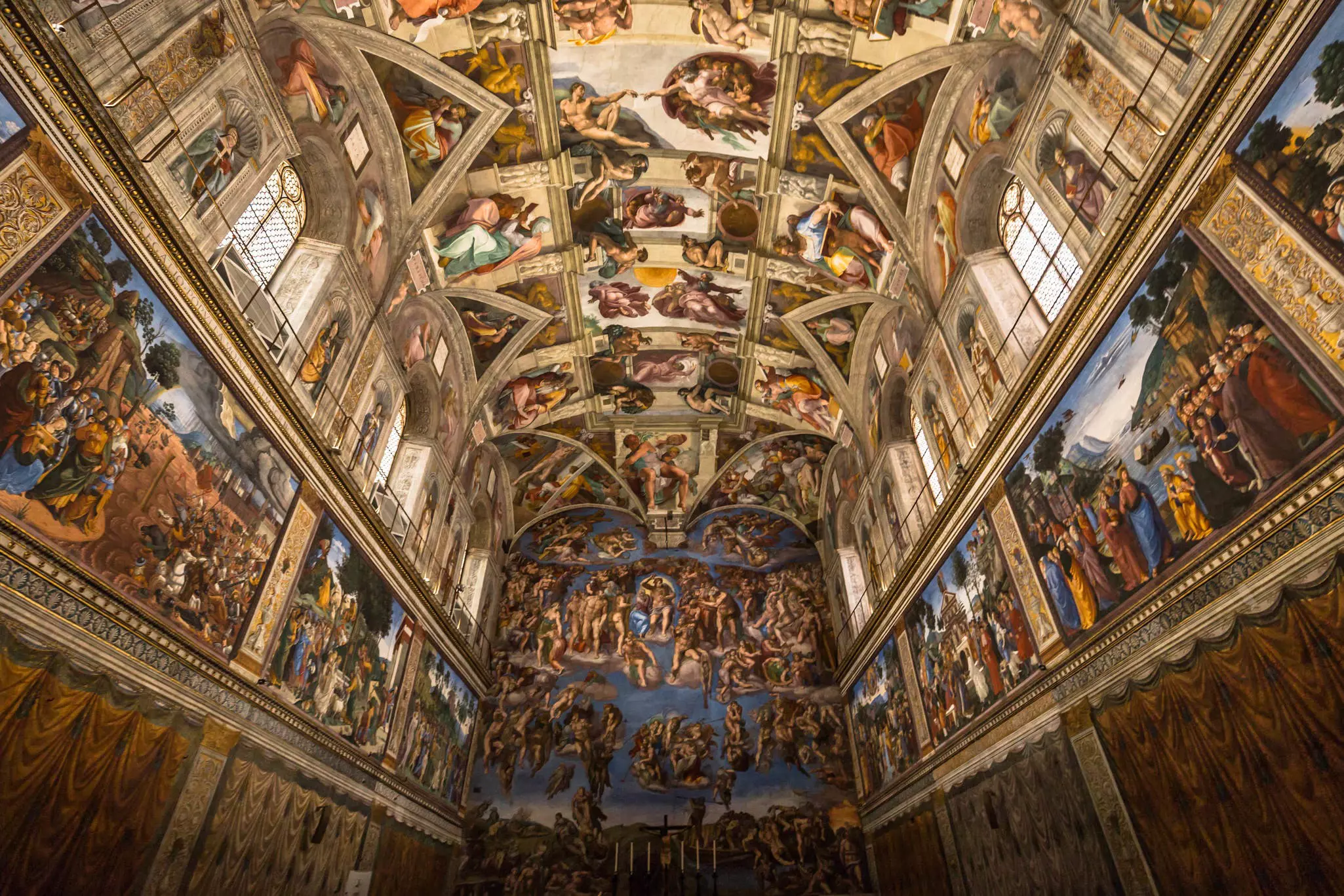
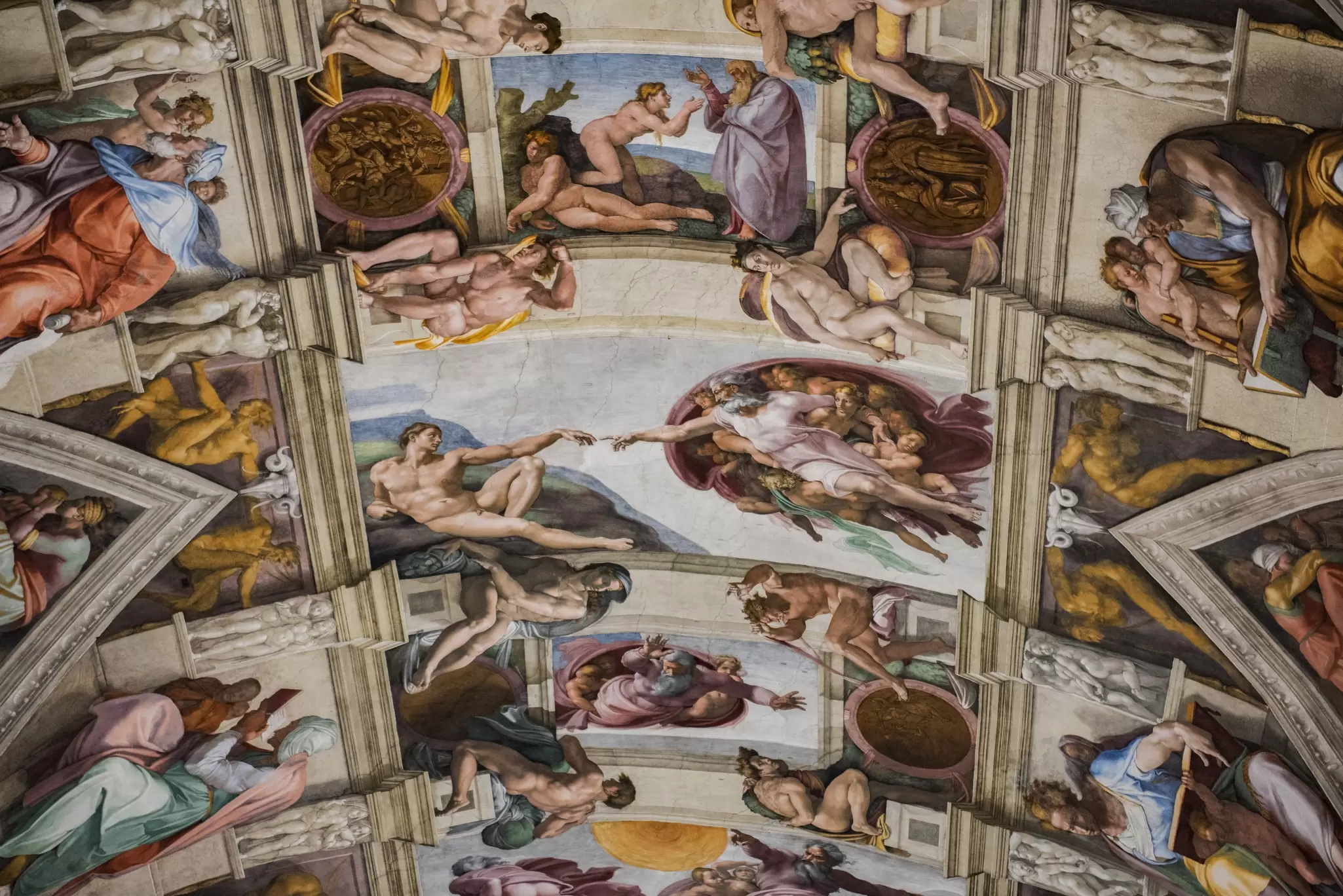
According to various historical sources, Michelangelo wasn’t particularly keen on accepting the pope’s commission – he had worked mainly as a sculptor since then and believed he didn’t know much about painting frescoes. In the end, he was persuaded for a fee of what would be around €1.5 to €2 million in today’s money. Michelangelo laid out a design based on stories from the Book of Genesis, which fill nine different panels surrounded by 20 nude male figures known as ignudi – which caused quite the scandal back when the chapel was first revealed to the 16th-century public. The first three panels closest to The Last Judgment represent God creating the world – with the Separation of Light from Darkness, featuring a fearsome God reaching out to touch the sun, the Creation of the Sun, Moon and Plants and the Separation of Land from Sea.
The following three panels are about humankind – with the famous Creation of Adam, featuring a bearded God reaching out to almost touch Adam’s finger, and then the Creation of Eve, as well as Original Sin and Banishment from the Garden of Eden. The last three panels are about Noah, and include the Sacrifice of Noah, The Flood and the Drunkenness of Noah. On the sides of the Genesis scenes are five ancient sibyls – including the ones from Delphi and Cumae – and seven biblical prophets, who all symbolize humankind’s continuous wait for redemption.
The Last Judgment
The Last Judgment, or Giudizio Universale in Italian, was originally commissioned by Pope Clement VII and then encouraged by his successor Pope Paul III, between the years 1536 and 1541 – it depicts Christ’s second coming in a sprawling fresco that takes up the entire 200 sq meters of the chapel’s western wall. Christ stands at the center of the composition, surrounded by a halo of golden light and a group of saints – his mother, the Virgin Mary, included. Above them, other angels carry the objects of Christ’s Passion, namely his cross and the pillar where he was bound to be flogged.
Underneath Christ and the saints, a group of angels with trumpets announces the end of time and the resurrection of the dead. We see the souls coming back to life in the bottom left corner, with the saved ascending to Heaven and the damned plunging into Hell on the bottom right corner. Among the creatures that populate Hell, we can recognize Caron, the infernal ferryman, brandishing an oar, and Minos, the judge of hell, with donkey ears and a twisting tail surrounding his body. The project was controversial from the start, especially for the fact that most of the figures represented in it were nude – so much so that they were ordered to be covered in 1564. The task fell to one of Michelangelo’s students, Daniele da Volterra, who added fig leaves and loincloths to more than 40 figures and earned the nickname il braghettone (the breeches maker) for it.
Other Wall Frescoes
It feels a bit strange calling the rest of the decorations of the Sistine Chapel the "other wall frescoes" – in any other place, they would rightfully be the center of attention since they’re all masterpieces in their own right. These frescoes were painted in the latter half of the 15th century to be part of the original chapel by a team of artists that included Botticelli, Pinturicchio, and Perugino among others. They tell the story of the lives of Moses and of Christ – to the left and the right of The Last Judgment, respectively. The most famous of them all is probably Perugino’s Handing of the Keys (1481–82), which shows Christ handing the keys of heaven to St Peter kneeling before him.