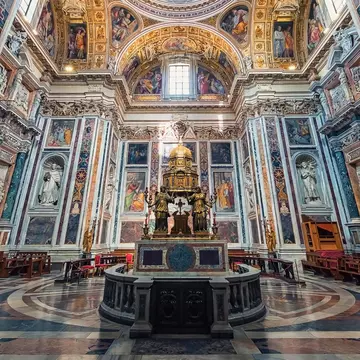
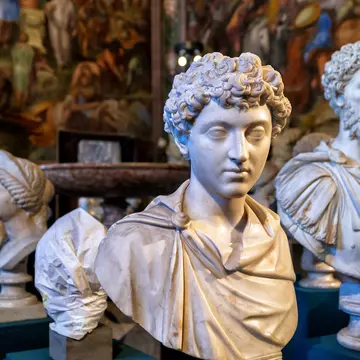
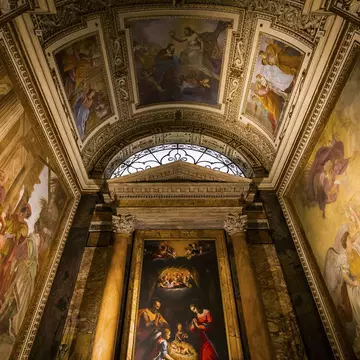
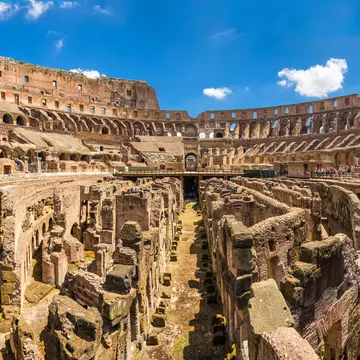
The baths that Termini station are named after, this huge complex could accommodate 3000 people, and was one of ancient Rome's largest. Now a museum on Rome's prehistory and epigraphy, its exhibits provide a fascinating insight into ancient Roman life, covering cults such as Mithraism, ancient altars and tombstone inscriptions. Don't overlook the vast and well-preserved baths hall, to the left as you approach the museum, now a temporary exhibition space. In the main museum, the large 16th-century cloister was built as part of the charterhouse of Basilica di Santa Maria degli Angeli e dei Martiri, and based on drawings by Michelangelo.
The cloister is home to classical sarcophagi, carved funerary altars and huge sculpted animal heads thought to have come from the Foro di Traiano.
As you wander around the museum, you'll see glimpses of the original complex, which was completed in the early 4th century as a state-of-the-art combination of baths, libraries, concert halls and gardens – the Aula Ottagona and Basilica di Santa Maria degli Angeli buildings were also once part of this enormous endeavour. It fell into disrepair after the aqueduct that fed the baths was destroyed by invaders in about 536 CE.
Note that the museum is one of four that collectively make up the Museo Nazionale Romano. A combined ticket (€15/8), which is valid for three days, includes admission to the other three sites: Palazzo Massimo alle Terme, Palazzo Altemps and the Crypta Balbi.