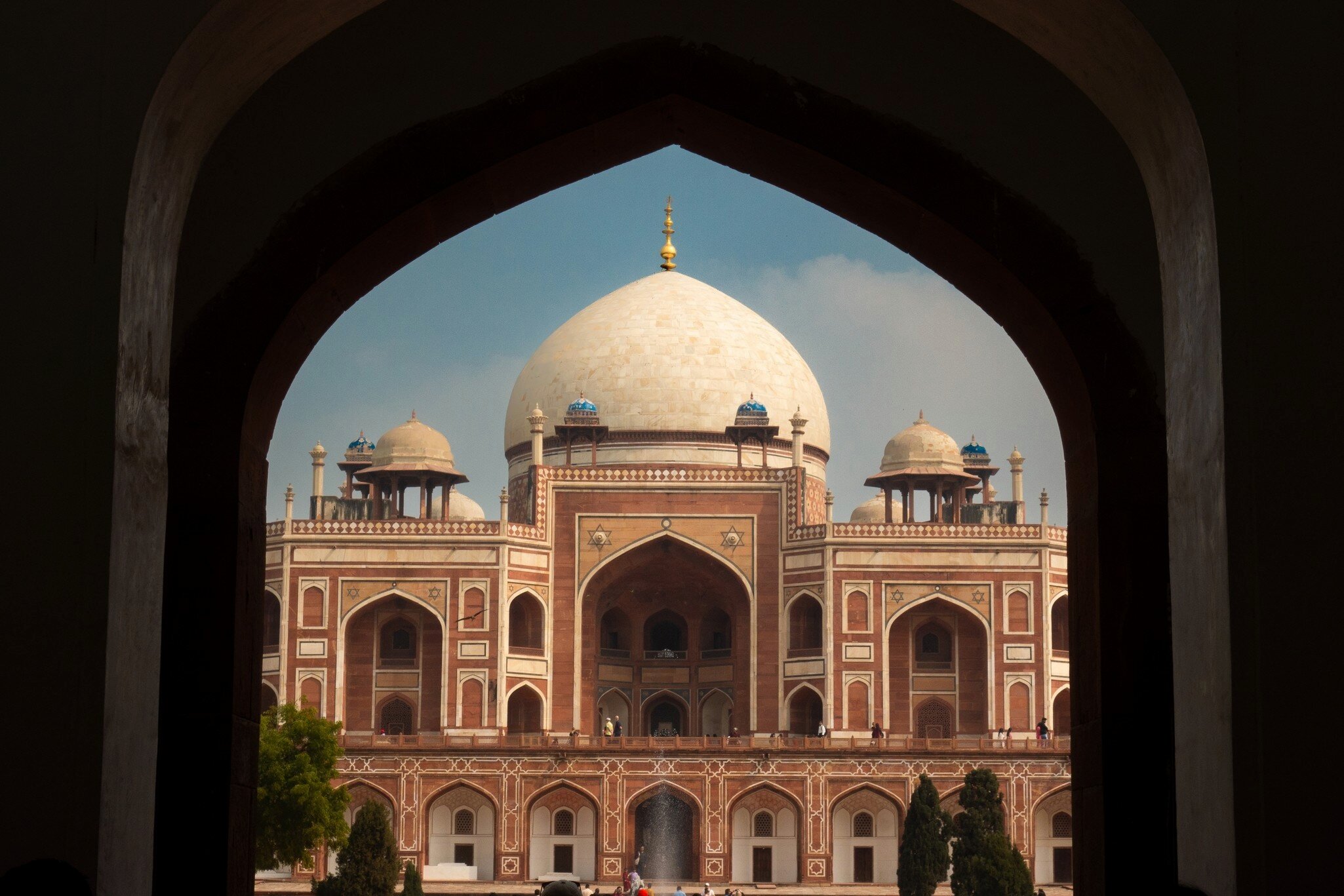
UNESCO-listed Humayun’s Tomb (asi.nic.in/pages/WorldHeritageHumayunTomb; adult/child ₹600/free) is sublimely well-proportioned, seeming to float above its symmetrical gardens. It’s thought to have inspired the Taj Mahal, which it predates by 60 years. Constructed for the Mughal emperor in 1570 by Haji Begum, Humayun’s Persian-born wife, the tomb marries Persian and Mughal elements. The arched facade is inlaid with bands of white marble and red sandstone, and the building follows strict rules of Islamic geometry, with an emphasis on the number eight. This was where the last Mughal emperor, Bahadur Shah Zafar, took refuge before being captured and exiled by the British in 1857.
The beautiful surrounding gardens contain Nai-ka-Gumbad, or "Barber's Tomb," which features a double dome and two graves inscribed with verses from the Quran. While rumor has it that the emperor's barber is entombed in this elegant shrine, archaeologists are not actually sure who lies within the two graves inside. Nearby stands the Nila Gumbad, named as such because of its blue (nila) tiled dome. Its lack of a double dome is unusual for the era, and while it's said to have been built in 1625, some speculate that the tomb may predate that of Humayun. On the southwestern corner of Humayun's Tomb, the Arab Sarai is a massive structure that may have been used to house mullahs – or simply the craftsmen who built the emperor's tomb.
To the right as you enter the complex, Isa Khan’s Tomb is a fine example of Lodhi-era architecture, constructed before Humayun's Tomb in 1548. Further south is the monumental Khan-i-Khanan’s Tomb (adult/child ₹250/free), plundered in Mughal times to build Safdarjung’s Tomb.