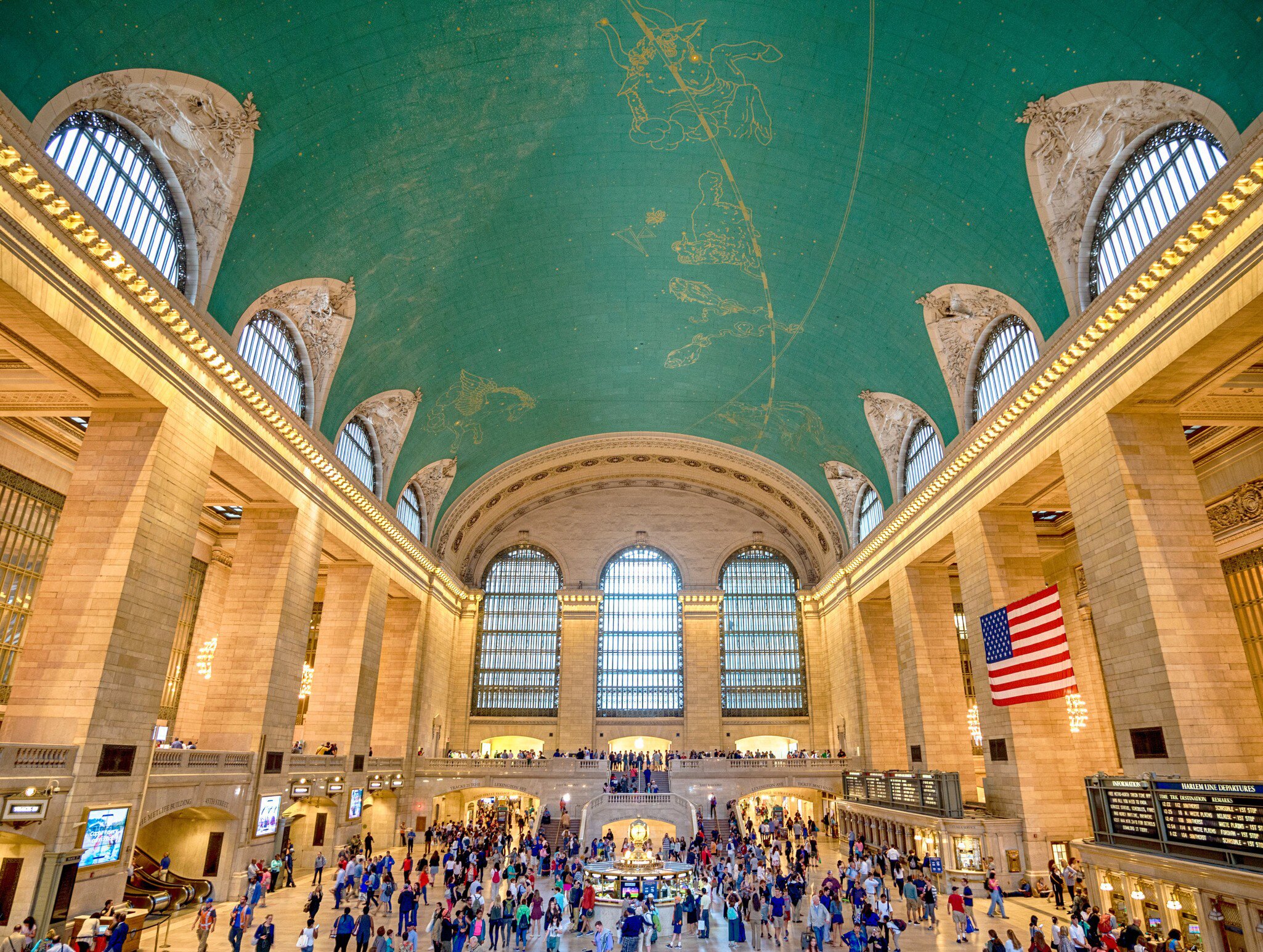
Completed in 1913, this enormous station hall is one of New York’s beaux-arts treasures. Commuters churn through the glorious marble-trimmed concourse, around a glowing opal-glass clock, beneath the vaulted ceiling. It depicts (inaccurately) the constellations, and what's visible today is a 1944 copy covering water damage in the original fresco designed by French painter Paul César Helleu. A 1990s renovation added twinkling lights (per Helleu's plan) and cleaned the ceiling. Follow Cancer's claws (northwest corner) to a tiny black rectangle: an un-retouched patch of soot. For more hidden wonders, head to the "Whispering Gallery" between the Main Concourse and Vanderbilt Hall, where an acoustic quirk allows people to stand on opposite gallery corners and carry a conversation in a whisper.
The exterior is a show too: clad in Connecticut Stony Creek granite at its base and Indiana limestone on top, Grand Central's facade is crowned by America's greatest monumental sculpture, The Glory of Commerce (also known as Transportation). Designed by the French sculptor Jules-Félix Coutan, the piece was executed in Long Island City by local carvers Donnelly and Ricci. Once completed, it was hoisted up, piece by piece, in 1914. Its protagonist is a wing-capped Mercury, the Roman god of travel and commerce. To the left is Hercules in an unusually placid stance, while looking down on the mayhem of 42nd St is Minerva, the ancient guardian of cities. The clock beneath Mercury's foot contains the largest example of Tiffany glass in the world.
There's plenty to eat and drink, too – try Grand Central Market (fast casual), Grand Central Oyster Bar & Restaurant (fine dining), Grand Central City Winery and the Campbell, which features live jazz on weekend evenings. You can also pop into the Transit Museum Store for a history lesson and great transport-themed NYC souvenirs.