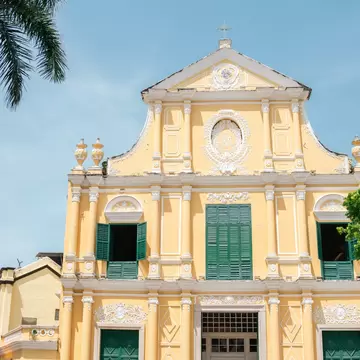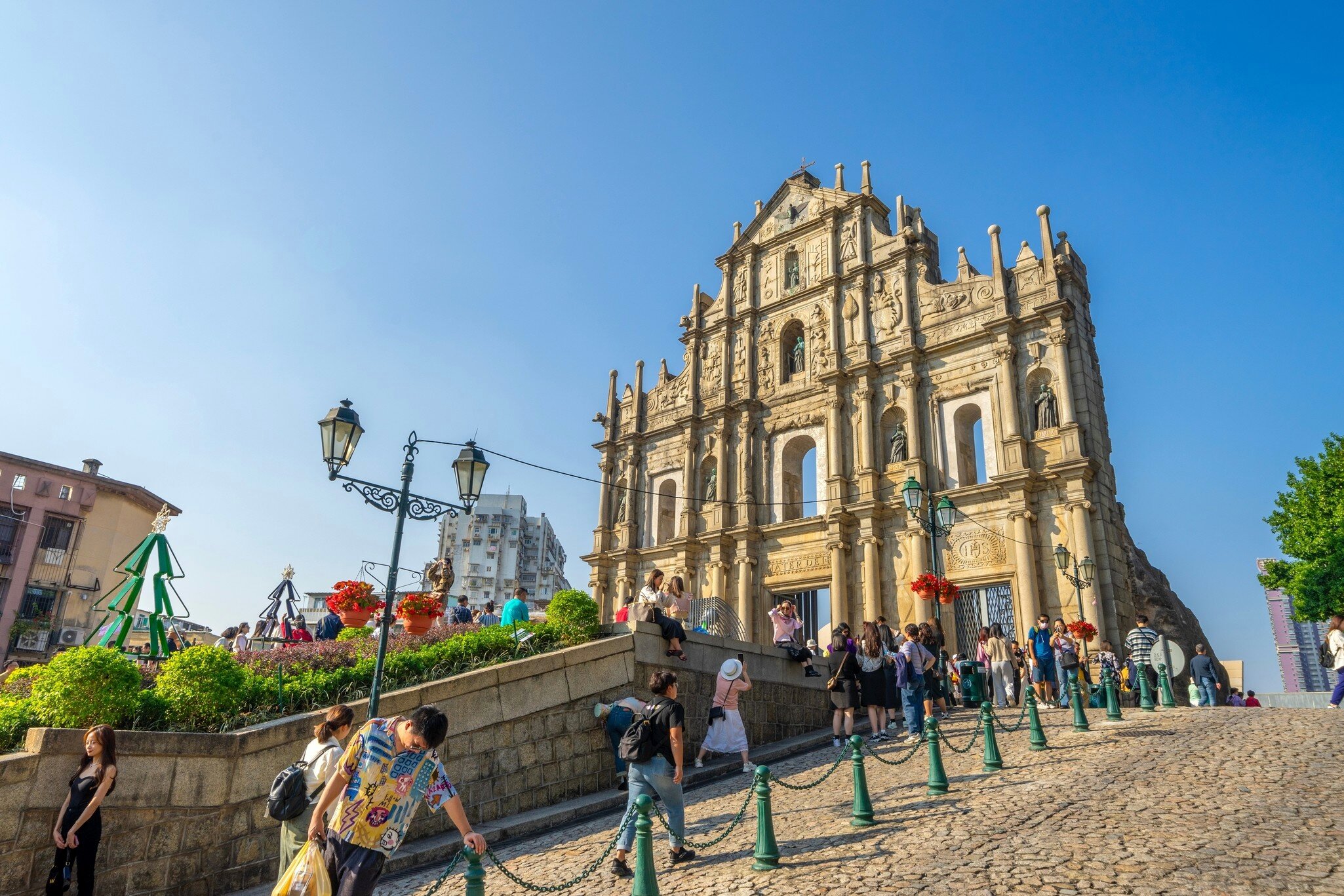
The most treasured icon in Macau, the towering facade and stairway are all that’s left of a Catholic church that was once the largest in Asia, known as the "Vatican of the East." The church was designed by an Italian Jesuit and built in 1602 by Japanese Christian exiles and Chinese craftsmen. It was abandoned after the expulsion of the Jesuits in 1762 and a military battalion was stationed here. In 1835 a fire erupted in the kitchen of the barracks, destroying everything, except what you see today.
The five-tiered facade is a picture of east–west synchronicity. In the center of the third tier stands the Virgin Mary with angels and two flowers: the peony (representing China) and the chrysanthemum (representing Japan). Just below the pediment, on the right side of the facade, is a dragon surmounted by the Holy Virgin. To the right of the Virgin is a carving of the tree of life and an apocalyptic woman (Mary) slaying a seven-headed hydra; the Japanese kanji next to her reads: "The holy mother tramples the heads of the dragon."
Behind the facade lie the vestiges of St Paul's College, formerly the site of the first western-style university in East Asia. Climb the steps to explore ruins leading to the Museum of Sacred Art & Crypt, which contains religious paintings, statues and artifacts. The crypt is home to entombed Jesuits, including Father Alexander Valignano (1539–1606), founder of St Paul's College.