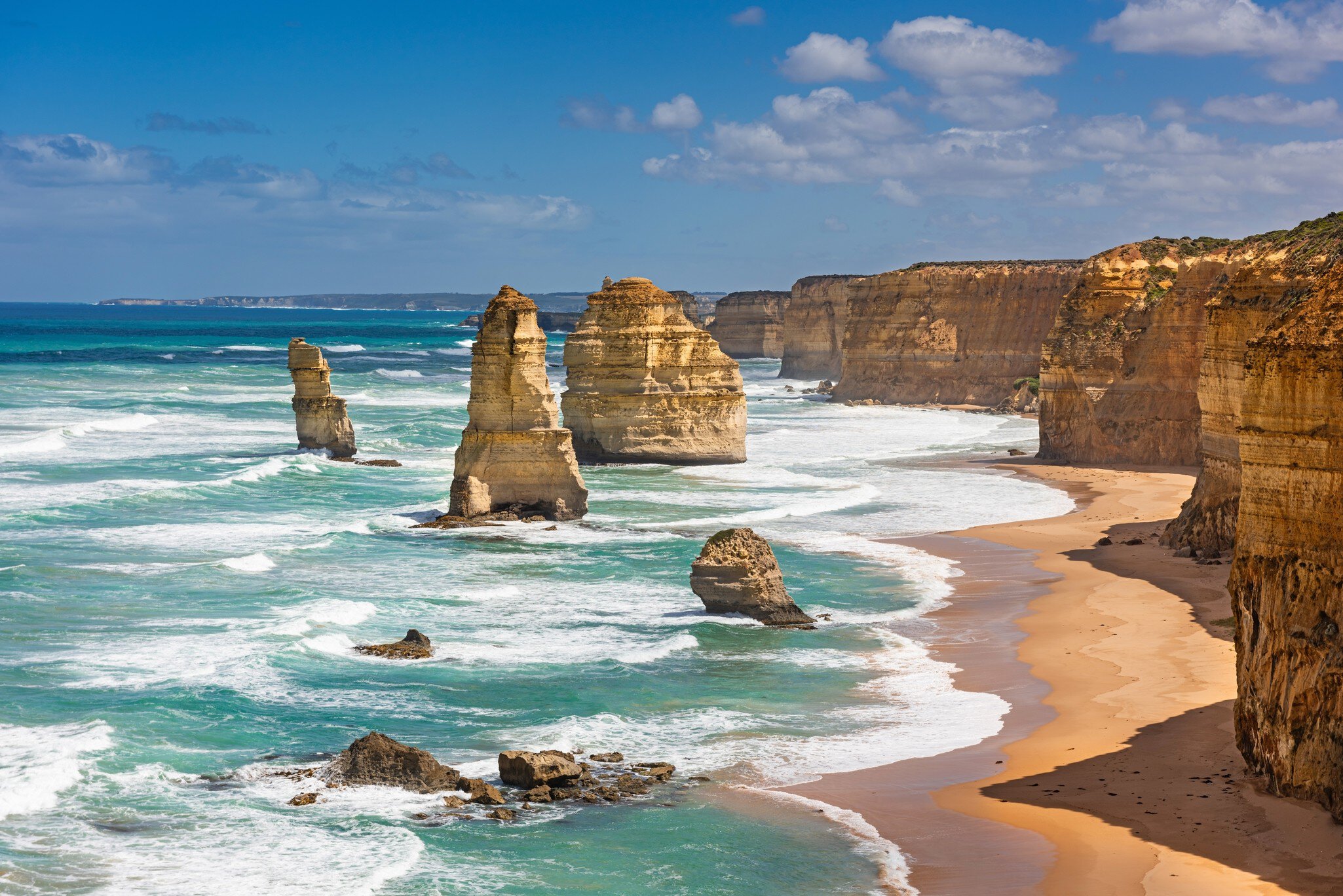
Port Campbell National Park is best known for the Twelve Apostles, towering limestone stacks that stand sentinel in the wild ocean less than 100m from the serrated coastline. They've changed over the years, shaped by weathering and erosion, and some disappeared completely. Visit at sunrise or sunset to enhance that feeling of awe, and avoid the crowds.
Why Twelve Apostles?
Despite the name, the Twelve Apostles are not 12 in number and, from all records, never have been. From the viewing platform, you can count seven, but some may obscure the others. Reach the boardwalk and viewing platform via the visitor center kiosk in the large car park.
Apostles are known as "stacks" in geological parlance, and they were originally called the "Sow and Piglets." In the 1960s, someone came up with a more catchy name, and since apostles come in a dozen, the number 12 was added sometime later. The two stacks on the eastern (Otway) side of the viewing platform are not technically among the Apostles – they’re Gog and Magog.
Walk the Gibson Steps
Once you've stopped at the visitor center, with its souvenirs and cafe, and walked under the Great Ocean Road itself for the view of the Twelve Apostles, follow signs to the Gibson Steps (2.2km return). These 86 steps, hacked by hand into the cliffs by 19th-century landowner Hugh Gibson (and now replaced by concrete ones), lead down to wild Gibson Beach. The steps were closed to the public due to rock falls at the time of writing.
A Bird's-Eye View
Helicopters (12apostleshelicopters.com.au; 15min flight from $195) offer an unmatched aerial view of the Twelve Apostles, Loch Ard Gorge, the Sentinel, the Arch and London Bridge – a recommended splurge. They take off from behind the main car park. Do not attempt to fly a drone around here!
Great Ocean Road Detours
Look out for car parks leading to lesser-known geological sites and natural attractions, some just as photogenic while less crowded than the Apostles.
Loch Ard Gorge Beach and blowhole with a backstory. Signboards tell the story of the two survivors of the Loch Ard shipwreck, who washed ashore here in 1878. From the car park, walk to lookout points over the gorge and the spectacular Island Arch. Steps down to the gorge and beach were closed in 2025 but should eventually reopen.
London Bridge Once connected to the land, the "bridge" eroded and collapsed in 1990, stranding two tourists who had to be rescued by police helicopter.
Grotto One of the most photogenic stops; follow a 700m boardwalk and trail down steps to the surreal sight of the ocean and a blue pool, both seen through a huge natural porthole.
Bay of Islands A beautiful sweep of bay with several limestone pillars, a beach to the left and caves to the right. It's a short walk with two viewpoints.
Free or Fee?
The Twelve Apostles have always been free to visit (and park), but at the time of writing a $126-million redevelopment of the new Visitor Centre Experience was underway (expected to be complete by end of 2026). This new exhibition and cultural center with rooftop lookout may be the incentive for the tourism board and local authorities to introduce either an admission fee (to access viewing platforms via the center) or a parking fee, but there was no confirmation of this at the time of writing.
