Aug 17, 20267 min read
Sydney to Perth by train: What to expect on one of the world’s longest train trips Jun 1, 2026
7 MIN READ

Writer
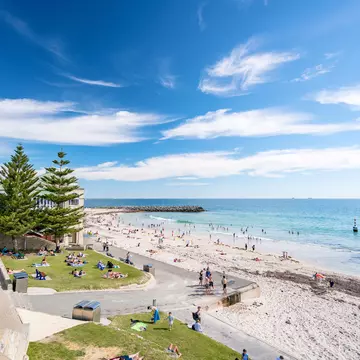
Cottesloe Beach in Perth, Western Australia. bmphotographer/Shutterstock

Writer
Highlights
Writer Tasmin Waby covers networks, eSIMs, wi-fi and data tips for Australia.
Choose Optus for city 5G or Telstra for rural coverage; TPG suits tight budgets.
eSIMs like Holafly activate before you land and need no passport or physical SIM swap.
On public wi-fi, use a VPN and a burner email to guard against hackers.
Lonely Planet may earn a commission from affiliate links on our site. All recommendations and reviews reflect our own independent opinions.
Congratulations, you’re heading to Australia, that vast land where the sun always shines and people are generally friendly – even in the biggest cities! Whether you’re beach-hopping, road-tripping or touring Australia’s highlights, staying connected is everything when it comes to traveling around Down Under. From booking an intercity coach to finding that secret cocktail bar tucked down an unmarked laneway, being able to access data on the go is key to a great trip. Luckily it’s not too difficult to stay seamlessly online.
Stay connected on your trip to Australia with these helpful tips on wi-fi, eSIMs and cell data.
Once you touch down in Australia and turn on your phone, your home data network will give you the option to buy a data package. But before you hit “yes” it’s a good idea to thoroughly research what it might cost you. If your phone supports eSIM technology, this might be a more cost-effective option than traditional roaming, allowing you to add a local Australian data plan digitally without swapping physical SIM cards.
Some remote roaming plans can be punishingly expensive: they allow for the use of limited data and then hit you with massive bills if you make (or receive!) phone calls or text messages.

There are three major mobile network players in Australia: Telstra, Optus and Vodafone/TPG. Telstra is best for coverage if you’re heading to rural areas. Optus offers slightly cheaper prices and its 5G speed in the city is better. If you’re mainly staying in cities, Optus is your best bet. Other competitors in the market, such as Lebara, use one of the three main networks’ infrastructure, but offer different pricing deals.
Activities like navigating with online maps, streaming videos via social media, sending messages to a group chat and uploading images to your cloud storage on the go will quickly add up. Just 1 hour spent streaming a TV show will chew through 1GB of data.
Switching to a local wi-fi network and using it to preload maps or download music and entertainment will save your mobile data. You can reduce the data you use with “data saving” options on most smartphones that pause automatic app updates and background tasks when you’re on mobile networks. You can also choose low-quality playback on streaming services.
Mobile phone retailers at most international airports, including Sydney, sell SIM cards. You can also pick up a SIM – and get excellent customer service – from mobile phone stores across most major cities in Australia. There’s even a Telstra store in Darwin.
You’ll need more than one document, such as a passport plus a drivers licence and bank card, to prove your identity. In stores, customer reps can answer any questions you have, from how to top up data or insert an extra physical SIM into your phone. The same can’t be said of telephone helplines, which can result in long periods on hold and tend to offer less useful advice.
Telstra and Optus both offer prepaid 7- or 28-day SIM cards, or a long-life plan that lasts a year. Each comes with data limits. After you’ve used these up, you will need to pay to top up your data. As an example, the Telstra 28-day 80GB is AU$44 and its 110GB plan is AU$54. On the other hand, TPG (using the Vodafone network) offers a cheaper deal with a 28-day 50GB plan for only AU$17.50 or 100GB plan for AU$22.50 – for the first 6 months. However, these prepaid plans renew automatically, which means you need to cancel 7 days before the start of your next billing period. There’s no minimum contract, so you can leave anytime, but if you forget to cancel it will be costly.
eSIMs like those from Holafly, Lonely Planet's preferred e-SIM partner, offer a few advantages to a physical SIM:
It can be bought anywhere, even before you leave home, so you have access as soon as you land.
There's no passport, fingerprint or address required.
You don't need to remove your current SIM.
You can use several carriers and phone numbers at once.
If you run out of data, it's easy to add more.
It's available on some smartphones, tablets and watches.
Local carriers Telstra, Optus and Vodafone also offer prepaid eSIM options, and international eSIMs are compatible with Australia’s mobile network. If you’re heading to remote areas, ideally your eSIM provider will use the Telstra network.

You can log on to free wi-fi at the airport, as well as many other public spaces including cafes, hotels, large public attractions like museums, and some shopping centers. Many will require your email address in exchange for the service (beware you may be signing up to a lifetime of spam emails). Additionally, public wi-fi networks are often vectors of cyber attacks.
To protect yourself when using these networks, it’s wise to have a “burner” email address for these occasions – to keep your work and personal email boxes clean – but make sure you set up your burner email with a strong password to prevent hacking or identity fraud. For added security, avoid transmitting sensitive personal data over public wi-fi networks, and consider using a VPN to encrypt your connection.
Australia has slower internet speeds than many developed countries – Speedtest ranks it 43rd globally for mobile internet speeds and 50th for fixed broadband. Australia’s average mobile download speed is 115.38 megabits per second (Mbps), compared to 210.04 Mbps in the United States or 256.32 Mbps in South Korea.
This is partly because of Australia’s size – it’s expensive to build infrastructure for vast areas with few people – and a reliance on antiquated technology. Much of the national broadband network runs on old copper wires, for example. The progressive rollout of 5G should speed things up, but you will notice differences in download speeds outside the city.
In many parts of Australia, it’s not unusual to find hotels with no wi-fi signal in rooms beyond the lobby area. Again this is mainly an infrastructure problem, although it can also be a blessing if you’re trying to reduce your – or your kid's – screen time. However, if you're someone who is used to always being connected, you may want to warn relatives back home that you could be offline for periods of time when traveling in Australia.

There are no specific concerns relating to censorship, accessing information or surveillance in Australia. And it is not illegal to make use of a VPN when traveling there – you should have no problems logging into geo-restricted websites via your VPN while away. Using a VPN to protect your data is also best practice when using public wi-fi networks.
English-speakers should have no problems getting connected and navigating websites in Australia.

Australians are generally pretty relaxed people, which means no one is going to tell you off if you break any unwritten rules of etiquette. That said, if you want to avoid offense it’s best to have some phone manners.
Keep your phone on silent in public places
Don't play videos or TikToks out loud in quiet spaces like on public transportation or in a cafe
Move away from other people if you're taking a private call
Don't take photos of people without their permission.
On the plus side, if you want someone to stop and give you directions because your phone ran out of battery or you need someone to take a group photo at an iconic tourist site, locals will be more than happy to oblige.
In an emergency: Dial 000 (for police, ambulance and fire services)
To navigate offline: Pick up a UBD Gregory’s road atlas
For remote hikes or road trips: Organize a satellite phone in case of emergency.
Book your Australia trip with Lonely Planet Journeys
See Australia how it's meant to be seen
Planned by local experts and tailored to you, Lonely Planet Journeys handles the logistics so you can just enjoy the trip. Tell us what you want and we'll build your Australia itinerary from scratch, or browse our bookable trips to get inspired.


Explore related stories