Set in foothills 3km north of Matale, surrounded by giant boulders, this monastery is a low-key, but intriguing, site. There's a charming series of Buddhist caves, religious wall paintings, and a stupa or two. It's easily accessible just off the main highway.
It was in Aluvihara that the Buddhist canon known as the Tipitaka was first transcribed from oral and Sinhalese sources into Pali text by 500 resident monks, during the Fourth Buddhist Council of the 1st century BCE.
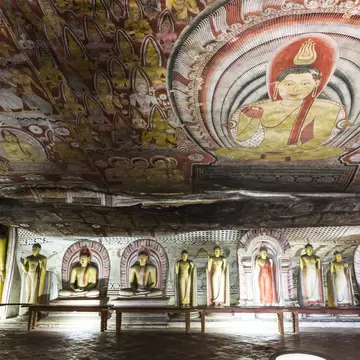
The first two caves contain 10m reclining Buddhas and some fine wall and ceiling paintings. The second cave is filled with cartoon-like murals of the realms of hell, while a set of garish statues in a gruesome side temple depicts a sinner with his skull cut open and his brains being ladled out by two demons.
Legend has it that a giant used three of the giant rocks here as a base for his cooking pot, and the name Aluvihara (Ash Monastery) refers to the ashes from the cooking fire.
Behind a boulder is a cave dedicated to Buddhaghosa, the fifth-century Indian scholar who spent years here working on Buddhist commentaries. Stairs continue to the top of the rock, where you’ll find a dagoba and views of a huge golden Buddha on the hillside above offering protection and blessings with an abhaya (palm facing-outward) gesture.
The small museum at the entrance holds some of the Tipitaka texts rewritten on palm leaf after the Aluvihara library was destroyed by British troops putting down a revolt in 1848. For a donation the caretaker will inscribe your name on a small length of ola (palm-leaf) using traditional charcoal ink.
A three-wheeler from Matale to Aluvihara costs about Rs 400 return, including waiting time.