Bikaner's enormous fortress, the Junagarh (adult/child ₹600/400), was raised between 1589 and 1593 by Raja Rai Singh, who served as a general to the Mughal emperor Akbar, and was never conquered. Inside its robust walls are two interesting museums, covered by the same ticket, reached through a chain of gateways Prachina Cultural Centre & Museum marked with the handprints of tragically immolated royal widows.
As you enter the main courtyard inside the walls, you'll see the (0151-2525609) to the right, with eclectic displays on the Bikaner dynasty and local folk arts, costumes, jewelry, furniture and ceramics.
The main Junagarh Museum (0151-2202297) is entered through the grand facade to the south. You'll pass through a red courtyard, then the red and white Karan Mahal Chowk – used for public audiences – then the graceful, cream-colored Anup Mahal Chowk, flanked by three exquisite palaces built for different members of the royal dynasty.
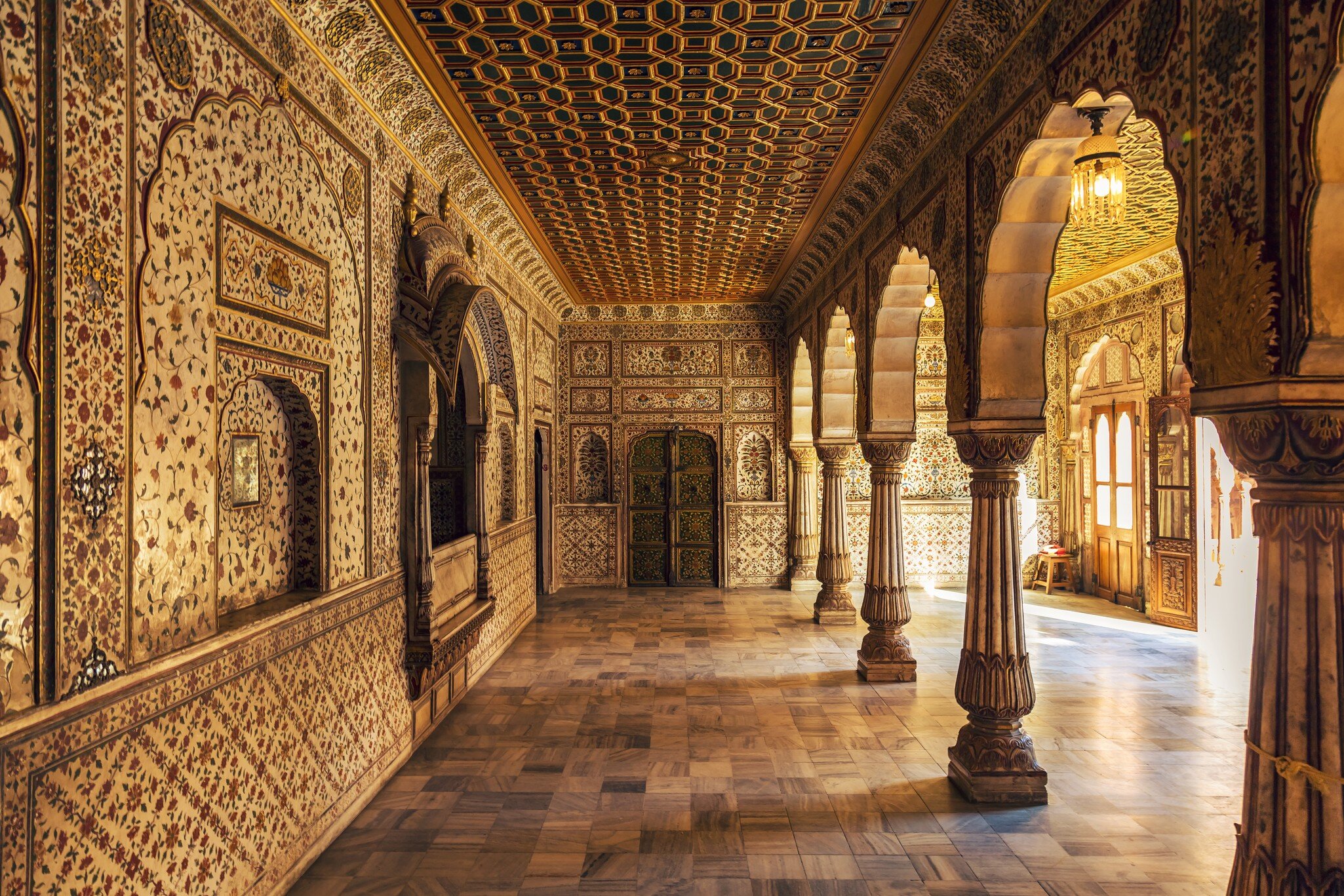
The Phool Mahal to the left features murals of flowers and vases, plus pole-mounted golden royal insignias. Lavishly gilded, the Anup Mahal in the center was the hall of private audiences. To the right is the soothing Badal Mahal (Cloud Palace), painted with blue cloud motifs.
Heading upstairs, you'll pass a row of "nail seats" used by fakirs (Muslim mystics) on the way to the 18th-century Gaj Mandir – a symphony of red, white and gold murals and ivory, sandalwood and mirrored glass inlay work.
Descend to reach the royal armory, bristling with swords and daggers, then the bas-relief covered Ganga Durbar Hall. The last royal space is the Vikram Vilas Durbar Hall, stuffed with royal heirlooms, including a De Havilland DH-9 biplane bomber donated to Raja Ganga Singh by Great Britain for services rendered in WWI.
An audio guide (requiring an identity document as a deposit) is available in English, French, German and Hindi, and is very informative.