Dec 5, 202511 min read
The 8 Best Things to Do in Giza, EgyptDec 5, 2025
11 MIN READ
Contributors
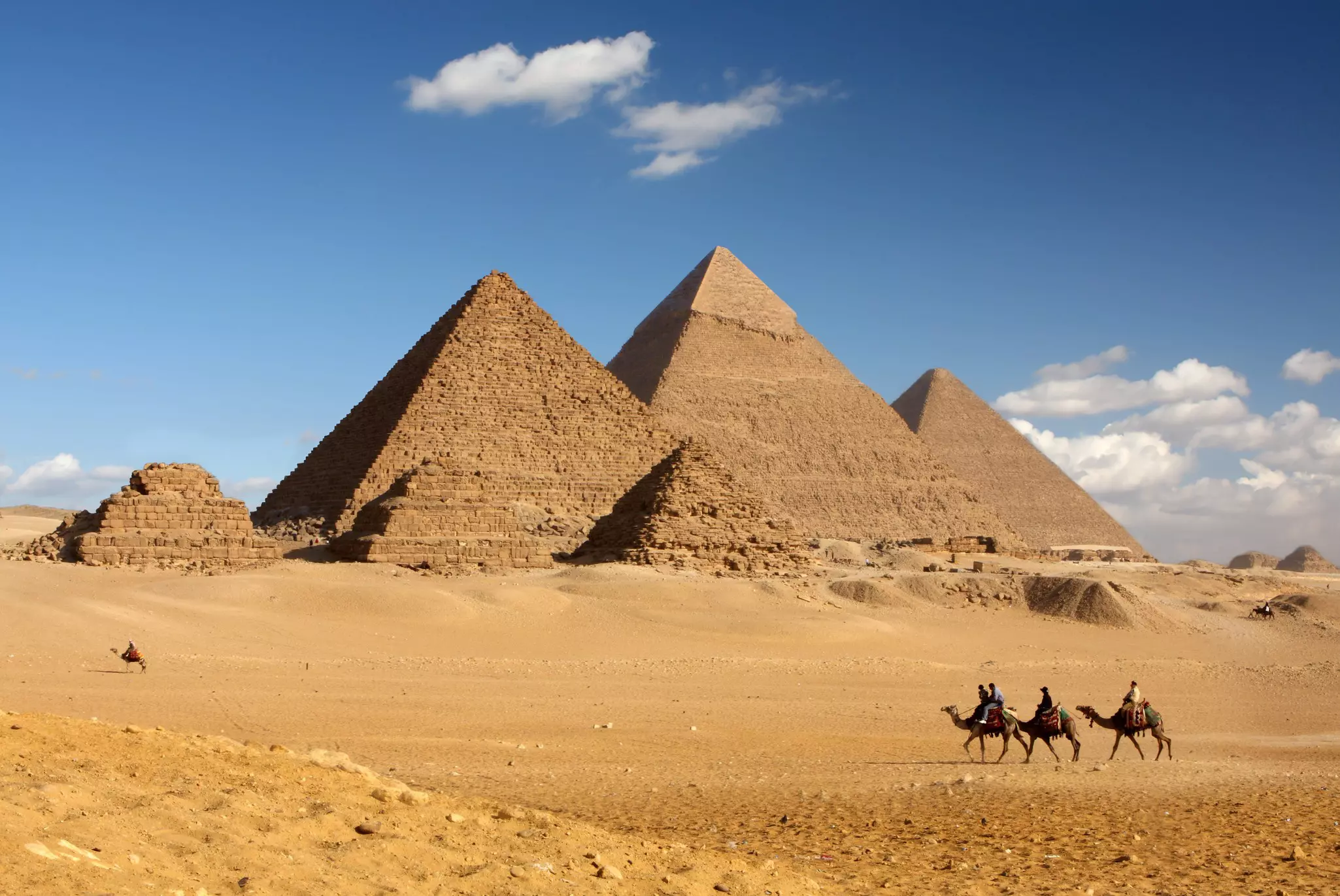
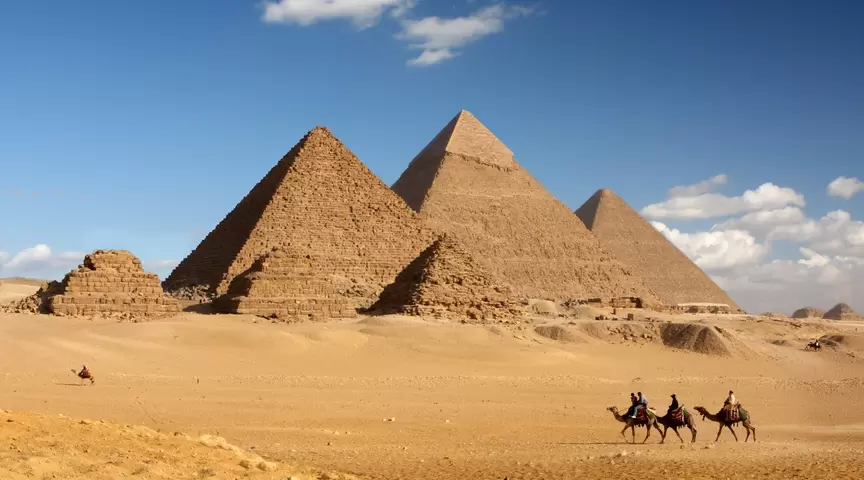
Camels walk past the Pyramids of Giza in Egypt. sculpies/Shutterstock
Contributors


Lonely Planet Editors, Lauren Keith
Lonely Planet may earn a commission from affiliate links on our site. All recommendations and reviews reflect our own independent opinions.
Going to Cairo without going to Giza would be like going to Egypt without seeing the Pyramids!
Technically, Giza comprises all of Cairo on west the Nile – but the place is inextricably linked with the Pyramids constructed for the pharaohs Khufu, Khafra and Menkaure. These iconic tomb structures have been luring visitors to Egypt since they were first constructed in the 3rd millennium BCE.
Grouped together in a single complex on the Giza Plateau, the Pyramids are Egypt’s most famous tourist attraction, and visiting can be a sensory overload. The area around the site is a rolling parade of horse-drawn carriages, camels, tour buses, taxis and touts. Vendors hawk tours, scarves, alabaster pyramid models and pyramid-shaped key chains.
A single entry fee will get you access to the Giza Plateau, though extra charges apply to enter the tombs and see specific areas of the complex. Coming early in the morning with a guide is a good way to avoid the crowds and discover overlooked features of the site, such as the tombs of the workers who built these vast monuments.
With the opening of the long-awaited Grand Egyptian Museum, Giza is undergoing perhaps the biggest change it has seen since the Great Pyramid of Khufu first rose. Improving the visitor experience are new rules and regulations on horse and camel drivers; improved toilet facilities; and a proliferation of modern cafes and upscale restaurants dishing up plates of Egyptian food in front of unbelievable views.
Consider the weather when planning your trip. The climate in Egypt can have a big impact on how enjoyable it is to explore this sparsely shaded site. The mild winter is the peak season, with crowds slightly smaller during the shoulder season months of March, April, May and September.
Some time-strapped sightseers stay in Giza and bypass Cairo entirely, though it’s more common to stay in Cairo and hop across the river to Giza. However you choose to visit Egypt’s most legendary sight, here are the best things to do in Giza.
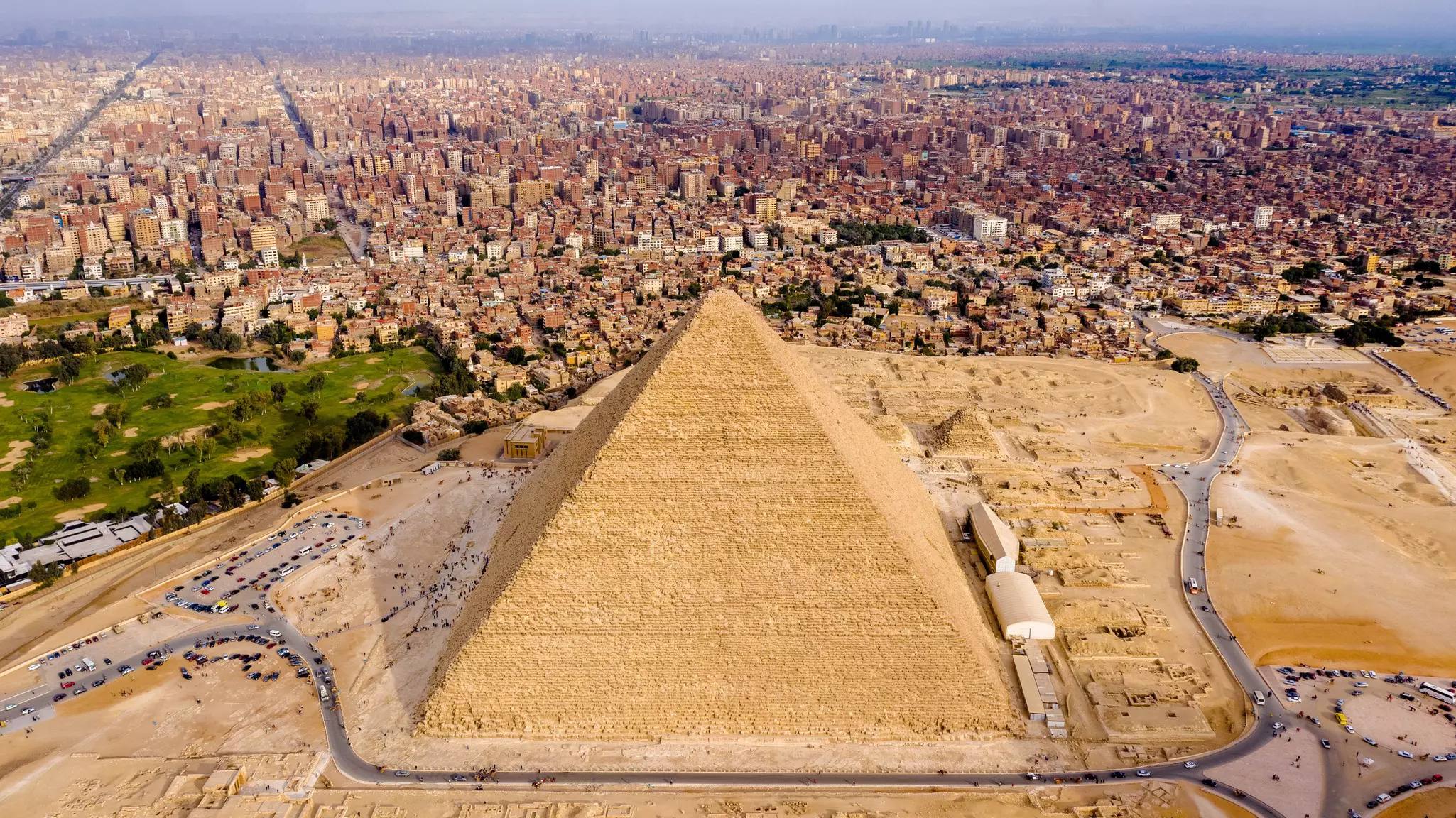
Built as a tomb for the 4th-dynasty Pharaoh Khufu (r 2589–2566 BCE), the Great Pyramid is the oldest structure on the Giza Plateau and the largest pyramid in Egypt. (And it’s nearly twice the height of its closest competitor outside Egypt, the Toniná pyramid in Mexico.) Needless to say, it’s the monument most people come to Giza to see.
Standing 146.5m high when it was completed in around 2570 BCE, this was the tallest structure in the world for nearly four millennia. Today, after 46 windy centuries and the loss of its limestone casing, its height has been reduced by 9m. Get close up to check out the mammoth stone blocks, each weighing 2.5 tonnes.
Though efficient tomb robbers have made sure there’s not much to see inside, just being able to enter such an ancient monument is an unforgettable experience for most visitors. It’s well worth with surcharge to the Giza Plateau entry fee.
The wait to get inside can take hours when it’s busy, and navigating the pyramid’s interior is a sweaty endeavor of climbing, crouching and squeezing through steep, narrow passageways. (It’s not suitable for people with mobility issues.) When you pause in the Great Gallery to catch your breath, look up and notice how precisely the blocks in the ceiling fit together, a remarkable feat of ancient engineering.
Your reward at the end of the journey is the dank, dark King’s Chamber, with walls of red granite blocks and Khufu’s empty sarcophagus standing at one end. Visit the Great Egyptian Museum first, then use your imagination to conjure up an image of how the tomb might have looked when Khufu was first interred.
Planning tip: Be sure to walk by the three small pyramids outside, built for Khufu’s wife, mother and daughter, and the Eastern Cemetery, reserved for members of the royal family and other high-ranking nobles. Which tombs are open depends on the government’s restoration schedule, but you should be able to view the ornately painted Tomb of Meresankh III, built for the wife of Khufu’s son, Khafre.
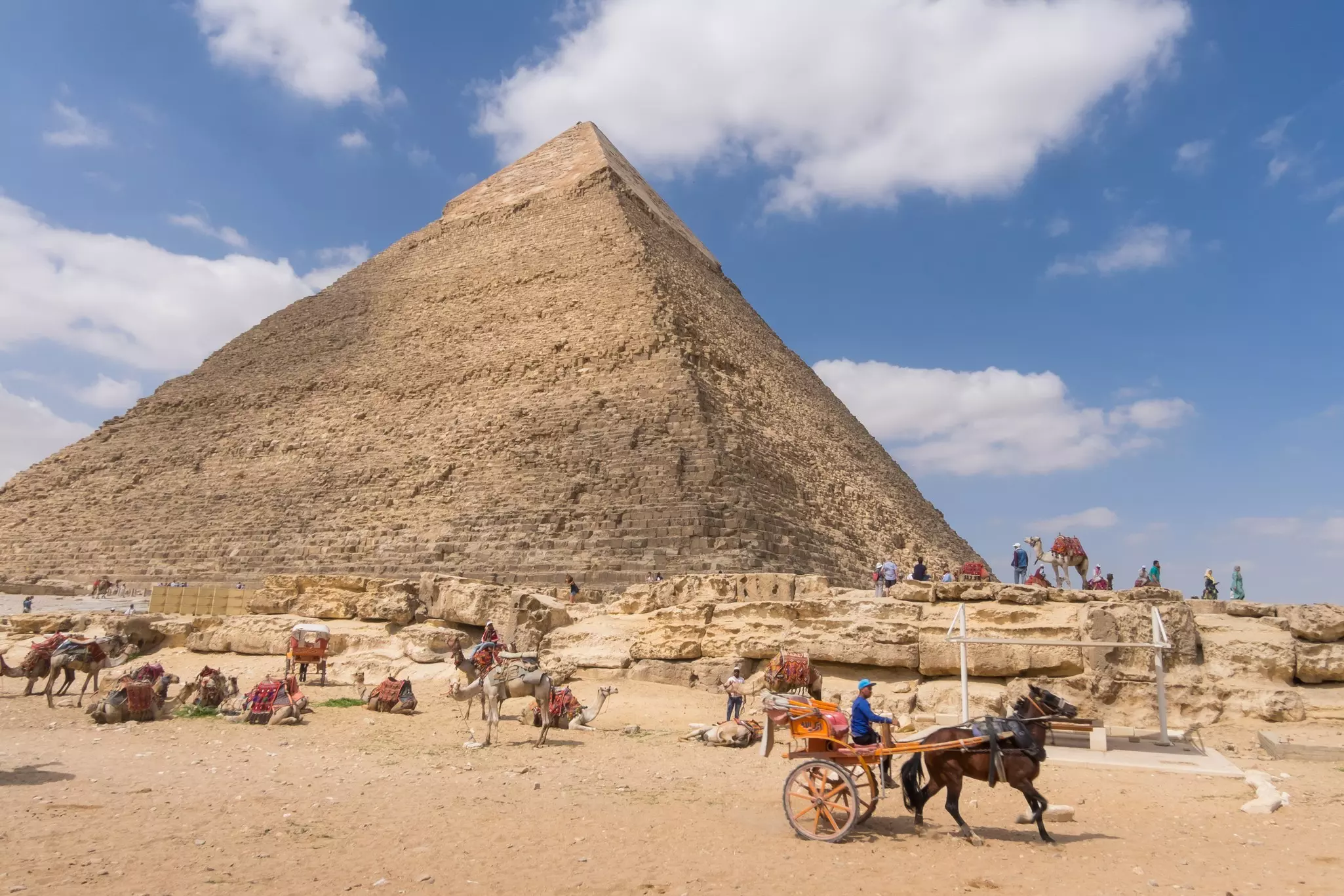
The other two enormous pyramids at Giza – built for the pharaohs Khafre and Menkaure – are open on an alternating basis, so you’ll find out which is open when you visit. At 136.4m, the pyramid of the Pharoah Khafre (r 2558–2532 BCE) is the second-tallest structure, but with its partially intact limestone casing and elevated position, it can look taller than the Great Pyramid from some angles.
If you are able to enter, you’ll descend along a claustrophobic shaft to a passageway and then cross to the main burial chamber, which still contains Khafre’s large granite sarcophagus. On the east side of the pyramid are the substantial remains of the pharaoh’s funerary temple, where Khafre was worshiped after his death. From the temple, a rock-paved causeway once provided access to the Nile, and you can still walk along it to reach the Sphinx.
At 62m, the Pyramid of Menkaure is the smallest of the trio, only about one-tenth of the bulk of the Great Pyramid. Menkaure (r 2532–2503 BCE) died before the structure was finished; if you look around the bottom of the pyramid, you can spot several pieces of granite that were never properly smoothed.
If the pyramid interior is open, you’ll be able to descend through three distinct levels – the lowest surprisingly large – and peer into the main tomb. Menkaure’s funerary temple sits on the eastern side of his pyramid, and to the south is a set of queens’ pyramids.
Planning tip: Thanks to the vendors and touts pushing souvenirs and horse and camel rides at every turn, visiting the Giza Plateau can be a little exhausting. If you need a break from the hard sell, retreat to a local restaurant or cafe.
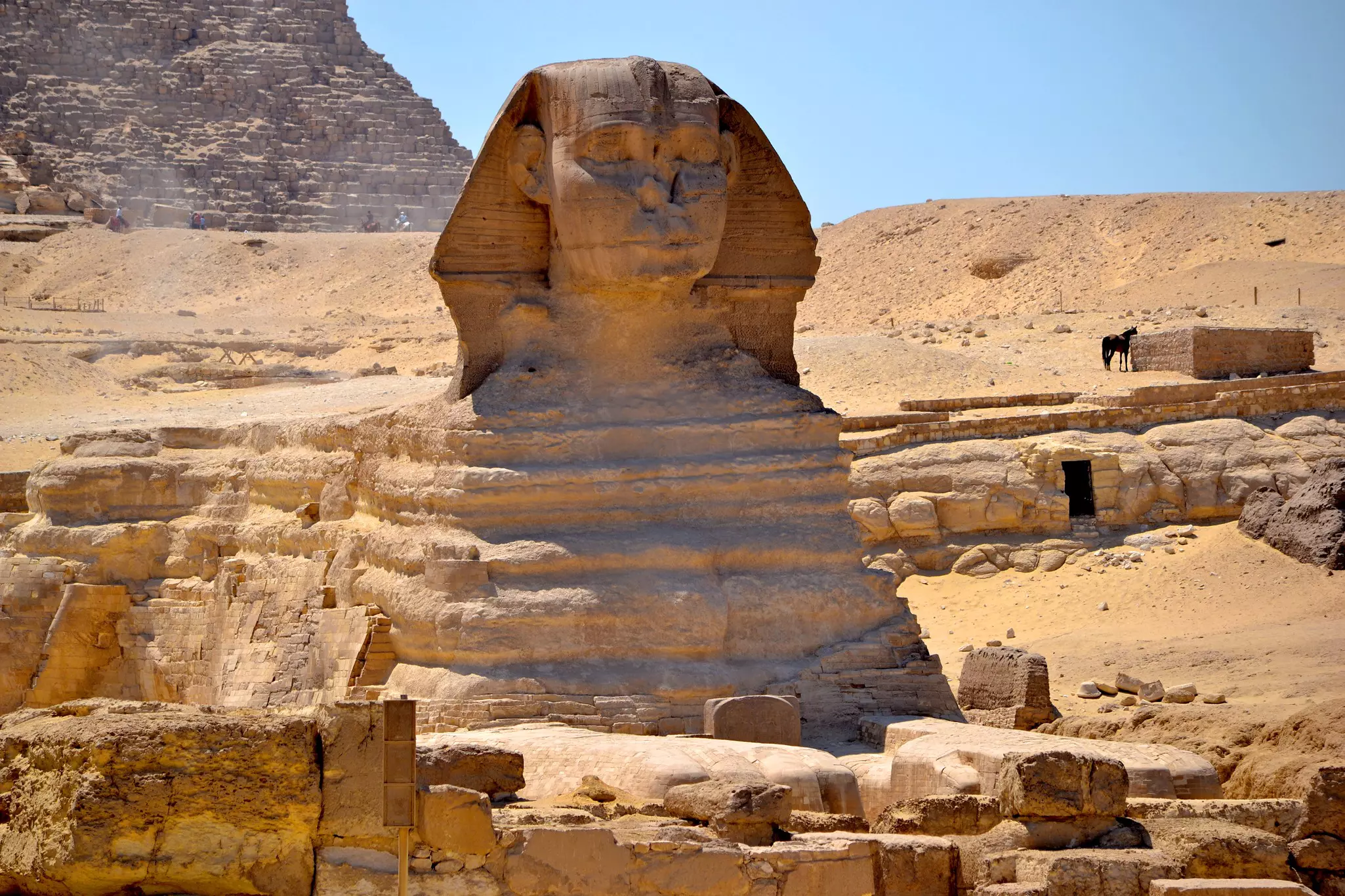
There’s no direct connection between Giza’s famous Sphinx and the puzzle-posing monster of ancient Greek legend. Still, mysteries swirl around this huge statue. Possibly depicting the head of Khafre mounted on the body of a lion, this enormous effigy was carved from the bedrock of the Giza plateau in around 2500 BCE. Its purpose has never been fully explained.
In Arabic, the statue is known as Abu Al Hol (“Father of Terror”), and a Sufi mystic is thought to have lopped off the Sphinx’s nose in the 14th century to discourage peasants from worshiping the monument. (The legend that Napoleon shot off the nose during his 1798 invasion of Egypt is today discredited.)
For the classic view, approach via the ruins of the Valley Temple of Khafre, following the southern side of the sunken pit that holds the Sphinx. While everyone is snapping the obligatory Sphinx headshot, walk to the end of the platform so you can view the statue’s brickwork paws and haunches.
Planning tip: Some expensive private tours lead visitors between the paws of the Sphinx to view the so-called Dream Stele, erected by Thutmose IV in 1401 BCE. According to the inscription, Thutmose dreamed of a powerful relic buried on this spot, and the gods revealed he would become pharaoh if he cleared the sand.
If you plan to ride a camel somewhere in Egypt, Giza is as good a place any in the country to do so. Swaying out into the sand on a camel to view the classic panorama of the three pyramids surrounded by a sweep of desert is certainly a memorable way to view this ancient site. You can do the same journey on horseback, which while less evocative is certainly more comfortable than on a camel.
Giza has no shortage of camel and horse drivers eager to make your desert panorama dreams come true. Just expect a fair bit of sales pressure. While there’s technically an official government-set rate for rides, in practice, bargaining is the name of the game. Don’t mount up until you’ve agreed on a price; most operators charge at least US$20 for a 30-minute ride.
Planning tip: Since some operators treat their animals poorly, make sure your horse or camel looks healthy and well fed. Two stables with good reputations for animal welfare and hassle-free bookings are NB Stables and FB Stables, both outside the Pyramid complex.
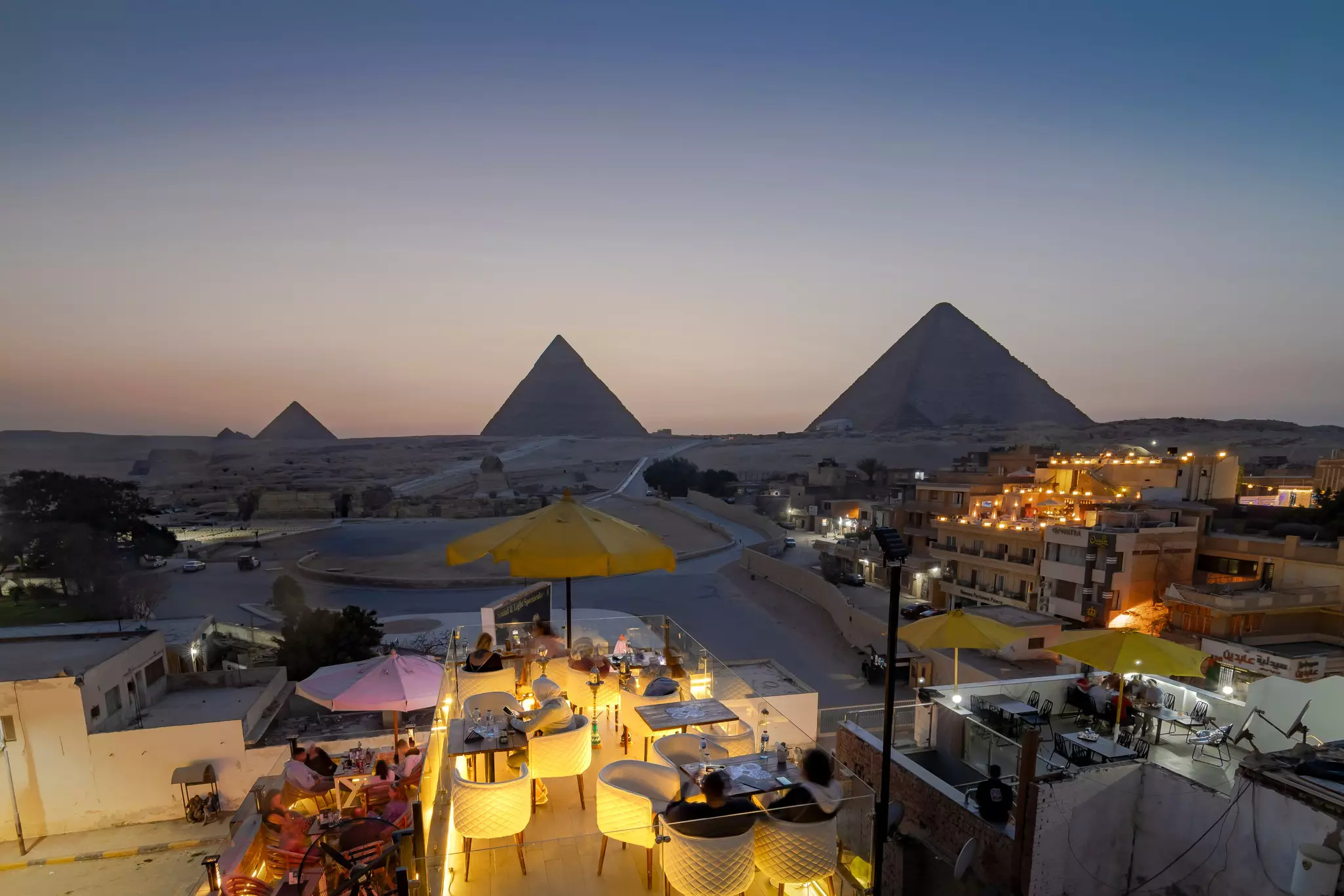
After wandering the Giza Plateau in the sun, you’ll have earned some relaxation time. Before 2020, there was nowhere to eat at the Pyramids complex, but that’s now changed with the opening of two upscale eateries and a selection of cafes where you can explore Egyptian cuisine while you admire the vista.
At Khufu’s, Chef Mostafa Seif offers feasts of traditional Egyptian dishes that have been given the fine-dining treatment with a fresh, contemporary twist. Egypt’s street-food classic kushari (a mix of noodles, rice, brown lentils, fried onions and tomato sauce) is flipped and turned into a salad, while roasted pigeons are stuffed with spiced freekeh (roasted green wheat). The views are similarly memorable.
There are even better views (though a less impressive menu) at 9 Pyramids Lounge, away from the bustle down an unpaved road on the south side of the plateau. Traditional cushioned seats on the ground are the perfect spot to soak up the scene over an Egyptian breakfast or meaty grill. Afterward, swing by Ladurée cafe for tasty French-style macarons and teas.
For something more casual, all-day 139 Pavilion at the Marriott Mena House hotel has an international menu and huge windows opening onto the Pyramids, while Andrea El Mariouteya is famous for its spit-roasted chicken and tasty mezze dishes (eat in the garden while overlooking the city sprawl).
Planning tip: Reservations are required for Khufu’s and 9 Pyramids Lounge. Since you must have a Giza Plateau entry ticket to access both restaurants, plan to eat here while touring the Pyramids.
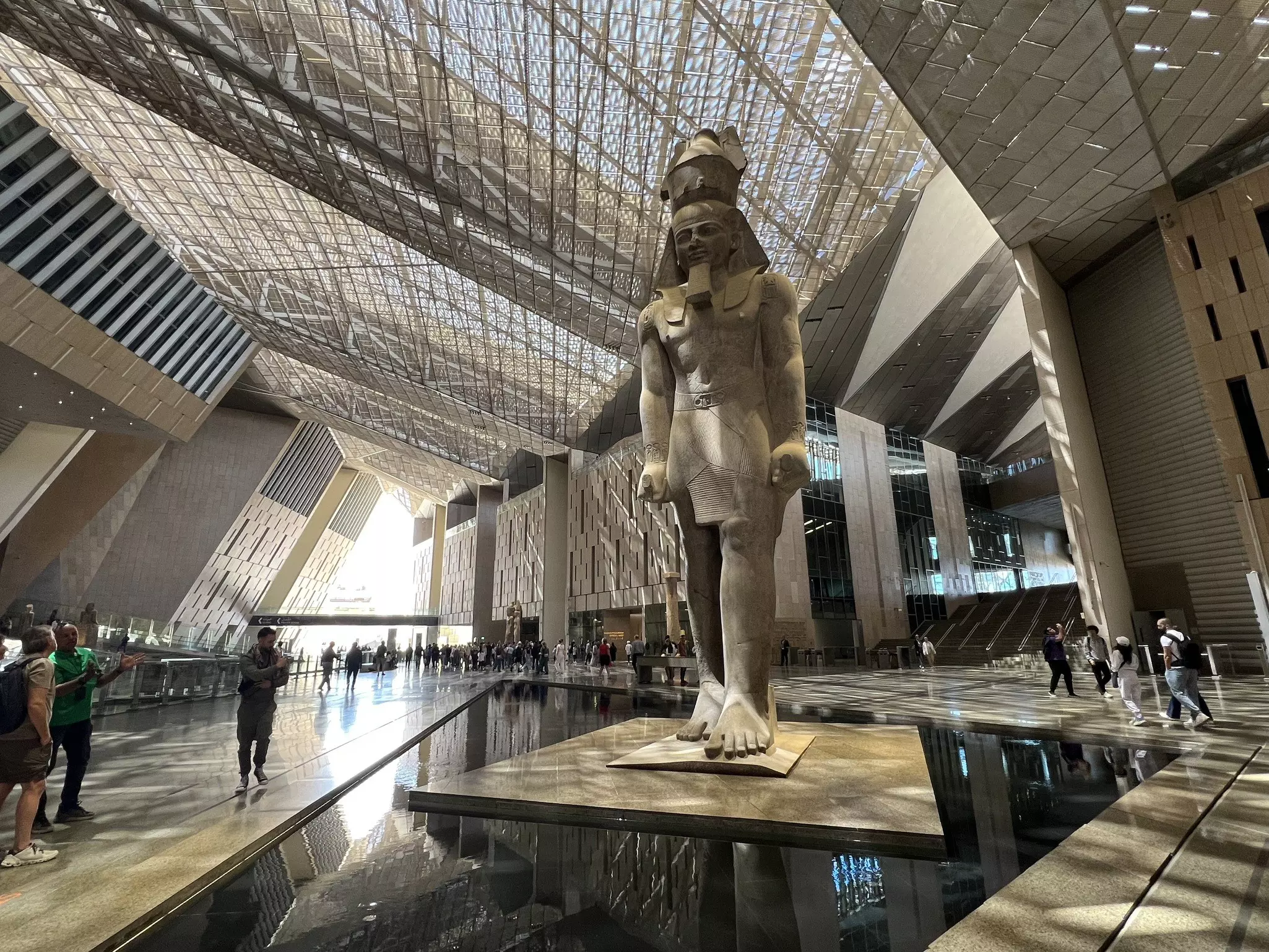
Not to be confused with the long-established (and still impressive) Egyptian Museum in downtown Cairo, the Grand Egyptian Museum represents perhaps the most anticipated cultural opening of the 21st century. One of the largest archeological museums in the world, this prestigious institution was 20 years in the making, finally opening its last galleries in late 2025.
The biggest lure of this fabulous museum is the funerary treasure of Tutankhamun, gathered together in one place for the first time. But don’t spend all your time boggling at the boy-pharaoh’s iconic funeral mask and 4000-year-old toys. Other galleries explore ancient Egyptian history in all its richness, from the symbology of the royal image to ancient Egyptian funeral traditions.
Commendably accessible to visitors with disabilities, the main galleries are split into four time periods, from 700,000 BCE to 394 CE, with displays organized around three themes: society, kingship and beliefs. The beautifully lit presentations of statues, jewelry, tomb furniture and painted reliefs have descriptions in English. Since there’s a lot to take in, allow half a day here, if not longer.
Planning tip: Before exploring on your own, it’s worth signing up for a 90-minute guided tour of the highlights with a knowledgeable English-speaking guide; book tour tickets ahead online. If you build up an appetite while exploring, there are coffee shops, ice-cream parlors and two restaurants at the bottom of the Grand Staircase.
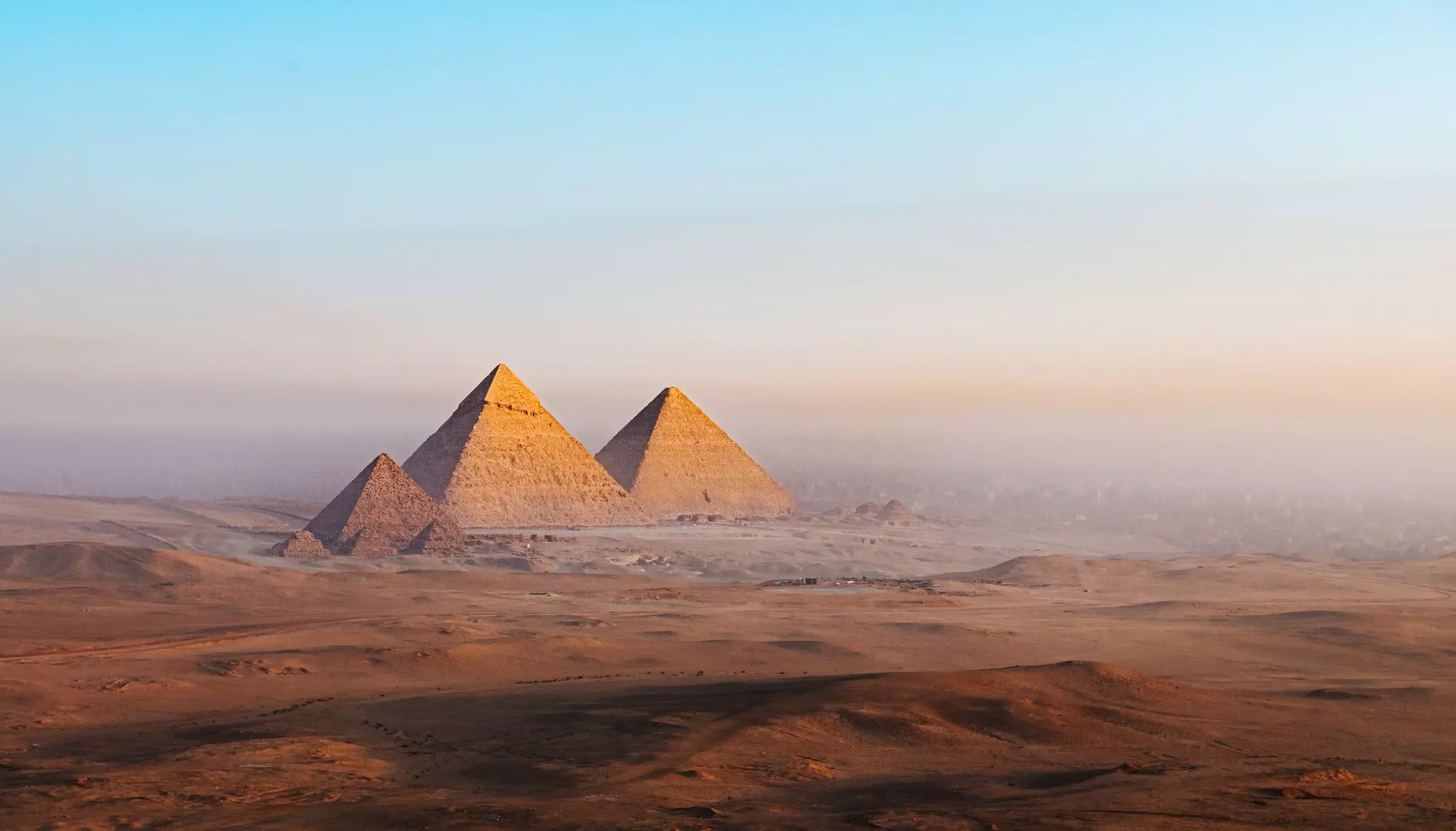
If you thought seeing the Pyramids from the flight into Cairo was impressive, you can fly even closer to these ancient wonders on a paramotoring trip (like paragliding, but with an engine). With an instructor, you’ll mount a contraption that looks like a tandem bicycle with a motor at the back and a parachute overhead, before taking off into the sky for a 15-minute whirl over the Giza Plateau.
For an adventure at ground level, several operators offer 1- or 2-hour quad-biking trips that race around the empty stretch of desert beyond the pyramid complex. Inspect your vehicle before you set off and pay at the end of the tour in case any aspect of the trip is not as described.
Planning tip: Operators only offer paramotoring trips during the winter months, usually on Fridays, Saturdays and Sundays. The 30-minute experience costs around US$200, with a 15-minute safety briefing.
Souvenirs are sold in Giza with enthusiasm, but much of what is on offer is generic or of dubious quality. For something more memorable, the two dozen artists who work at the Ramses Wissa Wassef Art Center are known for their distinctive tapestries, which depict nature and scenes from rural Egypt.
Crude imitations are standard fare in Cairo souvenir shops, but the works for sale and on display in this artisan gallery are in a completely different class – like master paintings executed in colored yarn. Stop by for a free guided tour around the workshops, then admire the finished works in the museum.
Planning tip: The Ramses Wissa Wassef Art Center is about 4km southeast of the Giza Plateau site; get here by taxi or Uber rideshare.
This article was adapted from Lonely Planet’s Egypt guidebook, published in December 2025.
Book your Egypt trip with Lonely Planet Journeys
See Egypt how it's meant to be seen
Accommodations, activities and ground transportation all taken care of, so you can focus on the fun part. Tell us what your dream trip to Egypt looks like, and our local experts will build it from scratch. Or start with one of our itineraries and make it your own.

Explore related stories