Gyeongsangbuk-do

Advertisement

Introducing Gyeongsangbuk-do

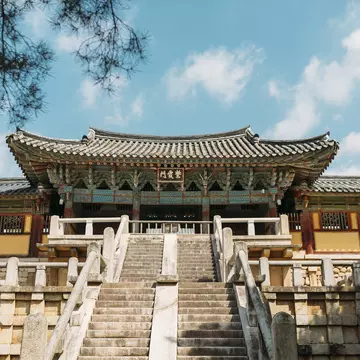
Gyeongsangbuk-do’s natural beauty is seconded only by its profusion of spectacular temples, Confucian schools, ancient pagodas, rock-carved Buddhas, teashops and tombs. Gyeongju, once the capital of the Shilla dynasty (57 BC–AD 935), is often called ‘the museum without walls’ for its historical treasures, many of which are outdoors. The oddly symmetrical ‘hills’ in the centre of town are serene, peaceful pyramids – stately reminders of the dead they still honour. Thankfully, this beautiful city was spared the ravages of bombings in the Korean War; even today it retains a 19th-century feel.

Advertisement

Come here and find treasures in all directions. Andong, in the north, offers mouthwatering mackerel, a fascinating folk village, strong soju (locally brewed vodka) and many temples as well, including the oldest wooden building in South Korea. To the south, check out Daegu’s medicinal herb market or peek at the anachronistic ‘pink light district’ that still operates despite new laws banning prostitution.

While technically in Gyeongsangbuk-do’s southern sister (Gyeongsangnam-do), Haeinsa is a must-see temple-library most easily accessed via Daegu: check out the 1000-year-old wooden tablets, preserved in a building so ahead of its time that modern science hasn’t improved it.

In the ‘Sea of Korea’, as Koreans call it, is the rugged, mist-kissed island of Ulleungdo, where fishing villages dry squid in quantities that boggle the mind. Even further east lies Dokdo (aka Takeshima), a fishing ground still disputed today.

History

This beautiful province holds many of South Korea’s oldest treasures. Whether you plan on meandering through Gyeongju’s ‘open-air museum’ or want to create your own elixir of eternal life in Daegu’s Herbal Medicine Market, you will find that the area’s historical events are more tangible here, less a part of the distant past and more a part of the present. At the centre of South Korea, this area was once the capital of the Shilla empire (57BC–935AD), and as such was a central part of Korean government and trade. During this almost 1000-year-long empire, the Shilla rulers created alliances with China to defeat Japanese threats, as well as to repel other Korean invaders. During this time Confucian laws were widely adopted and informed all aspects of Korean life including who, where, and when a person could marry. In many ways these traditions are still held by modern Koreans, who often follow Confucian rules (as well as their parents’ wishes) in deciding how to marry.

Last updated: Feb 17, 2009

Thorn Tree forum discussion

Recent posts

  1. thehelpfultraveler avatar
    October in Korea: A Great Time to Visit

    by thehelpfultraveler 24 September 2010

    Movie premiers, international dancers and kimchi, oh my! October is one of the best times of year to visit Korea. Perfect walking weather…
  2. fish04 avatar
    Re: Autumn and places in South Korea

    by fish04 20 August 2010

    Seoul, - DMZ - Seoraksan - Gyeongju would make for a nice loop around the Northern portion of the county. Seoraksan is definitely…
  3. ab1121 avatar
    South Korea- Teaching English, where to go?

    by ab1121 12 February 2010

    I am applying to teach English in South Korea for a period from 6 months to 2 years. The accommodations range from dormitory style, apartmen…

See all Thorn Tree forum discussions for Gyeongsangbuk-do

In our shop

Bags feeling light?
Coffee table looking bare?
Get your guidebooks, travel goods, even individual chapters, right here.

See all books in our shop

Hotels & Hostels

Check out all our reviewed and recommended accommodation and book online.

Find hotels & hostels

Travel Insurance

Going to South Korea? Make sure you're covered.

Get a quote

See all travel services

Advertisement