Introducing Antarctica
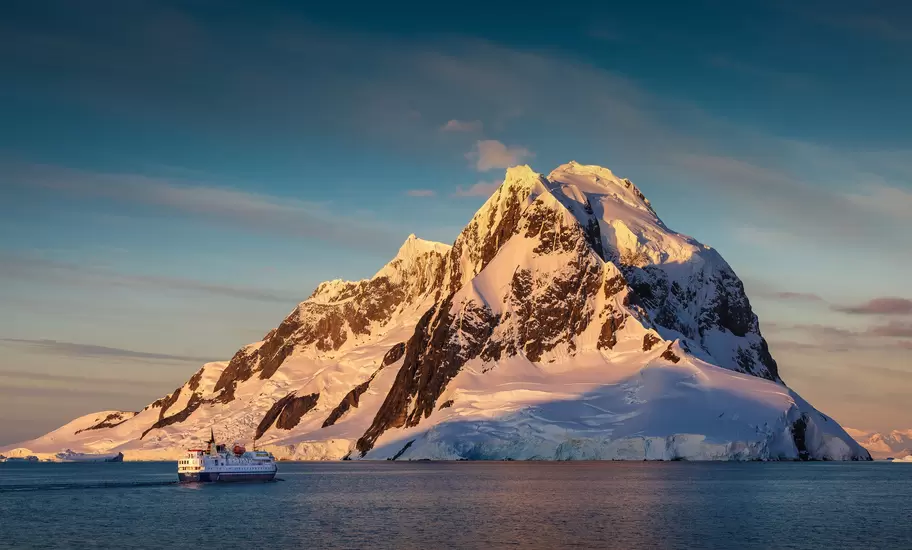
No place on earth compares to this vast white wilderness distilled to an elemental haiku: snow, ice, water, rock. Antarctica is simply stunning. The enormity of its ice shelves and mountain ranges invariably heightens feelings of humanity’s insignificance and nature’s grandeur. Antarctica’s peculiar beauty may haunt you for the rest of your days. Even the trip over, crossing the Southern Ocean is an experience – with no landmass, low-pressure systems circle clockwise unimpeded, eventually reaching incredible speeds. The Falkland Islands in the South Atlantic are often included in a trip to Antarctica
Advertisement
Because the continent has never had a native population – even today, scientists and other staff members at research stations are only temporary residents – Antarctic wildlife is still unafraid of people. Well-behaved visitors usually elicit no more than disinterested yawns from seals and penguins focused on rearing their young and evading predators. The human reaction is exactly opposite: almost all visitors to Antarctica find that their experiences here exceed their expectations.
Everyone – scientist, support worker, government official and tourist alike – who comes to this, the most isolated continent, must ‘earn’ Antarctica, either by making an often-difficult voyage or a costly flight. Ice and weather, not clocks or calendars, determine the itinerary and the timetable of all travel here.
An international treaty signed by 46 countries, representing the large majority of the world’s population, governs Antarctica. The continent, the treaty parties concur, is too large and important to belong to just one country. They further agree that Antarctica, unique among the world’s landmasses, should remain a peaceful, free and demilitarized place of international cooperation and scientific research, open to all, with a minimum of human development.
Antarctica’s most pressing issue is its environment and how best to protect it. The major impacts on the Antarctic environment are caused by people who have never even visited it. Climate change and ozone depletion are prime examples of the way human activity elsewhere affects Antarctica. But studies have also found that lead particles from gasoline combustion are blown to Antarctica as soon as one month after they leave exhaust pipes in South America, Australia and New Zealand, and pesticide residue has been found both in seabird guano and in penguin tissues. Plastic and other rubbish washes up on Antarctica’s beaches in ever-increasing amounts.
Human activity in the Antarctic is also having negative impacts. Longline fishing for Patagonian toothfish has been a twofold environmental disaster. Toothfish are caught in enormous and unsustainable numbers, with much of the catch illegal, and albatrosses in their thousands are also caught on the steel hooks, dragged down hundreds of meters and drowned – an ignoble end for such magnificent fliers.
Despite continuing concerns that oil drillers or miners will ruin Antarctica’s snowscape, the continent’s largest industry by far is tourism. While governments fret over how best to regulate tourism to minimize its impact, they’re hindered by the fact that since no one owns Antarctica, no single country can legislate behavior here. Meanwhile, tour companies police themselves, although no industry has ever been completely successful at that task, fraught as it is with conflicts of interest. For Antarctica’s sake, may the parties involved use their best judgment for the sake of safeguarding the Antarctic environment, and not just their own individual financial concerns.
Make it happen
- Go on a voyage to South Georgia and the Antarctic Peninsula
- Cruise to the magnificent South Shetland Islands
- Discover the Falkands, South Georgia and the South Orkney Islands
- Go in search of the Emperor Penguin
Last updated: Jan 20, 2012
Tips & articles
-
Believe your eyes: the world’s strangest optical illusions and mirages
10 May 2012
Can you believe your eyes? When it comes to these head-twisters, chances are you can’t. Come around the globe with...
-
Where to go in December
26 April 2012
Only one month left for travelling in 2011! Not sure where to go? See what Lonely Planet Magazine suggests:Patagonia, ArgentinaTake...
-
Top 10 things to do in 2012
19 December 2011
It’s not as if you need an excuse for travel…but if you did, here are the anniversaries, gatherings and essential...
Thorn Tree forum discussion
Recent posts
-
Re: Cheapest way to get to Antarctica?
by Rafikii 23 May 2012
THANKS A MILLION EVERYONE!!! This trip is obviously one of those big ones. trying to get onto it very early and build my return to South…
-
RE: Me and my backpack's 100 favourite places
by Peregrinef 22 May 2012
#3 We just got back from a trip to Antarctica. Yep, it is the most expensive, but it's certainly not tough. You get very well looked after…
-
RE: Me and my backpack's 100 favourite places
by updownallaround7 21 May 2012
That's pretty cool. I have a goal in mind of visiting all 7 continents before I turn 23. I'm 19 right now and have been to 2 (North…
Hotels & Hostels
Check out all our reviewed and recommended accommodation and book online.
Advertisement