Hué Sights

  1. Bao Quoc Pagoda

    Last renovated in 1957, Bao Quoc Pagoda was founded in 1670 by Giac Phong, a Buddhist monk from China. It was given its present name in 1824 by Emperor Minh Mang, who celebrated his 40th birthday here in 1830.

    Read more about Bao Quoc Pagoda

  2. Chieu Ung Pagoda

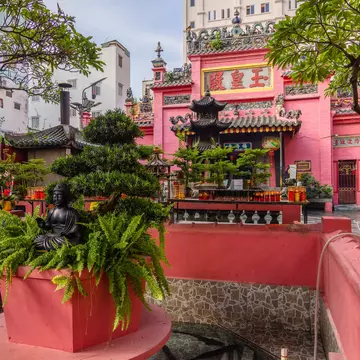
    Founded by the Hainan Chinese Congregation in the mid-19th century, Chieu Ung Pagoda was rebuilt in 1908. The pagoda's sanctuary retains its original ornamentation, which is becoming faded but has been mercifully unaffected by the third-rate modernistic renovations that have marred other such structures. The pagoda was built as a memorial to 108 Hainan merchants, who were mistaken for pirates and killed in Vietnam in 1851.

    Read more about Chieu Ung Pagoda

  3. Chua Ong Pagoda

    Founded by Hué's Fujian Chinese Congregation during the reign of Vietnamese emperor Tu Duc (1848-83), Chua Ong Pagoda was severely damaged during the Tet Offensive when a nearby ammunition ship blew up. A gold Buddha sits in a glass case opposite the main doors of the sanctuary. The left-hand altar is dedicated to the goddess of the sea, Thien Hau Thanh Mau, who is flanked by her two assistants, 1000-eyed Thien Ly Nhan and red-faced Thuan Phong Nhi, who can hear for 1000 miles.

    Read more about Chua Ong Pagoda

  4. Citadel

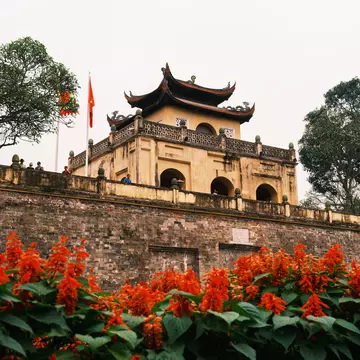
    Most of Hué's sights and a sizeable chunk of its population reside within the 2m-thick, 10km-long walls of its Citadel on the north bank of the river. Begun in 1804 on a site chosen by Emperor Gia Long's geomancers, it was originally made of earth and later strengthened with brick.

    Read more about Citadel

  5. Dien Tho Residence

    The stunning, partially ruined Dien Tho Residence (1804) once comprised the apartments and audience hall of the Queen Mothers of the Nguyen dynasty. The audience hall houses an exhibition of photos illustrating its former use, and there is a display of embroidered royal garments. Just outside is their Highnesses' enchanting pleasure pavilion, a carved wooden building set above a lily pond.

    Read more about Dien Tho Residence

  6. Dieu De National Pagoda

    The entrance to Dieu De National Pagoda, built under Emperor Thieu Tri's rule (1841-47), is along Dong Ba Canal. It is one of the city's three 'national pagodas', which were once under the direct patronage of the emperor. Dieu De is famous for its four low towers, one to either side of the gate and two flanking the sanctuary. There are bells in two of the towers; the others contain a drum and a stele dedicated to the emperor.

    Read more about Dieu De National Pagoda

  7. Emperor's Reading Room

    Behind the Royal Theatre, the two-storey Emperor's Reading Room , decorated with interesting roof mosaics, was the only part of the Forbidden Purple City to have escaped damage during the French re-occupation of Hué in 1947.

    Read more about Emperor's Reading Room

  8. Flag Tower

    At the centre of the wall facing the river, the 37m-high Flag Tower is Vietnam's tallest flagpole. Erected in 1809 and extended in 1831, it was knocked down in 1904 by a typhoon that devastated the city. It was rebuilt in 1915 only to be destroyed again in 1947. Two years later it was erected once again, in its present form. During the VC occupation in 1968, the National Liberation Front flag flew defiantly from the tower for 3½ weeks.

    Read more about Flag Tower

  9. Forbidden Purple City

    Behind the palaces, in the very centre of the Imperial Enclosure, the Forbidden Purple City is a citadel-within-a-citadel-within-a-citadel. Reserved solely for the personal use of the emperor, the only servants allowed into this compound were eunuchs who would pose no threat to the royal concubines. It was almost entirely destroyed in the wars, and a large part is now draped in green foliage. Take care as you wander around the ruins as there are some gaping holes.

    Read more about Forbidden Purple City

  10. General Museum Complex

    The General Museum Complex is housed in an exquisite building once a school for princes and the sons of high-ranking mandarins. It combines, in an odd juxtaposition, a pagoda devoted to archaeology, a small Natural History Museum and a building devoted to the 'movement of revolutionary struggle and anti-French colonialism resistance war'. There's a tank collection out front.

    Read more about General Museum Complex

  11. Advertisement

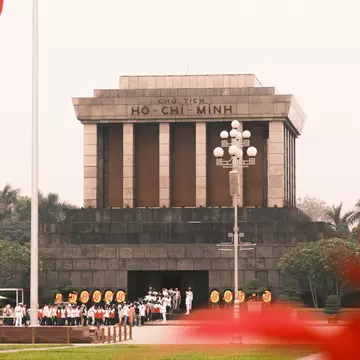
  12. Ho Chi Minh Museum

    On display at the Ho Chi Minh Museum are photographs, some of Ho Chi Minh's personal effects, and documents relating to his life and accomplishments. All have English captions.

    Read more about Ho Chi Minh Museum

  13. Hung To Mieu Temple

    A Divine Kitchen and Divine Storehouse sit either of a small walled enclosure housing the Hung To Mieu Temple. This is a restored 1951 reconstruction of the original, built in 1804 to honour Gia Long's parents. Both temples were used by the court on death anniversaries, but women (including the Empress) were strictly forbidden.

    Read more about Hung To Mieu Temple

  14. Imperial Enclosure

    Housing the emperor's residence and the main buildings of state, the Imperial Enclosure is a citadel-within-a-citadel, with 6m-high walls that are 2.5km in length. The enclosure was badly bombed during the French and American wars, and a large part of it is still park-like ruins. Restoration of the least damaged sections and the complete rebuilding of others is an ongoing project.

    Read more about Imperial Enclosure

  15. Museum of Royal Fine Arts

    The beautiful hall that houses the Museum of Royal Fine Arts was built in 1845 and restored when the museum was founded in 1923. The walls are inscribed with poems written in nom (Vietnamese script). The most precious artefacts were lost during the American War, but the ceramics, furniture and royal clothing that remain are well worth the visit. The outside courtyard has interesting ceremonial cannons, stone court sculptures and large brass bells and vats.

    Read more about Museum of Royal Fine Arts

  16. National School

    One of the most famous secondary schools in Vietnam, the National School was founded in 1896 and run by Ngo Dinh Kha, the father of South Vietnamese president Ngo Dinh Diem. Many of the school's pupils later rose to prominence in both North and South Vietnam. One of them was General Vo Nguyen Giap, strategist of the Viet Minh victory at Dien Bien Phu and North Vietnam's long-serving deputy premier, defence minister and commander-in-chief.

    Read more about National School

  17. Ngo Mon Gate

    The principal entrance to the Imperial Enclosure is Ngo Mon Gate, which faces the Flag Tower. The central passageway with its yellow doors was reserved for the use of the emperor, as was the bridge across the lotus pond. Others had to use the gates to either side and the paths around the pond.

    Read more about Ngo Mon Gate

  18. Ngu Phung

    On top of the Ngo Mon Gate is Ngu Phung, where the emperor appeared on important occasions, most notably for the promulgation of the lunar calendar. On 30 August 1945, the Nguyen dynasty ended here when Emperor Bao Dai abdicated to a delegation sent by Ho Chi Minh's Provisional Revolutionary Government.

    Read more about Ngu Phung

  19. Phung Tien Temple

    Behind To Mieu, Phung Tien Temple still lies in ruins. It once served a similar purpose to the former, although women were permitted to worship here.

    Read more about Phung Tien Temple

  20. Royal Theatre

    The Royal Theatre, begun in 1826 and later home to the National Conservatory of Music, has been rebuilt on the former foundations. Cultural performances are held here daily at , , and .

    Read more about Royal Theatre

  21. Thai Hoa Palace

    Built in 1803, Thai Hoa Palace is a spacious hall with an ornate timber roof supported by 80 carved and lacquered columns. It was used for the emperor's official receptions and other important court ceremonies, such as anniversaries and coronations. During state occasions, the emperor sat on his elevated throne and his mandarins paid homage.

    Read more about Thai Hoa Palace

  22. Advertisement

  23. To Mieu Temple

    On the other side of the courtyard is the long, low, red and gold To Mieu Temple itself. Inside are shrines to each of the emperors, topped by their photos. Under the French only the seven liked by the colonial power were thus honoured - Ham Nghi, Thanh Thai and Duy Tan were only added in 1959. The temple is flanked on the right by a small robing house and on the left by a shrine to a soil god.

    Read more about To Mieu Temple