Showing 1-20 of 20 results
-
Afrosiab Museum
At a 2.2-sq-km site called Afrosiab, northeast of the bazaar, are excavations of Marakanda (early Samarkand) more or less abandoned to the elements. The Afrosiab Museum leads the visitor through the 11 layers of civilisation that is Afrosiab. From the museum, walk 1km north to the current excavation site where you may find weather-beaten archaeologists picking coins out of the dust.
-
Bibi-Khanym Mausoleum
Across Tashkent kochasi is Bibi-Khanym's own compact 14th-century mausoleum.
-
Bibi-Khanym Mosque
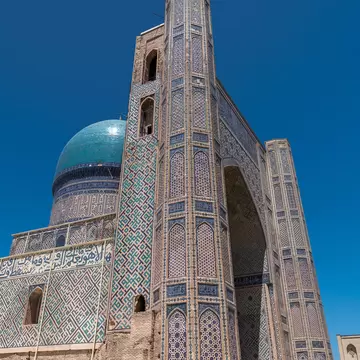
The enormous congregational Bibi-Khanym Mosque, northeast of the Registan, was finished shortly before Timur's death and must have been the jewel of his empire. Once one of the Islamic world's biggest mosques (the main gate alone was 35m high), it pushed construction techniques to the limit. Slowly crumbling over the years, it finally collapsed in an earthquake in 1897.
-
Gagarin Monument
Out by the Uzbekistan Airways office, the Gagarin Monument will thrill lovers of Soviet iconography. It looks like it was plucked out of a giant cereal box.
-
Guri Amir Mausoleum
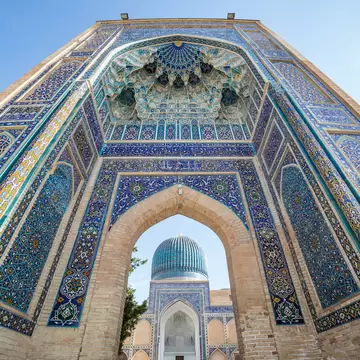
Timur, two sons and two grandsons, including Ulugbek, lie beneath the surprisingly modest Guri Amir Mausoleum and its trademark fluted azure dome. Timur had built a simple crypt for himself at Shakhrisabz, and had this one built in 1404 for his grandson and proposed heir, Mohammed Sultan, who had died the previous year.
-
Hazrat-Hizr Mosque
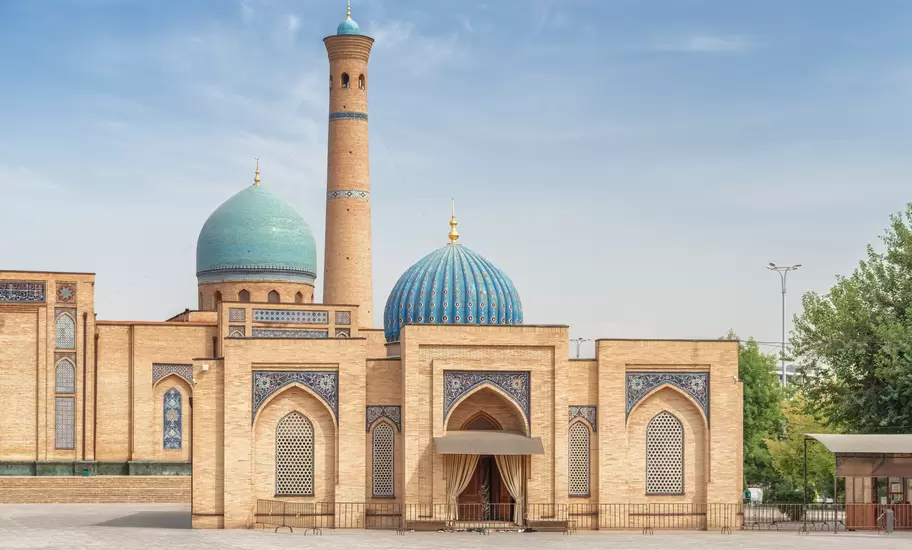
Across the intersection from the bazaar, the Hazrat-Hizr Mosque occupies a hill on the fringes of Afrosiab. The 8th-century mosque that once stood here was burnt to the ground by Jenghiz Khan in the 13th century and was not rebuilt until 1854. In the 1990s it was lovingly restored by a wealthy Bukharan and today is Samarkand's most beautiful mosque, with a fine domed interior and views of Bibi-Khanym, Shah-i-Zinda and Afrosiab from the minaret. The ribbed aivan ceiling drips colour.
-
Hodja-Nisbaddor Mosque
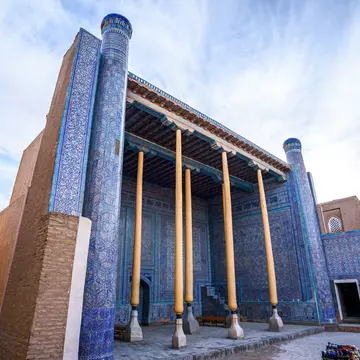
South of the Registan on Suzangaran is the fine Hodja-Nisbaddor Mosque, a small 19th-century summer mosque with an open porch, tall carved columns and brightly restored ceiling.
-
International Museum of Peace and Solidarity
The quirky International Museum of Peace and Solidarity used to occupy a building in central Navoi Park, but the building was demolished in 2006 to pave the way for park renovations. The museum should have a new home by the time you read this. Curator Anatoly Ionesov has a remarkable collection of disarmament and environmental memorabilia and has collected thousands of signatures, including some very famous ones, in the name of peace.
Read more about International Museum of Peace and Solidarity
-
Ishratkhana Mausoleum
If you prefer your ruins really ruined, it's worth the slog out to the Tomb Raider-style, 15th-century Ishratkhana Mausoleum. With a preponderance of pigeons and an eerie crypt in the basement, this is the place to film your horror movie.
-
Khodja Abdi Darun Mausoleum
Across the street from the Ishratkhana Mausoleum is the Khodja Abdi Darun Mausoleum, which shares a tranquil, shady courtyard with a mosque and a hauz (artificial stone pools). To get here take marshrutka 22 or 32.
-
Advertisement
-
Makhdumi Khorezm Mosque
A recently restored gem is the Makhdumi Khorezm Mosque, 100m east of the Registan. If it's locked ask the caretaker to let you in for a glimpse at the lush ceiling tilework.
-
Registan
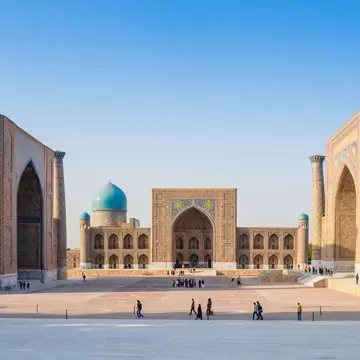
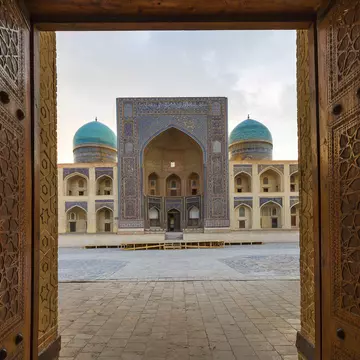
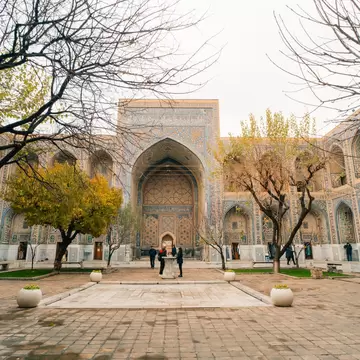
This ensemble of majestic, tilting medressas - a near-overload of majolica, azure mosaics and vast, well-proportioned spaces - is the centrepiece of the city, and one of the most awesome single sights in Central Asia. The Registan, which translates to 'Sandy Place' in Tajik, was medieval Samarkand's commercial centre and the plaza was probably a wall-to-wall bazaar.
-
Rukhobod Mausoleum
Between Guri Amir and the main road is Rukhobod Mausoleum, dated 1380 and possibly the city's oldest surviving monument. It now serves as a souvenir and craft shop.
-
Shah-i-Zinda
Its shiny restoration in 2005 has been called an abomination by some, but the Shah-i-Zinda remains Samarkand's most moving sight. The name, which means 'Tomb of the Living King', refers to its original, innermost and holiest shrine - a complex of cool, quiet rooms around what is probably the grave of Qusam ibn-Abbas, a cousin of the Prophet Mohammed who is said to have brought Islam to this area in the 7th century.
-
Sher Dor (Lion) Medressa
The entrance portal of the Sher Dor (Lion) Medressa, opposite Ulugbek's and finished in 1636, is decorated with roaring felines that look like tigers but are meant to be lions, flouting Islamic prohibitions against the depiction of live animals. It took 17 years to build but still hasn't held up as well as the Ulugbek Medressa, built in just three years.
-
State Art Museum
Samarkand's largest museum walks you through the history of art in the region, starting with archaeological finds from Afrosiab and the Timurid era. The highlight is probably the decorative and applied arts exhibits upstairs, which include an impressive collection of old carpets - including some splendid 200-year-old Afghan and Persian specimens - prayer rugs, nuptial sheets and suzani .
-
Tilla-Kari (Gold-Covered) Medressa
In between Ulugbek Medressa and the Sher Dor (Lion) Medressa is the Tilla-Kari (Gold-Covered) Medressa, completed in 1660, with a pleasant, gardenlike courtyard. The highlight here is the mosque, intricately decorated with gold to symbolize Samarkand's wealth at the time it was built. The mosque's delicate ceiling, oozing gold leaf, is flat but its tapered design makes it look domed from the inside.
-
Tomb of the Old Testament Prophet Daniel
The restored Tomb of the Old Testament Prophet Daniel is 400m northeast of the Afrosiab Museum, on the banks of the Siob River (turn left off Tashkent kochasi just before the bridge). The building is a long, low structure topped with five domes, containing an 18m sarcophagus - legend has it that Daniel's body grows by half an inch a year and thus the sarcophagus has to be enlarged.
-
Ulugbek Medressa
Ulugbek Medressa on the west side is the original medressa, finished in 1420 under Ulugbek (who is said to have taught mathematics there; other subjects included theology, astronomy and philosophy). Beneath the little corner domes were lecture halls, and at the rear a large mosque. About 100 students lived in the two storeys of dormitory cells here.
-
Ulugbek's Observatory
Continuing north you'll encounter the remains of Ulugbek's Observatory, one of the great archaeological finds of the 20th century. Ulugbek was probably more famous as an astronomer than as a ruler. His 30m astrolab, designed to observe star positions, was part of a three-storey observatory he built in the 1420s. All that remains is the instrument's curved track, unearthed in 1908.
-
Advertisement
Showing 1-20 of 20 results