go to content go to search box go to global site navigation

Syria

Sights in Syria

‹ Prev

of 6

  1. A

    Khan As'ad Pasha

    Just beyond the hammam is the grand entrance to Khan As'ad Pasha, arguably the finest and most ambitious piece of architecture in the Old City - a cathedral among khans. Built in 1752 under the patronage of As'ad Pasha al-Azem, it encompasses a vast space achieved through a beautiful arrangement of eight small domes around a larger circular aperture, allowing light to stream in above a circular pool. The domes are supported on four colossal grey-and-white piers that splay into elegant arches.

    Beyond the khan, the souq intersects with Straight St.

    reviewed

  2. B

    Khaled ibn al-Walid Mosque

    Built as recently as the first decade of the 20th century, Homs' best-known monument, Khaled ibn al-Walid Mosque , is an attractive example of a Turkish-style mosque. The black-and-white Mamluk-style stone banding in the courtyard is particularly striking. Inside the prayer hall, over in one corner, is the domed mausoleum of Khaled ibn al-Walid, the military strategist and hero who conquered Syria for Islam in AD 636.

    You can enter the mosque if dressed modestly. Women have to borrow a 'yishmak' (as they call the abeyya, or woman's cloak, here), cover their hair and also must enter through the small side door on the right to see the marble tomb. Do not enter during…

    reviewed

  3. C

    Church of the Girdle of Our Lady

    From the Christian Quarter along Sharia Abi al-Hawl, continue due east, straight over the crossroad, until you see a small gateway topped by a cross - this leads through a grey stone wall to the Church of the Girdle of Our Lady . In 1953 the patriarch of Antioch, Ignatius Aphraim, declared a delicate strip of woven wool and silk, found in the church six months earlier, to be a girdle worn by the Virgin Mary.

    The story is that it had survived intact since the ascension of Mary into heaven, preserved in one container or another in a church on this spot. The church is an attractive little grey-stone building with a red pantile roof, and is still an active centre for Syrian…

    reviewed

  4. Souq

    A few steps from the An-Nuri Mosque is Homs' restored old Souq, which buzzes in the evenings when the whole city seemingly comes out to shop. With its grey stones, vaulted ceilings and elegant white lamp posts, it's one of Syria's most attractive souqs. The artisans, carpenters, cobblers, metal-workers and knife-sharpeners sitting cross-legged on the floors of their workshops make it all the more fascinating, and it's an easy place to while away a couple of hours.

    Great buys include gold, sheesha pipes, spices and clothes.

    reviewed

  5. D

    Azze Hrawe

    From the Church of the Girdle of Our Lady, follow the road that heads off to the north, taking the first right for the Azze Hrawe, a Mamluk-era residence of impressive size. It was being restored at the time of research and should soon open to the public as a National Folklore Museum. There's a beautiful big courtyard with a fountain and a liwan (summer room) featuring exquisite carved-wood decoration. Don't hesitate to knock on the door if it's closed; nobody minds you snooping around.

    reviewed

  6. E

    Chapel of Ananias

    In the far northeast corner of the Christian quarter, the Chapel of Ananias is housed in the cellar that was reputedly the house of Ananias, an early Christian disciple. To find the chapel, take Sharia Hanania, the last street on the left before Bab ash-Sharqi; it's at the far north end in a crypt below the house.

    Sharia Hanania is a lovely little street that's home to souvenir and antique shops, restaurants and bars.

    reviewed

  7. F

    Army Museum

    The Army Museum has a fascinating collection of military hardware from the Bronze Age to the near present. Exhibits range from flint arrowheads to a pile of the twisted remains of planes shot down in the 1973 war with Israel.

    reviewed

  8. G

    National Museum

    The most important of Syria's museums is the National Museum, and you'll get more out of Syria's archaeological sites if you take in the museum before and after your visits to the sites.

    Purchase your ticket at the gate then stroll through the shady sculpture garden, best appreciated after seeing the museum proper.

    Enter through the main gate of Qasr al-Heir al-Gharbi, a desert palace west of Palmyra dating from AD 688, the time of the Umayyad caliph Hisham. The gate was transported to Damascus stone by stone and reconstructed as part of the museum façade.

    Within the museum, the exhibits are presented thematically and grouped into preclassical, classical and Islamic…

    reviewed

  9. H

    National Museum

    Aleppo's National Museum , in the middle of town opposite the tourist office, is rather nondescript apart from the extraordinary colonnade of giant granite figures that fronts the entrance. Standing on the backs of stylised creatures are wide-eyed characters, replicas of pillars that once supported the 9th-century-BC temple-palace complex at Tell Halaf, near the border with Turkey in the northeast of the country.

    From the entrance hall the exhibits were displayed chronologically in an anticlockwise direction, but at the time of research the museum was undergoing extensive 'renovation', which was being conducted with scant concern for safety and little respect for the…

    reviewed

  10. I

    Umayyad Mosque

    One of Islam's most important buildings (its first great mosque), the magnificent Umayyad Mosque is Syria's most important religious structure. Its architectural and decorative splendour ranks with Jerusalem's Dome of the Rock, while in sanctity it's second only to the holy mosques of Mecca and Medina. It possesses a history unequalled by all three. The northern part of the mosque is an expansive, open Courtyard with a white limestone floor, flanked on three sides by a two-storey arched arcade. The fourth side is the façade of the prayer hall, dominated by a central section covered with enchanting, shimmering, golden mosaics.

    Worship on this site dates back 3000 years to…

    reviewed

  11. Advertisement

  12. Citadel

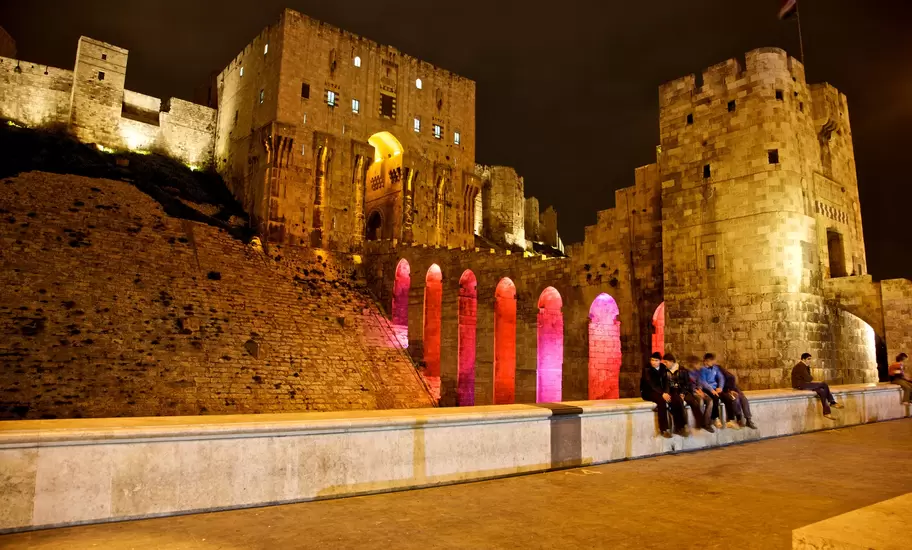
    Rising up on a high mound at the eastern end of the souq, the Citadel is Aleppo's most famous and most spectacular landmark. Dominating the city, it has long been the heart of its defences.

    The mound it stands upon is not, as it first seems, artificial: it's a natural feature that originally served as a place of worship, as evidenced by two basalt lions unearthed and identified as belonging to a 10th-century-BC temple.

    It's thought the first fortifications were erected at the time of the Seleucids (364-333 BC), but everything seen today dates from much later. The Citadel served as a power base for the Muslims during the 12th-century Crusades, when the moat, 20m deep and…

    reviewed

  13. J

    Azem Palace

    The Azem Palace was built in 1749 by the governor of Damascus, As'ad Pasha al-Azem. It's fashioned in typical Damascene style of striped stonework, achieved by alternating layers of black basalt and limestone. The rooms of the modest palace are magnificent, decorated with inlaid tile work and the most exquisite painted ceilings.

    Azem Palace comprises a complex of splendid buildings, courtyards and gardens that were built between 1749 and 1752 as a private residence for the governor of Damascus, As'ad Pasha al-Azem. It remained the Azem residence until the beginning of the 20th century, when the family moved outside the Old City and the house was sold to the French to…

    reviewed

  14. K

    Great Mosque

    On the northern edge of the souq is the Great Mosque or Umayyad Mosque, the younger sibling (by 10 years) of the Umayyad Mosque in Damascus. It's also known as Al-Jamaa Zacharia after Prophet Zacharia, the father of St John the Baptist. Started by Caliph Al-Walid (r AD 705-15), who earlier founded the Umayyad Mosque in Damascus, the work was completed by his successor Caliph Suleiman (r AD 715-17).

    However, aside from the plan, nothing survives of the original mosque as the building has been destroyed and rebuilt countless times. Miraculously, the mosque's freestanding minaret has managed to survive in exactly its original form, as built from 1090 to 1092, although it…

    reviewed

  15. L

    Al-Mohammediyya

    Hama's most distinctive attractions are its norias, wooden water wheels up to 20m in diameter (the equivalent in height of a four- or five-storey building), which have graced the town for centuries. The land around the Orontes is considerably higher than the river itself, which is deeply incised into its rocky bed, making it hard to irrigate. The norias were constructed to scoop water from the river and deposit it into aqueducts, which then channelled it to nearby fields and gardens.

    There have been norias in Hama since at least the 5th century AD, as attested by a mosaic displayed in Hama's new museum, but the wheels seen today are the design of the 13th-centruy…

    reviewed

  16. M

    Great Colonnade

    The spine of ancient Palmyra was a stately colonnaded avenue stretching between the city's main funerary temple in the west and the Temple of Bel in the east, and covering a distance of almost 1km. Unlike the typical Roman model, Palmyra's main avenue was far from straight, pivoting decisively at two points - a result of piecemeal growth and improvisation.

    Where the modern asphalted road slices across the ancient way is an imposing monumental arch ( M04D2). Dating from the reign of Septimius Severus, when Palmyra was at its peak, the construction is actually two arches, joined like a hinge to swing the street through a 30-degree turn, aiming it at the Temple of Bel.

    The…

    reviewed

  17. N

    Palmyra Museum

    Only the keenest of archaeologists would benefit from a visit to Palmyra's modest museum. With its poor labelling, it adds little to the experience of Palmyra. There are a few highlights, however, including a large-scale model of the Temple of Bel that gives a good impression of how the complex would have looked in its original state, and some fascinating friezes depicting camel trains and cargo ships, attesting to the importance trade played in the wealth of Palmyra.

    There are some dynamic mosaics found in nobles' houses east of the Temple of Bel, including one representing a scene from the Iliad in which Ulysses discovers Achilles disguised in women's clothes, concealed…

    reviewed

  18. Sayyida Zeinab Mosque

    The splendid Iranian-built Sayyida Zeinab Mosque on the site of the burial place of Sayyida Zeinab, granddaughter of Mohammed, is about 10km south of the city centre, in a neighbourhood that is popular with Iranian pilgrims and is now home to most of the city's Iraqi refugees. Stylistically, the mosque is similar to that of Sayyida Ruqqaya in the Old City, with a glistening gold onion-shaped dome, intricately decorated blue tiles covering its façade and two freestanding minarets.

    Women will have to don a cloak, available at the entrance, before entering, and men should wear trousers and a long-sleeved shirt. The main entrances to the sanctuary are on the northern and…

    reviewed

  19. Central Norias

    Hama's most distinctive attractions are its norias, wooden water wheels up to 20m in diameter (the equivalent in height of a four- or five-storey building), which have graced the town for centuries. The land around the Orontes is considerably higher than the river itself, which is deeply incised into its rocky bed, making it hard to irrigate. The norias were constructed to scoop water from the river and deposit it into aqueducts, which then channelled it to nearby fields and gardens.

    There have been norias in Hama since at least the 5th century AD, as attested by a mosaic displayed in Hama's new museum, but the wheels seen today are the design of the 13th-centruy…

    reviewed

  20. Krak des Chevaliers (Qala'at al-Hosn)

    Author Paul Theroux described Krak des Chevaliers as epitomising the dream castle of childhood fantasies. TE Lawrence simply called it 'the finest castle in the world'. Trust them. This remarkably well-preserved Crusader castle looks almost exactly as it would have 800 years ago.

    Guarding the only major pass between Antakya in Turkey and Beirut in Lebanon, it was built and expanded between 1150 and 1250, and eventually housed a garrison of 2000. The castle held out against several attacks, but was lost to the Mamluk Sultan Beybar in 1271.

    The castle has two parts: an outside wall with 13 towers and an inside wall and keep. The two are separated by a moat which was used to…

    reviewed

  21. O

    Takiyya as-Süleimaniyya

    Lying immediately east of the National Museum, Takiyya as-Süleimaniyya was built over six years, beginning in 1554, to a design by the Ottoman Empire's most brilliant architect, Sinan. A favourite of Sultan Süleyman the Magnificent, Sinan would later create the splendid Süleymaniye Mosque that dominates Istanbul's skyline.

    The Takiyya (an Ottoman term for a Sufi hostel) is a more modest affair than the Istanbul mosque, blending local Syrian styles (the alternating Mamluk-era black-and-white banding and honeycomb-style stonework over the main entrance) with typically Turkish features (the high central dome and pencil-shaped minarets). It has two parts: the mosque to the…

    reviewed

  22. Advertisement

  23. Souq al-Hamidiyya

    Just to the south of the citadel, Souq al-Hamidiyya is the long, covered market that leads into the heart of the Old City. A cross between a Parisian passage, a department store and a Middle Eastern bazaar, its main thoroughfare is lined with clothes emporiums and handicrafts shops, while its narrow side streets are crowded with stalls selling everything from cheap shoes to kids' toys.

    A vault of corrugated-iron roofing blocks all but a few torch-beam-like shafts of sunlight, admitted through bullet holes punctured by the machine-gun fire of French planes during the nationalist rebellion of 1925.

    Although the street dates back to Roman times, its present form is a product…

    reviewed

  24. Souq Saroujah

    A charming, laid-back neighbourhood of narrow alleys lined with small shops and punctuated by medieval tombs and mosques, Souq Saroujah is a fascinating place for a stroll.

    In medieval times the areas immediately outside of the city walls were developed as burial places for the dead; you can still see this today, with large areas of cemeteries lying to the south of the old cities of both Damascus and Aleppo. Occasionally, however, the needs of the living would overwhelm those of the dead. Such was the case with the area now known as Souq Saroujah. During the Ayyubid era the fields just north of the Barada River became a favoured location for the tombs and mausoleums of…

    reviewed

  25. P

    Tower of Elahbel

    Further west of the Towers of Yemliko (a group of towers constructed as multistorey burial chambers), deeper into the hills, are plenty more funerary towers, some totally dilapidated, others relatively complete. By far the best preserved is the Tower of Elahbel, which is situated about 500m west of the Yemliko group. Built in AD 103, it has four storeys and could purportedly accommodate up to 300 sarcophagi. It's possible to ascend an internal staircase to visit the upper storey tomb chambers and to get out onto the roof.

    Also here is the chamber that formerly housed the Hypogeum of Yarhai, dismantled and reconstructed in the National Museum.To visit Elahbel it's…

    reviewed

  26. Hypogeum of the Three Brothers

    In addition to the funerary towers, Palmyra boasts a second, later type of tomb, the hypogeum, which was an underground burial chamber. As with the towers, this chamber was filled with loculi fitted with stone carved seals. The best of the 50 or more hypogea that have been discovered and excavated, apart from the Hypogeum of Yarhai, is the Hypogeum of the Three Brothers , which lies just southwest of the Palmyra Cham Palace hotel.

    The tomb dates from AD 160 to AD 91. It is very modest in size but contains some beautiful frescoes, including portraits of the three brothers in oval frames. There are also three large sarcophagi topped by figures reclining on couches. You'll…

    reviewed

  27. Qala'at ibn Maan

    To the west of the ruins perched high on a hilltop, Qala'at ibn Maan is most notable as the prime viewing spot for overlooking the ruins of Palmyra. The castle is said to have been built in the 17th century by Fakhreddine (Fakhr ad-Din al-Maan II), the Lebanese warlord who challenged the Ottomans for control of the Syrian desert. However, it's also possible that some sort of fortifications existed up here well before then.

    The castle is surrounded by a moat, and a footbridge allows access to the rooms and various levels within. However, it's not necessary to enter the castle to enjoy the views. The best time to go up is in the late afternoon, with the sun to the west,…

    reviewed