Museum sights in Barcelona
-
A
Fundació Joan Miró
Joan Miró, the city’s best-known 20th-century artistic progeny, bequeathed this art foundation to his hometown in 1971. Its light-filled buildings, designed by close friend and architect Josep Lluís Sert (who also built Miró’s Mallorca studios), are crammed with seminal works, from Miró’s earliest timid sketches to paintings from his last years.
Sert's shimmering white temple to the art of one of the stars of the 20th-century Spanish firmament is considered one of the world's most outstanding museum buildings; the architect designed it after spending much of Franco's dictatorship years in the US, as the head of the School of Design at Harvard University. The…
reviewed
-
B
Museu del Futbol Club Barcelona
One of Barcelona's most visited museums is the Museu del Futbol Club Barcelona, next to the club's giant Camp Nou stadium. The museum, renovated in 2010, provides a high-tech view into the club, with massive touch screens allowing visitors to explore arcane aspects of the legendary team. The best bits of the museum itself are the photo section, the goal videos and the views out over the stadium. You can admire the (in at least one case literally) golden boots of great goalscorers of the past and learn about the greats who have played for Barça over the years, including Maradona, Ronaldinho, Kubala and many others.
reviewed
-
C
Museu Picasso
The setting alone, in five contiguous medieval stone mansions, makes the Museu Picasso unique (and worth the probable queues). The pretty courtyards, galleries and staircases preserved in the first three of these buildings are as delightful as the collection inside.
While the collection concentrates on the artist’s formative years – sometimes disappointing for those hoping for a feast of his better-known later works (they had better head for Paris) – there is enough material from subsequent periods to give you a thorough impression of the man’s versatility and genius. Above all, you come away feeling that Picasso was the true original, always one step ahead of himself…
reviewed
-
D
Museu d'Història de Barcelona
One of Barcelona's most fascinating museums takes you back through the centuries to the very foundations of Roman Barcino. You'll stroll over ruins of the old streets, sewers, laundries and wine- and fish-making factories that flourished here following the town's funding by Emperor Augustus around 10 BC. Equally impressive is the building itself, which was once part of the Palau Reial Major (Grand Royal Palace) on Plaça del Rei (King’s Sq, the former palace’s courtyard), among the key locations of medieval princely power in Barcelona.The square is frequently the scene of organised or impromptu concerts and is one of the most atmospheric corners of the medieval city.
reviewed
-
E
Museu Nacional d’Art de Catalunya
From across the city, the bombastic neobaroque silhouette of the Palau Nacional can be seen on the slopes of Montjuïc. Built for the 1929 World Exhibition and restored in 2005, it houses a vast collection of mostly Catalan art spanning the early Middle Ages to the early 20th century. The high point is the collection of extraordinary Romanesque frescoes.
This building has come to be one of the city’s prime symbols of the region’s separate, Catalan identity, but the fact that it was constructed under the centralist dictatorship of Miguel Primo de Rivera, lends a whiff of irony.
The real highlight here is the Romanesque art section, considered the most important…
reviewed
-
F
Museu Marítim
Venice had its Arsenal and Barcelona the Reials Drassanes (Royal Shipyards), from which Don Juan of Austria’s flagship galley was launched to lead a joint Spanish-Venetian fleet into the momentous Battle of Lepanto against the Turks in 1571.
These mighty Gothic shipyards are not as extensive as their Venetian counterparts but they’re an extraordinary piece of civilian architecture nonetheless. Today the broad arches shelter the Museu Marítim, the city’s seafaring-history museum and one of the most fascinating museums in town.
The shipyards were, in their heyday, among the greatest in Europe. Begun in the 13th century and completed by 1378, the long, arched bays (the…
reviewed
-
G
Museu de la Música
Some 500 instruments (less than a third of those held) are on show in this museum, housed on the 2nd floor of the administration building in L’Auditori, the city’s main classical-music concert hall.
Instruments range from a 17th-century baroque guitar through to lutes (look out for the many-stringed 1641 archilute from Venice), violins, Japanese kotos, sitars from India, eight organs (some dating from the 18th century), pianos, a varied collection of drums and other percussion instruments from across Spain and beyond, along with all sorts of phonographs and gramophones. There are some odd pieces indeed, like the buccèn, a snake-head-adorned brass instrument.
Much of…
reviewed
-
H
Museu de les Arts Decoratives, Palau Reial de Pedralbes
The Museu de les Arts Decoratives in Palau Reial de Pedralbes brings together an eclectic assortment of furnishings, ornaments and knick-knacks dating as far back as the Romanesque period. The plush and somewhat stuffy elegance of Empire- and Isabelline-style divans can be neatly compared with some of the more tasteless ideas to emerge on the subject of seating in the 1970s. It is planned eventually to house these collections in a brand-new design museum in Plaça de les Glòries Catalanes. When this will happen is open to speculation and, in the meantime, some of the collection will get a new temporary home in what was until 2008 the Museu Tèxtil i d’Indumentària in…
reviewed
-
I
Museu Barbier-Mueller d'Art Pre-Colombí
The wonderfully illuminated artefacts inside the medieval Palau Nadal are part of the treasure trove of pre-Columbian art collected by Swiss businessman Josef Mueller (who died in 1977) and his son-in-law Jean-Paul Barbier, who directs the Musée Barbier-Mueller in Geneva. Together, the two museums form one of the most prestigious collections of such art in the world.
In blacked-out rooms, the beautifully spotlit artefacts stand out as if on stage. South American gold jewellery introduces the collection, followed by rooms containing ceramics, jewellery, statues, textiles and other objects. Every year or two, the composition of the exhibition is altered, with pieces moved…
reviewed
-
J
Museu de Ceràmica
Museu de Ceràmica, in the Palau Reial de Pedralbes, has a good collection of Spanish ceramics from the 10th to 19th centuries, including work by Picasso and Miró. Spain inherited from the Muslims, and then further refined, a strong tradition in ceramics – here you can compare some exquisite work (tiles, porcelain tableware and the like) from some of the greatest centres of pottery production across Spain, including Talavera de la Reina in Castilla-La Mancha, Manises and Paterna in Valencia, and Teruel in Aragón.
reviewed
Advertisement
-
K
Museu de Ceràmica, Palau Reial de Pedralbes
The palace houses two museums. The Museu de Ceràmica has a good collection of Spanish ceramics from the 13th to 19th centuries, including work by Picasso and Miró. Spain inherited from the Muslims, and then further refined, a strong tradition in ceramics – here you can compare some exquisite work (tiles, porcelain tableware and the like) from some of the greatest centres of pottery production across Spain, including Talavera de la Reina in Castile, Manises and Paterna in Valencia, and Teruel in Aragón. Upstairs is a display of fanciful modern ceramics from the 20th century – here they have ceased to be a tool with aesthetic value and are purely decorative.
reviewed
-
L
Museu d’Història de la Immigració de Catalunya
The Museu d’Història de la Immigració de Catalunya is dedicated to the history of immigration in Catalonia. The star piece of this museum is a wagon of the train known as El Sevillano, which in the 1950s trundled between Andalucía and Catalonia, jammed with migrants on an all-stops trip that often lasted more than 30 hours! The one-room exhibition in the former country house, Can Serra (now surrounded by light industry, ring roads and warehouses), contains a display of photos, text (in Catalan) and various documents and objects that recall the history of immigration to Catalonia from the 19th century on. There’s also an engaging video with images of migrant life…
reviewed
-
M
Museu Frederic Marès
One of the wildest collections of historical curios lies inside this vast medieval complex, once part of the royal palace of the counts of Barcelona. A rather worn coat of arms on the wall indicates that it was also, for a while, the seat of the Spanish Inquisition in Barcelona. Frederic Marès i Deulovol (1893-1991) was a rich sculptor, traveller and obsessive collector. He specialised in medieval Spanish sculpture, huge quantities of which are displayed in the basement and on the ground and 1st floors – including some lovely polychrome wooden sculptures of the Crucifixion and the Virgin. Among the most eye-catching pieces is a reconstructed Romanesque doorway with four…
reviewed
-
N
Sitges Museums
Only half an hour from Barcelona by train, Sitges is a unique resort that in summer attracts hordes of fashionable city folk and a huge international gay set. A former fishing village, it was a trendy hang-out for artists and bohemians in the 1890s and has remained one of Spain's more unconventional resorts ever since. Sitges resort is no less attractive in winter, although you won't have much company as you cavort between its three museums, admire the sun-bleached baroque church atop a bluff over the beach, soak up the village atmosphere and wonder if it's too cold for a dip at the nude beach southwest of town.
reviewed
-
O
Museu i Centre d’Estudis de l’Esport Dr Melcior Colet
Puig i Cadafalch’s Casa Company (1911) looks like an odd Tyrolean country house and is marvellously out of place. A collection of photos, documents and other sports memorabilia stretches over two floors – from an incongruous 1930s pair of skis and boots to the skull-decorated swimming costume of a champion Catalan water-polo player.
A curio on the ground floor is the replica of a stone commemoration in Latin of Lucius Minicius Natal, a Barcelona boy who won a quadriga (four-horse chariot) race at the 227th Olympic Games…in AD 129.
reviewed
-
Museu Barbier-Mueller d’Art Precolombí
Occupying Palau Nadal, this museum holds part of one of the world’s most prestigious collections of pre-Colombian art, including gold jewellery, ceramics, statues and textiles. The artefacts from indigenous South American cultures come from the collections of the Swiss businessman Josef Mueller (1887–1977) and his son-in-law Jean-Paul Barbier, who directs the Musée Barbier-Mueller in Geneva. The museum is small but the pieces are outstanding and often rotated, so that the exhibition is never quite the same on return visits. Admission is free on the first Sunday of the month.
reviewed
-
P
Museu del Modernisme Català
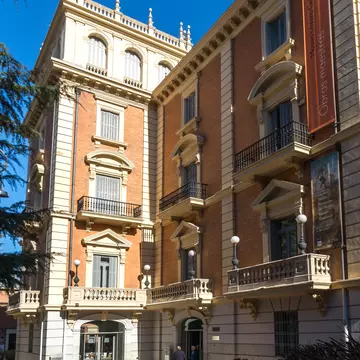
Housed in a Modernista building, the ground floor seems a like a big Modernista furniture showroom. Several items by Antoni Gaudí, including chairs from Casa Batlló and a mirror from Casa Calvet, are supplemented by a host of items by his lesser-known contemporaries, including some typically whimsical, mock medieval pieces by Puig i Cadafalch.
The basement, showing off Modernista traits like mosaic-coated pillars, bare brick vaults and metal columns, is lined with Modernista art, including paintings by Ramon Casas and Santiago Rusiñol, and statues by Josep Llimona and Eusebi Arnau.
reviewed
-
Q
Museu d’Història de Catalunya
The Palau de Mar building facing the harbour once served as warehouses, but was transformed in the 1990s. Inside is the Museu d’Història de Catalunya, something of a local patriotic statement, but interesting nonetheless.
The permanent display covers the 2nd and 3rd floors, taking you from the Stone Age through to the early 1980s. It is a busy hotchpotch of dioramas, artefacts, videos, models, documents and interactive bits: all up, an entertaining exploration of 2000 years of Catalan history.
See how the Romans lived, listen to Arab poetry from the time of the Muslim occupation of the city, peer into the dwelling of a Dark Ages family in the Pyrenees, try to mount a…
reviewed
-
R
Dalí
One of the best things about this collection is its superb location in the Royal Art Circle building just near La Catedral. This somewhat hyped display offers 60-odd little-known sculptures by a man who was largely renowned for his paintings. Documents, sketches and photos by and of the artist complete the picture. If you can’t visit his museum-mausoleum in Figueres, this is no substitute, but does provide some clues to the life and work of the mustachioed maestro.
reviewed
-
S
Cosmocaixa
Kids (and kids at heart) are fascinated by displays here and this science museum has become one of the city’s most popular attractions. The single greatest highlight is the recreation over 1 sq km of a chunk of flooded Amazon rainforest (Bosc Inundat). More than 100 species of Amazon flora and fauna (including anacondas, colourful poisonous frogs and caymans) prosper in this unique, living diorama in which you can even experience a tropical downpour.
In another original section, the Mur Geològic, seven great chunks of rock (90 tonnes in all) have been assembled to create a ‘geological wall’.
These and other displays on the lower 5th floor (the bulk of the museum…
reviewed
Advertisement
-
T
Museu Egipci
Hotel magnate Jordi Clos has spent much of his life collecting ancient Egyptian artefacts, brought together in this private museum. It’s divided into different thematic areas (the Pharaoh, religion, funerary practices, mummification, crafts etc) and boasts an interesting variety of exhibits.
There are statuary, funereal implements and containers, jewellery (including a fabulous golden ring from around the 7th century BC), ceramics and even a bed made of wood and leather. In the basement is an exhibition area and library, displaying volumes including original editions of works by Carter, the Egyptologist who led the Tutankhamen excavations. On the rooftop terrace is a…
reviewed
-
U
Museu de Montserrat
The Museu de Montserrat has a varied art collection ranging from an Egyptian mummy to works by Degas and Caravaggio. Use the funiculars and walking paths to explore this incredible piece of nature.For train timetables and prices from Barcelona to Girona and Sitges, check www.renfe.es. For Montserrat, the R5 line trains operated by FGC (www.fgc.es) run from Plaça d'Espanya station to Monistrol de Montserrat.
reviewed
-
V
Fundació Fran Daurel
The Fundació Fran Daurel (in Poble Espanyol) is an eclectic collection of 300 works of art including sculptures, prints, ceramics and tapestries by modern artists ranging from Picasso and Miró to more contemporary figures, including Miquel Barceló. The foundation also has a sculpture garden, boasting 27 pieces, nearby the Fundació and within the grounds of Poble Espanyol (look for the Montblanc gate). Frequent temporary exhibitions broaden the offerings further.
reviewed
-
W
Museu Etnològic
Barcelona’s ethnology museum presents a curious permanent collection that explores how various societies have worked down the centuries, as seen through collections of all sorts of objects. The entire museum was closed at the time of writing for major refurbishments. Check the website for reopening date.
Prior to the refurbishment, the museum started with a general look at ethnology in an introductory section, Orígens (Origins). Thereafter, collections covered the Pyrenees region in Catalonia (including traditional instruments and archive images of traditional dances) and Salamanca in central Spain, looking at a now largely extinct rural society. Further collections…
reviewed
-
X
Museu d'Arqueologia de Catalunya (MAC)
This archaeology museum, housed in what was the Graphic Arts palace during the 1929 World Exposition, covers Catalonia and cultures from elsewhere in Spain. Items range from copies of pre-Neanderthal skulls to lovely Carthaginian necklaces and jewel-studded Visigothic crosses.
There’s good material on the Balearic Islands (rooms X to XIII) and Empúries (Emporion, the Greek and Roman city on the Costa Brava; rooms XIV and XVII). The Roman finds upstairs were mostly dug up in and around Barcelona. The most beautiful piece is a mosaic depicting Les Tres Gràcies (The Three Graces), unearthed near Plaça de Sant Jaume in the 18th century. Another is of Bellerophon and the…
reviewed