go to content go to search box go to global site navigation

Slovakia

Things to do in Slovakia

‹ Prev

of 7

  1. A

    Cathedral of St Elizabeth

    The dark and brooding Cathedral of St Elizabeth wins the prize for sight most likely to grace your Košice postcard home. Europe's easternmost Gothic cathedral (first built in about 1380 but remodelled many times) dominates the square. Frescoes decorate the interior, as do the stone sculptures by Master Štefan, a local 15th-century sculptor. Ferenc Rákóczi II is buried in the crypt on the left side of the nave. For grand views of the town climb the cathedral's ornate tower.

    reviewed

  2. B

    Trenčín Castle

    Dominating a rocky crag above the old town, Trenčín castle is difficult to miss – especially at night when it's lit with green and purple spotlights. You have a hike to get here, but from the ramparts you're rewarded with sweeping views of the Váh river plain. Much of the series of fortifications and palaces you'll see is a reconstruction.

    The Well of Love, purportedly dug by a man trying to win his lover back from servitude in the castle, was probably dug by Hapsburg soldiers. To go inside the upper castle's three palaces, which are filled with decorative and fine artwork and weaponry, you have to join one of the frequent tours (in Slovak only; call two days ahead…

    reviewed

  3. Spiš Castle

    The sprawling ruins of Spišský hrad are the largest in Slovakia, some claim in all of Central Europe. The fortress was first constructed in 1209, wrecked by the Tatars in the 13th century and reconstructed in the 15th century.

    Although the castle burnt down in 1780, wandering through the labyrinth of half-height walls you get a good sense of how big the place really was. Few structures remain whole today, but there's a cistern, a chapel and a rectangular Romanesque palace, which holds the museum. Descend to the dungeon to see the meaty bits - it's incredible the torture devices the human mind can think up.

    The hilltop views are spectacular, especially in summer when…

    reviewed

  4. C

    Bratislava Castle

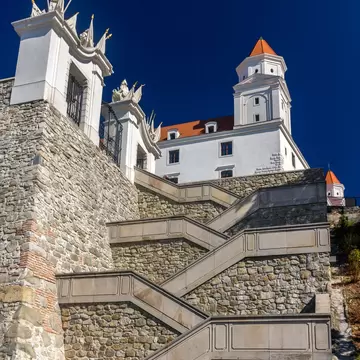
    From Hlavná stanica, Bratislava’s main train station, it’s around a 20-minute walk to Hurbanovo námestie, the northern edge of the old town. Dominating the city of Bratislava from above is Bratislava Castle, the city’s reconstructed 15th-century castle with views from the ramparts. Inside the castle, the Historical Museum covers folk crafts, furniture, modern art and history. At the time of research, the museum was being renovated. On the ground floor, the Treasury of Slovakia has a small collection of archaeological finds.

    reviewed

  5. D

    Zlaté piesky

    Zlaté piesky is a lake resort 7km northeast of the old town. It's where locals escape the summer heat. You can hire rowing boats and sailboards in summer. Take tram 4 from Kamenné nám, near the Tesco department store, to the terminus (20 minutes) and walk east for a couple of blocks; the lake will be on your right.

    reviewed

  6. E

    Mýtny domček

    Pictures of old Bratislava decorate the walls of the restaurant in the former toll house on the Old bridge. All the typical grilled and fried meats are on the menu, but there are also meal-sized salads with chicken or tuna.

    reviewed

  7. F

    Pizza Mizza

    The city's best slice. This modern, multistorey pizzeria is extremely popular, especially with expats, so you may want to book ahead. English is spoken here.

    reviewed

  8. G

    Holocaust Memorial

    Cross under the Staromestská highway to the pedestrian old town and there's a small Holocaust Memorial near where the old synagogue once stood.

    reviewed

  9. H

    Museum of Jewish Culture

    The Museum of Jewish Culture houses moving exhibits about Slovakia’s Jewish community lost during the Holocaust and WWII.

    reviewed

  10. I

    Synagogue

    Two blocks northeast of Nám SNP is the city's only operating Synagogue.

    reviewed

  11. Advertisement

  12. Malá Fatra National Park

    Wave after wave of mountains rise to a crescendo in the peaks that encircle the Vratná Valley. Malá Fatra National Park was created in 1987 largely to protect this prime piece of real estate. Heavily forested summers are a symphony of green in the popular park. Trails, ski lifts and a cable car put you right among the scenery.

    Naturally a place this pretty is overrun in the high summer and winter seasons, but you can always hike far enough to lose the crowds and the valley is almost empty in May or September. Snow hangs around until April in the higher elevations.

    Terchová, the lower entrance to the Vratná Valley, was also the birthplace of one of Slovakia's favourite…

    reviewed

  13. Devín Castle

    This castle, at the confluence of the Morava and Danube rivers, was the main Habsburg military bulwark. From here you can look across the river into Austria and south to Hungary just down the way. A small fort was built in the 13th century and a palace was added two centuries later.

    The first walled buildings at Devín Castle date from Roman times, remnants of which you can still see.

    The precipitous turret mounted atop a spirelike rock is known as the Virgin Tower. Legend has it that a lord of the castle fell in love, and ran off to his castle with a noble lady who shared his sentiment. When her uncle took to arms to get her back, she lept to her death from this perch…

    reviewed

  14. Čachtice Castle

    In the 17th century a mad Hungarian countess named Alžbeta Báthory (known as Bloody Liz to her mates) tortured and murdered more than 600 peasant women at Čachtice Castle (Čachtice hrad), where she was eventually imprisoned.

    Legend has it that she bathed in their blood to keep her skin young, but that's largely been dismissed by scholars. A fire destroyed the castle in 1708 and the ruins aren't much to look at today, but atop castle hill you have great views of the adjacent regional nature reserve and an eerie, lonely feel.

    There are no roads directly to the site, so getting there is by train, and travel is a bit tricky to coordinate between the villages and towns, so…

    reviewed

  15. Museum of Jewish Culture

    The excellent Museum of Jewish Culture (Múzeum Židovskej Kultúry) is in the grounds of Bratislava Castle. Displays on the history and culture of the region's much-persecuted Jews are in English and are deeply moving. Black-and-white photos show Bratislava's old Jewish ghetto and synagogue, which were demolished in the 1960s.

    The staff can help arrange a visit to rabbi Chatam Sofer's tomb. Rabbi Sofer was a staunch defender of traditional Judaism and against Reform practices. His tomb became a pilgrimage place, especially for Orthodox Jews from all over Europe. During the Nazi occupation the cemetery was basically buried under rubble, but his tomb has a new memorial…

    reviewed

  16. J

    Šariš museum

    There are two branches of the Šariš museum on the square. At the Icon Exposition you can see more than 160 dazzling icons from the 16th to 19th centuries.Originally, the stylised portraits of Christ Pantocrator, the Mother of God and a whole flock of saints decorated Greek Catholic and Orthodox churches east of here. The other branch, the 1509 town hall , centre square, houses the Historical Exposition (Historická expozícia). The building is a unique piece of early Renaissance architecture: note the bay staircase, the carved stone portals and the wooden inlay ceiling in the Meeting Room. The rooms contain local paintings, coins and weaponry.

    reviewed

  17. K

    Šariš museum Icon Exposition

    There are two branches of the Šariš museum on the square. At the Icon Exposition you can see more than 160 dazzling icons from the 16th to 19th centuries.Originally, the stylised portraits of Christ Pantocrator, the Mother of God and a whole flock of saints decorated Greek Catholic and Orthodox churches east of here. The other branch, the 1509 town hall , centre square, houses the Historical Exposition (Historická expozícia). The building is a unique piece of early Renaissance architecture: note the bay staircase, the carved stone portals and the wooden inlay ceiling in the Meeting Room. The rooms contain local paintings, coins and weaponry.

    reviewed

  18. L

    Luka

    Though cycling is very popular with locals, the dearth of bike-hire agents makes it tough for visitors. Luka is the only agency that hires bikes (800Sk per day). A good, but steep, route from the Luka office northeast of the centre is to continue north on Kysucká to the picnic and park area of Železná studienka, where there's a chairlift. The adventurous can transport themselves and the bike up via the chairlift and ride back down the mountain cycle path..

    Flatter routes include along the Danube to Devín castle (8km).

    reviewed

  19. M

    City Tower

    You can climb the City tower above the old town's only remaining gate. South of the tower, a 16th-century covered wooden staircase (Kryté schody) climbs to a bright-yellow 14th-century Parish church (Farský kostol) that has a simple outline bearing Gothic, Renaissance and baroque traces. The adjacent small cemetery chapel is probably the only purely Gothic building in town. From here you can ascend to the castle gate.

    reviewed

  20. Hungarian Rhapsody

    Hungarian Rhapsody

    8 days (Vienna)

    by World Expeditions

    Cycle from Vienna to Budapest along the Danube cycle path.

    Not LP reviewed

    from USD$1,160
  21. N

    Slavín War Memorial

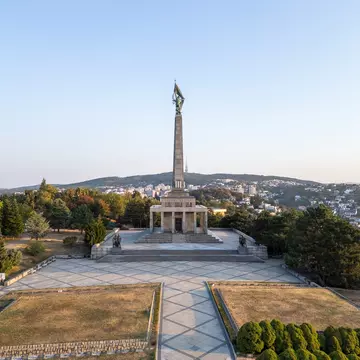
    On Slavín Hill, northwest of the old town, stand a cemetery and garden with fine views over the city. Towering over them is the Slavín War Memorial, an enormous pillar erected in 1960 in memory of the 6000 Soviet soldiers who died pushing the Nazis out of West Slovakia.

    To get there, take trolleybus 208 west from Hodžovo nám to the end of the line on Šulekova (20 minutes), and climb for 1km up Timravina and Mišíkova.

    reviewed

  22. Advertisement

  23. O

    Executioner's bastion

    The 15th-century Executioner's bastion is part of Košice's ancient fort-ifications and includes Ferenc Rákóczi House (adult/student 40/20Sk; h09:00-17:00 Tue-Sat, 09:00-13:00 Sun) containing some of the Hungarian heroes personal effects. Buy tickets here for Mikluš prison , a connected pair of 16th-century houses that once served as a prison and torture chamber.

    reviewed

  24. P

    Hotel Tatra

    The famous Roman inscription of AD 179 is on the cliff behind the Hotel Tatra and can only be seen through a viewing window on the hotel's staircase. Ask at the reception for permission to see it. The translation reads: 'To the victory of the emperor and the army which, numbering 855 soldiers, resided at Laugaricio. By order of Maximianus, legate of the 2nd auxiliary legion'.

    reviewed

  25. Q

    Slovak National Gallery

    Plans to make the Danube riverfront more of an attraction are in the works, but for now it's just a large, pleasant tree-lined place to walk. Waterfront and centre is the Slovak National Gallery, housing the nation's biggest art collection. An 18th-century palace and a Stalinist-modernist building make interesting cohosts for the eclectic showing, which ranges from Gothic to graphic art.

    reviewed

  26. Best Of Central Europe

    Best Of Central Europe

    15 days (Vienna)

    by Intrepid

    Stroll along the Ringstrasse in Vienna, Be captivated by Bratislava, Explore fairytale Cesky Krumlov, Get a taste of Bohemia in the Czech Republic, Soak up the…

    Not LP reviewed

    from USD$2,515 LAST MINUTE OFFER $2,138 SAVE $377
  27. R

    Monument of the Slovak National Uprising

    The central feature of the vast Nám SNP is a bronze Monument of the Slovak National Uprising, honouring to the antifascist uprising for which the square is named. In November 1989 huge crowds assembled here in the days leading up to the fall of the communist regime, and it was also here that Slovaks gathered before the Velvet Divorce from the Czech Republic.

    reviewed