History
For many travelers, the first word that comes to mind when thinking of Peruvian history is ‘Inca.’ Indeed the Inca civilization, the best-known and most-studied of South America’s pre-Columbian cultures, is the one you’re most likely to encounter on the road. Yet the mighty Incas are merely the tip of the archaeological iceberg. Peru had a bounty of pre-Columbian cultures, some preceding the Incas by millennia.
Peru is unequaled in South America for its archaeological wealth, and many archaeologists find Peru’s ancient sites and cultures as endlessly fascinating as those of Mexico, Egypt or the Mediterranean. Learning about and visiting these centuries-old ruins is the highlight of many travelers’ journeys as well, and even those travelers with limited interest in archaeology will find seeing some of the main sites rewarding.
What we know of Peru’s pre-Columbian civilizations has been gleaned almost entirely from archaeological excavation. With no written records available, archaeologists have had to derive historical information from the realistic and expressive decoration found on ancient ceramics, textiles and other artifacts. These relics are worth examining wherever they are on display in Peru’s many archaeological museums.
Contents
Preceramic period
Humans are relatively recent arrivals in the New World, probably spreading throughout the Americas after migrating across the Bering Strait about 20,000 years ago. Peru’s first inhabitants were nomadic hunters and gatherers who roamed the country in loose-knit bands, living in caves and hunting fearsome (and now extinct) animals such as giant sloths, saber-toothed tigers and mastodons. Hunting scenes were recorded in cave paintings made by Peru’s early inhabitants at Lauricocha near Huánuco and Toquepala near Tacna.
Domestication of the llama, alpaca and guinea pig began by about 4000 BC, though some sources claim that it may have begun as early as 7000 BC. Around the same time, people began planting seeds and learning how to improve crops by simple horticultural methods such as weeding.
The coastal strip of Peru was wetter than today’s desert, and a number of small settlements were established, thus changing the way of life of people living there from nomadic hunters and gatherers to settled agriculturists and fisherfolk. The inhabitants fished with nets or bone hooks, sometimes using rafts, and collected food such as shellfish, sea urchins, seabird eggs and even sea lions. Various forms of the Andean staple, the potato, began to be grown as a crop around 3000 BC, along with beans, quinoa, cotton, squashes and corn. Cotton was used to make clothing, mainly by using simple twining techniques and, later, by weaving.
Manioc (also called cassava) and sweet potatoes appeared on the coast early on, indicating trade links with the Amazon basin. Trade occurring between the Andean and Amazon regions was evidenced also by the use of the coca leaf for ritual purposes and the introduction of exotic rainforest bird feathers. Ceramics and metalwork were still unknown during this period in either area, although jewelry made of bone and shell has been found.
The coastal people lived in simple one-room dwellings, lined with stone or made from branches and reeds. These early Peruvians also built many structures for ceremonial or ritual purposes. Some of the oldest – raised temple platforms facing the ocean and containing human burials – date from the third millennium BC, indicating a prosperity based on the rich marine life of the coast. Some of these platforms were decorated with painted mud friezes. The more complex coastal ruins of Caral are unique: dating from as early as 3000 BC, they are evidence of the oldest civilization in South America, contemporaneous with more-famous ancient civilizations in Egypt, India and China. More recently the ruins of the oldest astronomical observatory in the Western Hemisphere were discovered on the coast just north of Lima.
Roughly contemporary with coastal settlements of the later Preceramic Period, the enigmatic site of the Temple of Kotosh near Huánuco is one of the earliest ruins in highland Peru. Little is known about the people who lived there, but their buildings rated among the most developed for that period, and pottery fragments found here predate those found in other parts of Peru by several hundred years.
Initial period
This period, so named for the initiation of ceramics production, extended from approximately 2000 to 1000 BC. What is known about it today has been gleaned from remains found in the Virú valley and Guañape area, just south of Trujillo on Peru’s north coast. More recently, large ceremonial temples from this period have been discovered in the Rímac valley above Lima and other coastal sites. Funerary offerings were made at many of them. During this time, ceramics developed from basic undecorated pots to sculpted, incised and simply colored pots of high quality. Weaving, fishing and horticulture also improved, the latter particularly through the development of irrigation. Toward the end of this time, agricultural terraces were first constructed in the highlands.
Early horizon
Lasting roughly from 1000 to 300 BC, this period has also been called the Chavín Horizon, after the site of Chavín de Huántar, east of Huaraz. It’s termed a ‘horizon’ because artistic and religious phenomena appeared, perhaps independently, within several cultures in different places at about the same time, indicating some kind of interchange of ideas and increasing cultural complexity. This horizon extended throughout much of the highlands and the coast.
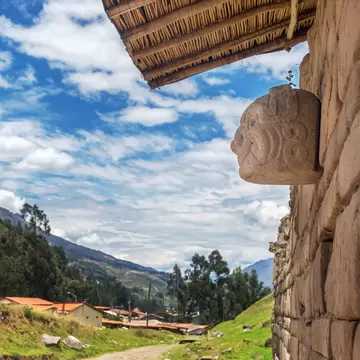
The salient feature of the Chavín influence is the repeated representation of a stylized feline (jaguar or puma) face with prominently religious overtones, perhaps symbolizing spiritual transformations experienced under the influence of hallucinogenic plants. Other animal faces, some mythical, and human faces are also found. Most importantly, this period represents the greatest early development in weaving, pottery, agriculture, religion and architecture – in a word, culture.
During this time, methods of working with gold, silver and copper also developed on the north coast.
Early intermediate period
Around 300 BC, the Chavín culture inexplicably lost its unifying influence. Over the next thousand or so years, several cultures became locally important, of which the best known is the unusually named Paracas Necropolis (named after the burial site discovered south of Lima), which produced cotton and wool textiles considered to be the finest pre-Columbian textiles of the Americas – with up to 398 threads per linear inch!
From about AD 100 to 700 pottery, metalwork and weaving reached a pinnacle of technological development in several regions. Two distinct cultures are particularly noted for their exceptional pottery: the Moche from the Trujillo area produced pottery from press molds, and the Nazca from the south coast introduced polychrome techniques. Both of these cultures recorded their life in intricate detail on their ceramics, leaving archaeologists with plentiful clues about this period.
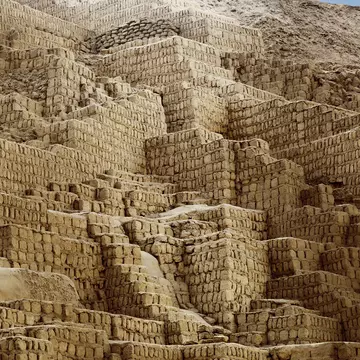
These cultures also left behind impressive sites that are worth visiting today. The Moche built massive platform mounds (popularly called ‘pyramids’) such as the Huacas del Sol y de la Luna (Temples of the Sun and Moon), which are located near Trujillo. Sipán, another Moche site situated near Chiclayo, contains a series of tombs that have been under excavation since 1987 and may be the most important archaeological discovery in South America since Machu Picchu. The Temple of the Moon is currently under excavation, and amazing friezes have been uncovered. Most recently, the elaborately tattooed mummy of a female Moche leader was discovered in 2006 at another coastal site.
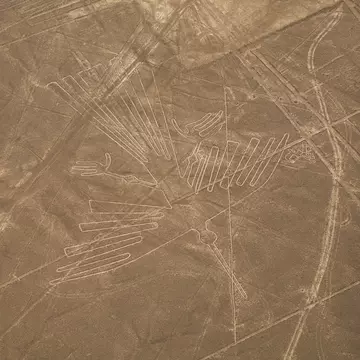
The Nazca made enigmatic giant designs in the desert, known as the Nazca Lines. At the turn of the 20th century, it was Peruvian archaeologist Max Uhle who first realized that the drifting desert sands hid remnants of a culture distinct from other coastal peoples. Soon huaqueros (grave robbers) came to plunder many of the most fascinating sites and sold their finds to individuals and museums. But you can view Nazca mummies at the Chauchilla Cemetery, and also visit the pyramids of Cahuachi, which are still undergoing excavations.
Middle horizon
Most of the latter half of the 6th century was marked by a catastrophic drought along the coast, contributing to the otherwise mysterious demise of the Moche.
From AD 600 to about 1100, the Wari (or Huari) emerged as the first expansionist peoples known in the Andes. Unlike the earlier Chavín, expansion was not limited to the diffusion of artistic and religious influence. Based in the Ayacucho region of the central highlands, the Wari were vigorous military conquerors who built and maintained important outposts throughout much of Peru. The sprawling ruins of their ancient capital can still be visited outside Ayacucho.
The Wari attempted to subdue the cultures they conquered by emphasizing their own values and suppressing local oral traditions and regional self-expression. Thus from about AD 700 to 1100, Wari influence is noted in the art, technology and architecture of most areas in Peru. More significantly, from an archaeologist’s point of view, any local oral traditions that may have existed were discouraged by these conquerors and slowly forgotten. With no written language to study either, archaeologists must rely entirely on the examination of excavated artifacts to gain an idea of what life during this period was like.
The Wari too, in their turn, were replaced by other cultures.
Late intermediate period
Because of their cultural dominance and oppressive rule, it is not surprising that the Wari were generally not welcomed by other cultures, despite the improvements they made in urban development and organization. By about AD 1000, their governance had been replaced by individual groups in local areas. These separate regional states thrived for the next 400 years. The best-known is the Chimu kingdom in the Trujillo area. Its capital was Chan Chan, famed as the largest adobe city in the world.
Several other cultures existed around roughly the same time as the Chimu. The cloud-forest-dwelling Chachapoyas warrior culture erected Kuélap, one of the most intriguing and significant of the highland ruins, and reasonably accessible to travelers. Back on the coast, the Sicán were descendants of the Moche culture. They were also excellent metalsmiths who actively traded with other tribes in the regions of present-day Ecuador, Chile and Colombia. Also contemporary with the Chimu were the Chancay people just north of Lima. The best collection of Chancay artifacts is at the Fundacion Museo Amano in Lima. Further south were the Ica and Chincha cultures, whose artifacts can be seen in the Museo Regional de Ica. At this time there were also several small altiplano (Andean plateau) kingdoms situated near Lake Titicaca that frequently warred with one another. They left impressive chullpas (funerary towers) dotting the bleak landscape – the best remaining examples are at Sillustani and Cutimbo. Last but not least, the formation of chiefdoms and social development in the Amazon jungle had already begun by the end of this period.
Inca empire
For all its glory, the Inca empire really only existed for barely a century. The reign of the first eight incas (kings) spanned the period from the 12th century to the early 15th century. But prior to 1438, the Incas, a small tribe who believed themselves to have descended from the ancestral sun god Inti, ruled over only the valley of Cuzco.
It was the ninth inca, Pachacutec, that gave the empire its first bloody taste of conquest. A growing thirst for expansion had led the neighboring highland tribe, the Chankas, to Cuzco’s doorstep around 1438, and Viracocha Inca fled in the belief that his small empire was lost. However, his son Pachacutec rallied the Inca army and, in a desperate battle, he famously routed the Chanka. This marked the beginning of a remarkably rapid military expansion.
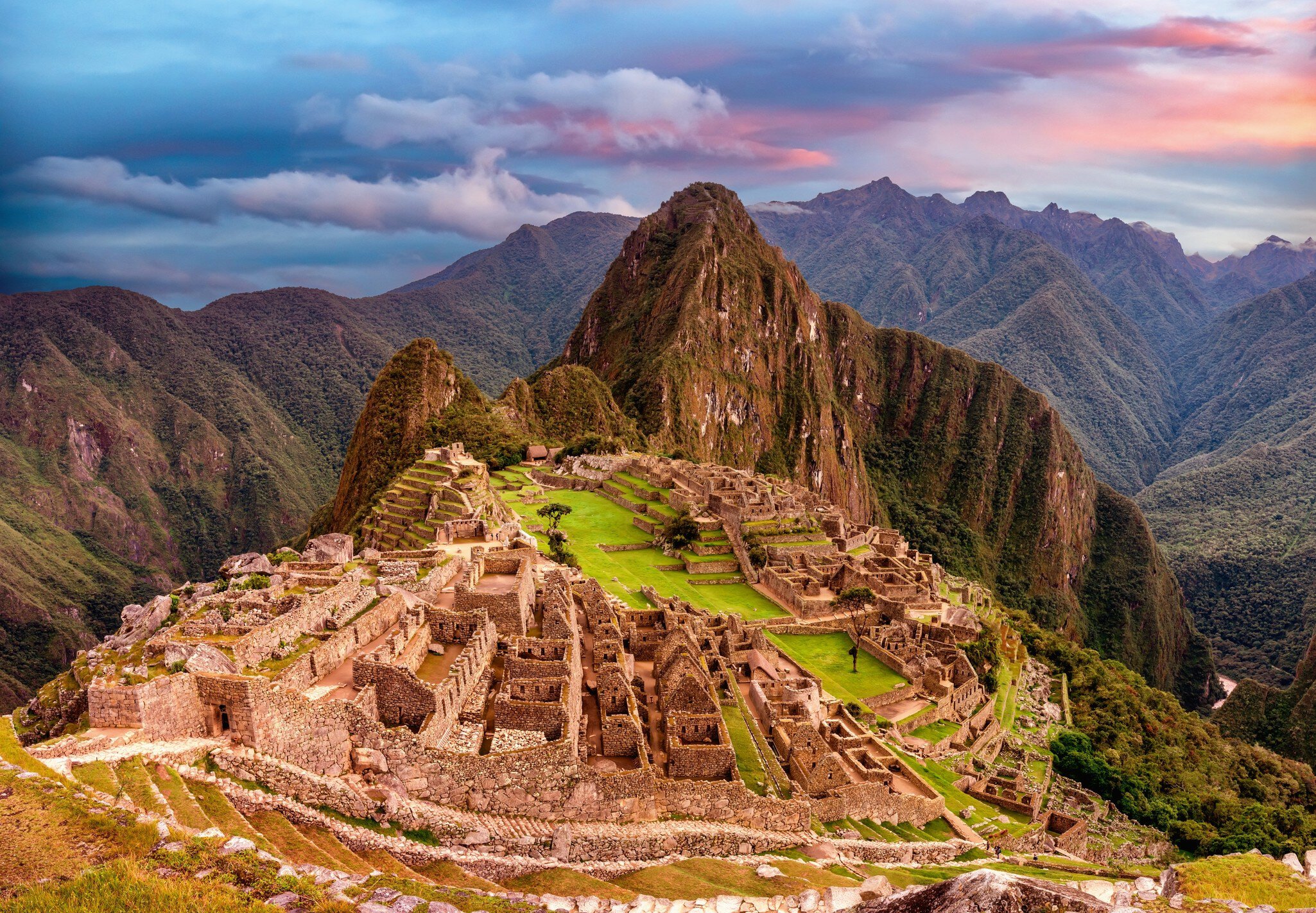
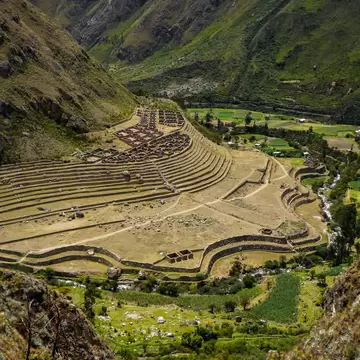
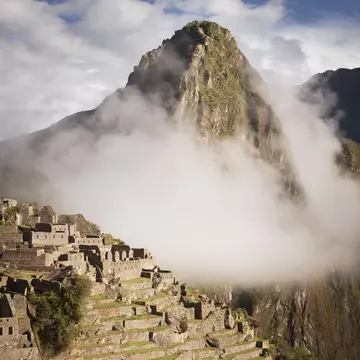
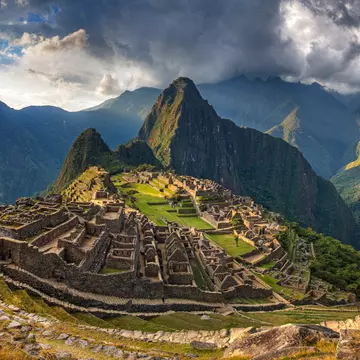
Buoyed by his victory in Cuzco, Pachacutec promptly bagged much of the central Andes over the next 25 years. The Inca empire, known as Tahuantinsuyo (Land of Four Quarters), conquered most of the cultures in the area stretching from southern Colombia to central Chile, including also the Andean regions of Bolivia and northern Argentina. It was also during this time that scores of fabulous mountaintop citadels were built, including famous Machu Picchu.
Like the Wari before them, the Incas imposed their way of life on the peoples they conquered. Thus when the Spanish arrived, most of the Andean area had been politically unified by Inca rule. This unification did not extend to many of the everyday facets of life for the conquered, and many of them felt some resentment toward the Inca leaders. This was a significant factor in the success of the Spaniards during their invasion of the New World.
Spanish invasion
When Europeans ‘discovered’ the New World, epidemics, including smallpox, swept down from Central America and the Caribbean. In 1527, the 11th inca Huayna Capac died of such an epidemic. Before expiring, he divided his empire between his two sons, Atahualpa, possibly born of a quiteña (inhabitant of Quito) mother, who took the north, and the pure-blooded native cuzqueño (inhabitant of Cuzco) Huascar, who took Cuzco and the south. Civil war promptly ensued, and the slow downfall of the Inca empire began.
After Columbus’ first landfall, the Spanish rapidly invaded and conquered the Caribbean islands and the Aztec and Mayan cultures of Mexico and Central America. By the 1520s, the conquistadors were ready to turn their attentions to the South American continent. In 1522 Pascual de Andagoya sailed as far as the Río San Juan in Ecuador. Two years later, Francisco Pizarro headed south but was unable to reach even the San Juan. In November 1526, Pizarro again headed south, this time with more success. By 1528 he had discovered the rich coastal settlements of the Inca empire.
After returning to Spain to court money and men for the impending conquest, he returned. Pizarro’s third expedition left Panama late in 1530. He landed on the Ecuadorian coast and began to march overland toward Peru. In September 1532, Pizarro founded the first Spanish town in Peru, naming it San Miguel de Piura. He then marched inland into the heart of the Inca empire. Pizarro succeeded in reaching Cajamarca in 1532, by which time Atahualpa had defeated his half-brother Huascar.
This meeting between Incas and Spaniards was to radically change the course of South American history. Atahualpa was ambushed by a few dozen armed conquistadors, who succeeded in capturing him, killing thousands of unarmed indigenous tribespeople. In an attempt to regain his freedom, the Inca offered a ransom of gold and silver from Cuzco, including that stripped from the walls of Qorikancha, the most glorious temple in the Inca empire.
But after holding Atahualpa prisoner for a number of months and teasing the Incas with ransom requests, Pizarro murdered the Inca leader anyway, and quickly marched on Cuzco. Mounted on horseback, protected by armor and swinging steel swords, the Spanish cavalry was virtually unstoppable. Despite sporadic rebellions, the Inca empire was forced to retreat into the mountains and jungle, and never recovered its glorious prestige or extent.
Colonial Peru
The Inca capital of Cuzco was of little use to the Spaniards, who were a seafaring people and needed a coastal capital to maintain communication with Spain. Accordingly, Pizarro founded Lima as the ‘City of Kings’ on the Feast of Epiphany, January 6, 1535, and this became the capital of the viceroyalty of Peru, as the colony was named.
The next three decades were a period of great turmoil, with the Incas fighting against their conquerors, and the conquistadors fighting among themselves for control of the rich colony. The conquistador Diego de Almagro was assassinated in 1538 and Francisco Pizarro suffered the same fate three years later at the hands of Almagro’s avenging son. Meanwhile, Manco Inca tried to regain control of the highlands and was almost successful in 1536, but he was forced to retreat to Vilcabamba in the jungle, where he was killed in 1544. Succeeding Incas were less defiant until 1572 when the last ruling Inca, Túpac Amaru, organized a rebellion in which he was defeated and eventually beheaded by the Spaniards in front of the cathedral in Cuzco’s main plaza.
Things were relatively peaceful, however, during the next 200 years. Lima became the main political, social and commercial center of the Andean nations. Cuzco became a backwater, its main mark on the colonial period being the development of the Cuzco school of art, the escuela cuzqueña, which blended Spanish and indigenous influences. Cuzco school canvases can be admired now in Lima’s museums and in the many colonial churches that were built in the highlands during the 17th and 18th centuries.
The rulers of the colony were the Spanish-born viceroys appointed by the Spanish crown. Immigrants from Spain held the most prestigious positions, while Spaniards born in the colony were generally less important. This is how the Spanish crown was able to control its colonies. Mestizos were placed still further down the social scale. Lowest of all were the indigenous peoples, who were exploited and treated as peones (expendable laborers,) under the encomienda system. This feudal system granted Spanish colonists land titles that included as property all of the indigenous people living within that area.
This finally boiled over into the 1780 indigenous uprising, led by Túpac Amaru II. Educated by Jesuits, this cuzqueño of royal Inca descent served his Spanish colonial masters at first while working to improve conditions for indigenous workers, especially in Peru’s mines. As his politics grew more radical, Túpac Amaru II adopted his great-grandfather’s Incan name and staged an all-out rebellion. When that struggle was quashed by the Spanish, the indigenous leaders were cruelly executed in Cuzco. Túpac Amaru II himself was drawn and quartered in Cuzco’s main plaza, the same place that his great-grandfather had been executed. No one knows whether any of the Inca royal line survived past this date.
Independence
By the early 19th century, the inhabitants of Spain’s Latin American colonies were dissatisfied with their lack of freedom and high taxation; South America was ripe for revolt and independence. In Peru’s case, what paved the way toward independence was the discovery and exploitation of a variety of rich mineral deposits, beginning with the seemingly inauspicious guano (seabird droppings) used for fertilizer.
The winds of change arrived in Peru from two directions. José de San Martín liberated Argentina and Chile, and in 1821 he entered Lima and formally proclaimed independence. Meanwhile, Simón Bolívar had freed Venezuela, Colombia and Ecuador.
In 1822 San Martín and Bolívar met privately in Guayaquil, Ecuador. What transpired during that heart-to-heart conversation is still a mystery, but afterward San Martín left Latin America altogether to live in France, while Bolívar continued with the liberation of Peru.
The most decisive battles for Peruvian independence were fought at Junín on August 6, 1824 and Ayacucho on December 9. But it wasn’t until 1826 that the Spanish finally surrendered.
Disorder at the borders
Unfortunately, independence didn’t spell the end of warfare for Peru. A brief war broke out with Spain in 1866, which Peru won, and was followed shortly by a longer war with Chile (1879–83), which Peru lost. The latter was over the nitrate-rich areas of the northern Atacama Desert and resulted in Chile annexing a large portion of coastal southern Peru. The area around Tacna wasn’t returned until 1929.
Peru went to war with Ecuador over a border dispute in 1941. A treaty drawn up in Rio de Janeiro in 1942 gave Peru jurisdiction over the northern sections of the departments of Amazonas and Loreto, but Ecuador disputed this border, and deadly skirmishes occurred between the two countries every few years. Finally, in 1998, the border issue was resolved, with Peru granting Ecuador access to the Amazon and leaving a tiny area in Ecuador’s control. Essentially, the 1942 border remains almost intact and the two countries are now at peace, although much unexploded ordinance (UXO) is waiting to be cleaned up.
Dictatorships & revolutionaries
For much of the 20th century, especially during the 1960s and ’70s, the governing of Peru was marked by a series of military dictatorships and coups.
Civilian rule returned in 1980 with President Fernando Belaúnde Terry, who had been ousted by a military coup in 1968. His earlier administration had been mired in disputes with a US-owned oil company when the military stepped in and took control of some of Peru’s most lucrative oil fields. After being exiled to Argentina for more than a decade, Belaúnde was allowed by the military to come back to Peru and run for office again. Although Belaúnde was admired for his staunch commitment to the democratic process, his second presidential term was marred by radical inflation, domestic terrorism and human-rights violations by the Peruvian armed forces.
The Maoist group Sendero Luminoso (Shining Path) waged a terrorist campaign against the central government from 1980 until the early 1990s, and the struggle led to between 40,000 and 60,000 deaths and ‘disappearances.’ The guerrilla group was linked to drug cartels and active mainly in Peru’s central highlands, but the effects of its activities were often felt in Lima. A smaller, unrelated guerrilla group, the Marxist-Leninist Movimiento Revolucionario Túpac Amaru (MRTA) also waged a war against the government, but this conflict was largely localized within the department of San Martín.
In 1985 Peru’s presidential elections were won by Alan García Pérez. Alan García, as he’s better known, was Peru’s youngest president ever and delighted the passionately proud populace with his weekly balconazos, oratory-filled appearances on the balcony of the Presidential Palace. He further pleased Peruvians by cutting taxes and freezing prices. For a while he was Peru’s shining star, but the economy could not support García’s largesse, and the currency was massively devalued.
The last years of the García presidency were grim – no more balconazos, hyperinflation (at one point, it reached 10,000%!), Sendero Luminoso guerrillas heightening their activities, and a national state of emergency with a 1am to 5am curfew in Lima. Demonstrations and protests were an almost daily occurrence. By the end of García’s five-year term, the country was in economic and political chaos. García went into exile after being accused of embezzling millions of dollars, and thereafter lived in luxurious apartments in Colombia, France and Germany. Amazingly, after the statute of limitations had run out, he returned to Peru to run for president again – twice!
Fujimori mania
The socioeconomic situation improved after the 1990 elections when Alberto Fujimori, a Japanese-Peruvian, defeated the novelist Mario Vargas Llosa, a right-winger who advocated pro-business, free-market ‘shock treatment’ for Peru’s ailing economy. Fujimori capitalized on fears that such treatment would mean more poverty and increased unemployment, and he was seen as an alternative to the established parties and policies.
Fujimori’s austere program of economic reform resulted in unprecedented rises in the cost of food and other essentials, but it also allowed a liberal reformation of import/export, tax and foreign-investment regulations, leading to international financial support. He favored gradual reforms, deregulation of state monopolies and a new currency pegged to the US dollar. When the nuevo sol became Peru’s new currency in 1991, it had an incredible equivalent worth of one billion old soles.
In April 1992 Fujimori suspended the constitution and dissolved congress in an autogolpe (coup from within). This perceived dictatorial, antidemocratic move led to a suspension of foreign aid, as well as outcry within Peruvian governmental circles. Nevertheless, Fujimori had the backing of the majority of the population and proceeded to catalyze the greatest economic and social improvements Peru had seen in decades.
Fortunately for Fujimori, the major leaders of both the Sendero Luminoso and the MRTA were captured in 1992, which helped keep his popular support intact following the autogolpe. In 1993 a new constitution was approved that changed the law stipulating a president could not run for two successive terms, conveniently allowing Fujimori to run for re-election. Other changes included the approval of a new, 120-member unicameral congress (previously bicameral) and the institution of the death penalty for terrorists. Meanwhile, inflation dropped to under 20% and the Peruvian currency stabilized.
In 1995 Fujimori ran for a second term, easily beating opponent Javier Pérez de Cuellar, a former UN secretary general. A notable incident during Fujimori’s second term was the seizure of the Japanese ambassador’s residence during an official reception in December 1996 by 14 members of the MRTA. Hundreds of prominent people were taken hostage. The guerrillas demanded, among other things, the release of MRTA members currently in prison, a rollback of the government’s free-market reforms and improvement in the cruel and inhuman treatment of prisoners, which is still common in Peruvian jails. Most of the hostages were soon released, although 72 men were held until 22 April 1997 when Peruvian commandos stormed the embassy, killing the captors and releasing all of the hostages except one who died along with two soldiers. This action came under criticism as it was claimed that some of the MRTA members were repeatedly shot, despite attempts to surrender.
In 2000 Fujimori again ran for office, claiming that a third term was possible because his first term predated the 1993 constitutional change. He received 49.9% of the vote, just short of the 50% needed to win outright. His main challenger was Alejandro Toledo, a leftist of indigenous Andean highlands descent and a shoeshine-boy-turned-economist who had little political experience. Toledo received 40.2% of the vote but claimed that the elections had been fraudulent, with some departments casting more votes than there were voters.
A run-off was scheduled for May 2000. Toledo refused to run, citing electoral fraud. The Organization of American States (OAS) sent a team of investigators, and the international community threatened sanctions against Peru unless the run-off was postponed, irregularities were corrected and the election was held in a democratic manner. Fujimori did not allow the run-off to be postponed and, despite having no opponent, allowed the apparently flawed electoral process to vote him in. The pressure from the OAS diminished as world leaders realized that they had nothing to gain and much to lose by imposing economic sanctions on the country.
Meanwhile, Fujimori claimed he knew nothing about the money laundering and corruption scandals that his intelligence chief Vladimiro Montesinos had been involved in and he continued his presidential duties, including a state trip to Asia. While there, the Peruvian Congress declared him to be morally unfit to govern, and on November 20, 2000 Fujimori sent in his resignation while visiting Japan.
Normally one of two vice-presidents would have taken on the presidency, but both resigned following Fujimori’s disgraceful exit. Instead, the opposition head of congress, Valentin Paniagua, was sworn in as interim president on November 22. Despite calls to return and face the charges made against him, Fujimori claimed his ancestral Japanese citizenship and stayed on in self-imposed exile in Japan.
Twenty-first century
When new presidential elections were held in April 2001, Peruvians seemed to have completely forgotten the grim 1980s and almost voted the silver-tongued orator Alan García back into office. The former president was beaten, but only by a slim margin, by Alejandro Toledo.
During the campaign, Toledo had made much of his indigenous heritage in a country where most of the populations is of indigenous or mixed heritage. Symbolically, he staged some of his inauguration ceremonies at the mountaintop Inca citadel of Machu Picchu. As priests offered coca leaves and chicha (fermented corn beer) to the heavens, more pragmatic pundits below wondered if Toledo could live up to the grandiose promises he made during his campaign.
Toledo took over a country struggling to come to terms with its past. His inexperience eventually led to an administration plagued by corruption scandals and a complete failure to deliver new jobs. By 2003, although the currency remained strongly pegged to the US dollar, Peruvians were again facing increased unemployment, stagnant wages and a higher cost of living. Toledo’s popularity was at an all-time low (below 10%, the lowest of any South American president). For the first time in almost a decade, the country was again plagued by strikes and demonstrations.
That same year, Peru’s Truth and Reconciliation Commission (CVR) presented its findings on human rights abuses and violence during the 1980s and ’90s, a first step toward justice for victims. Meanwhile, an international warrant for the arrest of Fujimori was filed with Interpol, stepping up the country’s efforts to extradite the former leader from Japan. The arrest warrant, issued by a supreme court judge and based on Fujimori’s alleged involvement in massacres undertaken by the paramilitary death squad Grupo Colina, did not convince Japanese authorities to return the exiled Fujimori for trial.
In 2005, Fujimori voluntarily returned from exile in Japan and announced that he planned to run for the presidency again, only to be arrested in Chile on an extradition warrant to face long-standing charges of corruption and human rights abuses. Although he was barred from placing his name on the presidential ballot, his daughter Keiko ran a successful campaign of her own and became one of Lima’s congressional representatives. It proved in part how much of a hold Fujimori still had on the Peruvian populace.
With Fujimori out of the way, the 2006 presidential elections eventually narrowed to a face-off between the populist nationalist Ollanta Humala, an indigenous Andean ex–army officer who had served under Fujimori, and ex-president Alan García, who had put Peru on the path to financial ruin during the 1980s. Early polls showed the right-wing National Unity candidate Lourdes Flores pulling ahead, but her early momentum faded.
Voters apparently decided that the devil you know is better than the one that you don’t, and elected the more conservative candidate García. This was quite a blow to Venezuelan President Hugo Chávez, who many Peruvians perceived had meddled in their elections by stridently voicing his support of Humala, whose political positions against foreign investment and in favor of a strong central government and income redistribution fit perfectly with Chávez’ dream of South American socialist solidarity. The diplomatic flare-up between Peru and Venezuela only intensified after the elections, when Chávez called Peru the lapdog of the USA and initially refused ties with the new García administration.
Meanwhile, foreign investors breathed a sigh of relief at the presidential election results, predicting business as usual in Peru, and the nuevo sol currency remains stable – for now.