Osaka Sights

  1. Amerika-Mura Triangle Park

    In the middle of it all is Amerika-Mura Triangle Park, an all-concrete park with benches where you can sit and watch the parade of fashion victims. Amerika-Mura is one or two blocks west of Midō-suji, bounded on the north by Suomachi-suji and on the south by Dōtombori-gawa.

    Read more about Amerika-Mura Triangle Park

  2. Dōtombori

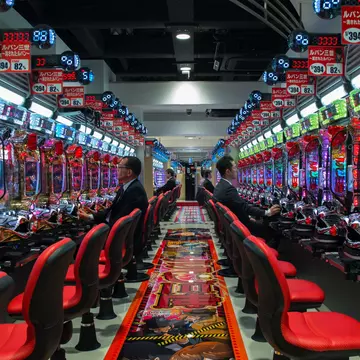
    Dōtombori is Osaka's liveliest nightlife area. It's centred around Dōtombori-gawa and Dōtombori Arcade, a strip of restaurants and theatres where a peculiar type of Darwinism is the rule for both people and shops: survival of the flashiest. In the evening, head to Ebisu-bashi bridge to sample the glittering Bladerunner esque nightscape.

    Read more about Dōtombori

  3. Giant Ferris Wheel

    Before hitting the main attractions, you might want to get some perspective on it all by taking a whirl on the Giant Ferris Wheel . Said to be the largest Ferris wheel in the world, the 112m-high wheel offers unbeatable views of Osaka, Osaka Bay and Kōbe. Give it a whirl at night to enjoy the vast carpet of lights formed by the Osaka/Kōbe conurbation.

    Read more about Giant Ferris Wheel

  4. Hōzen-ji & Fudō-myōō statue

    Only a short walk south of Dōtombori Arcade you'll find Hōzen-ji, a tiny temple hidden down a narrow alley. The temple is built around a moss-covered Fudō-myōō statue. This statue is a favourite of people employed in mizu shobai (water trade) who pause before work to throw some water on the moss-covered statue. Nearby, you'll find Hōzen-ji Yokochō, a tiny alley filled with traditional restaurants and bars.

    Read more about Hōzen-ji & Fudō-myōō statue

  5. Museum of Oriental Ceramics

    With more than 2700 pieces in its permanent collection, this museum has one of the finest collections of Chinese and Korean ceramics in the world. At any one time, about 300 of the pieces from the permanent collection are on display, and there are often special exhibits.

    Read more about Museum of Oriental Ceramics

  6. National Bunraku Theatre

    Bunraku (puppet theatre) did not originate in Osaka, but was popularised here. The most famous bunraku playwright, Chikametsu Monzaemon (1653-1724), wrote plays set in Osaka concerning the lives of merchants and other regular folk normally ignored by traditional Japanese drama. Bunraku became a favourite art form and this theatre seeks to revive its popularity.

    Read more about National Bunraku Theatre

  7. National Museum of Ethnology

    Located in Osaka Banpaku-kōen (World Expo Park) the National Museum of Ethnology is arguably Osaka's best, and it's worth the trip from downtown Osaka or Kyoto, especially if there's a good special exhibit on (check the Kansai Time Out for upcoming exhibits).

    Read more about National Museum of Ethnology

  8. Open Air Museum of Old Japanese Farmhouses

    The open-air museum has 11 traditional Japanese country houses, which were brought from all over Japan and painstakingly reconstructed. Inside each you'll find period-era furniture, homewares and tools. Most impressive is the giant gasshō-zukuri (thatch-roofed) farmhouse from Gifu-ken. The surrounding park is beautiful, with lots of maple trees and bamboo.

    Read more about Open Air Museum of Old Japanese Farmhouses

  9. Organic Building

    Before setting off to see the sights of Shinsaibashi and Dōtombori, we recommend a quick stop at the Organic Building, a whimsical building covered with giant flower pots (hence the name). It's three blocks north and two blocks west of exit 3 of Shinsaibashi subway station on the Midōsuji line.

    Read more about Organic Building

  10. Osaka Aquarium

    Osaka Aquarium, also known as Kaiyukan , is expensive, but worth the visit. It has the world's biggest aquarium tank, which is home to a whale shark and an astonishing variety of smaller sharks, rays and other fish. Exhibit captions are in Japanese and English. The crowds can be avoided if you arrive early in the day.

    Read more about Osaka Aquarium

  11. Advertisement

  12. Osaka City Hall

    Sandwiched between Dōjima-gawa and Tosabori-gawa, this island ( M0638) is a pleasant oasis of trees and riverside walkways in the midst of Osaka's unrelenting grey. It's also home to Osaka City Hall, the Museum of Oriental Ceramics and Nakano-shima-kōen. The latter park, on the eastern end of the island, is a good place for an afternoon stroll or picnic lunch.

    Read more about Osaka City Hall

  13. Osaka Human Rights Museum

    The Osaka Human Rights Museum which goes by two names, is dedicated to the suffering of Japan's Burakumin people and other oppressed groups, including Koreans, the handicapped, the Ainu and women. The most fascinating exhibits deal with the Burakumin, outcasts in Japan's four-tiered caste system that was officially outlawed in 1879 under the Emancipation Edict issued by the Meiji government.

    Read more about Osaka Human Rights Museum

  14. Osaka Museum of History

    Just southwest of Osaka-jō, the new Osaka Museum of History is housed in a fantastic new building adjoining the Osaka NHK Broadcast Center. The display floors of the museum occupy the 7th to the 10th floors of the new, sail-shaped building.

    Read more about Osaka Museum of History

  15. Osaka Rekishi Hakubutsukan (Osaka Museum of History)

    Just southwest of Osaka-jō, the new Osaka Museum of History is housed in a fantastic new building adjoining the Osaka NHK Broadcast Center. The displays are very well done and there are plenty of English explanations; taped tours are available.

    Read more about Osaka Rekishi Hakubutsukan (Osaka Museum of History)

  16. Osaka-jō (Osaka Castle)

    Osaka's most popular attraction is a 1931 reconstruction of the original 1583 castle. Although it's a copy, it's a very good one, and both the castle and the heritage museum inside are very popular. The castle is surrounded by a beautiful park with many cherry blossom trees.

    Read more about Osaka-jō (Osaka Castle)

  17. Osaka-Jo castle

    The Osaka-Jot castle was built as a display of power by Toyotomi Hideyoshi after he achieved his goal of unifying Japan. One hundred thousand workers toiled for three years to construct an 'impregnable' granite castle, finishing the job in 1583. However, it was destroyed just 32 years later, in 1615, by the armies of Tokugawa Ieyasu.

    Read more about Osaka-Jo castle

  18. Shitennō-ji

    Founded in 593, Shitennō-ji has the distinction of being one of the oldest Buddhist temples in Japan, although none of the present buildings are originals; most are the usual concrete reproductions, with the exception of the big stone torii (Shintō entrance gate). The torii dates back to 1294, making it the oldest of its kind in Japan. Apart from the torii, there is little of real historical significance, and the absence of greenery in the raked-gravel grounds makes for a rather desolate atmosphere. The adjoining museum (admission ¥200) is of limited interest.

    Read more about Shitennō-ji

  19. Shitennō-ji (Shitennō Temple)

    Shitennō-ji, founded in 593, has the distinction of being one of the oldest Buddhist temples in Japan, although none of the present buildings are originals; most are the usual concrete reproductions, with the exception of the big stone torii (gate). This dates back to 1294, making it the oldest of its kind in Japan.

    Read more about Shitennō-ji (Shitennō Temple)

  20. Spa World

    Next door to Festival Gate is the superspa known as Spa World. Billed as the world's largest spa, it consists of two floors of baths, one Asian themed and one European themed, and a rooftop waterworld with pools and waterslides, along with restaurants and relaxation areas.

    Read more about Spa World

  21. Sumiyoshi Taisha

    This shrine is dedicated to Shintō deities associated with the sea and sea travel, in commemoration of a safe passage to Korea by a 3rd-century empress. Having survived the bombing in WWII, they offer a rare opportunity to see a Shintō shrine that predates the influence of Chinese Buddhist architectural styles.

    Read more about Sumiyoshi Taisha

  22. Advertisement

  23. Tsūten-kaku

    For something completely different, take a walk through this retro entertainment district just west of Tennō-ji-kōen. At the heart of it all you'll find crusty old Tsūten-kaku tower ( M063F), a 103m-high structure that dates back to 1912 (the present tower was rebuilt in 1969). When the tower first went up it symbolised everything new and exciting about this once-happening neighbourhood ( shin-sekai is Japanese for 'New World').

    Read more about Tsūten-kaku

  24. Umeda Sky Building

    This building is Osaka's most conspicuous piece of modern architecture: its towers look like two enormous piles of children's blocks covered in glass. Osakans are sharply divided: some love it, others think it looks unfinished and ugly. Whatever you think, it's worth taking the elevator to the top and looking over Osaka as if you were its alien conqueror.

    Read more about Umeda Sky Building

  25. Universal Studios Japan

    Universal Studios is a major theme park: fluorescent, noisy, and strenuously cute. It has many rides, most of them based on particular Universal movies, all of them with trademarked or copyright-protected names. These include 'Shrek's 4-D Adventure™' and 'Jurassic Park - The Ride®'. The opportunity to buy Universal movie tie-in products is virulent.

    Read more about Universal Studios Japan