Dublin History

History

More than just about any other city we know, Dublin wears its history on its sleeve. Dubliners themselves are highly passionate scholars of their own history – and we mean their own history. Perhaps because it continues to have such a strong bearing on modern life, it’s near impossible for any two Irish people to agree on the details of any one historical episode.

10, 000–8000 BC

Human beings arrive in Ireland during the Mesolithic era, originally crossing a land bridge between Scotland and Ireland and later the sea in hide-covered boats.

AD 431–432

Pope Celestine I sends Bishop Palladius to Ireland to minister to those ‘already believing in Christ’; St Patrick arrives the following year to continue the mission.

837

Plundering Vikings take a break from attacking monasteries, raping and pillaging to establish a new settlement at the mouth of the harbour and call it ‘Dyfflin’, which soon becomes a centre of economic power. They begin making alliances with some Irish kings.

988

High King Mael Seachlainn II leads the initial Irish conquest of Dyfflin, giving the settlement its modern name in Irish – Baile Átha Cliath, meaning ‘Town at the Hurdle Ford’.

1169

Henry II’s Welsh and Norman barons quickly capture Waterford and Wexford with the help of Dermot MacMurrough (King of Leinster). Although no one knew it at the time, this was the beginning of an 800-year occupation of Ireland by Britain.

1170

Strongbow captures Dublin and then takes Aoife, MacMurrough’s daughter, as his wife before being crowned King of Leinster. The marriage is the subject of a famous painting by Daniel Maclise that can be viewed in the National Gallery.

1172

King Henry II of England invades Ireland, using the 1155 Bull Laudabiliter issued to him by Pope Adrian IV to claim sovereignty over the island, and forces the Cambro-Norman warlords and some of the Gaelic Irish kings to accept him as their overlord.

1350–1530

The Anglo-Norman barons establish power bases independent of the English crown. Over the following two centuries, English control gradually recedes to an area around Dublin known as ‘the Pale’.

1534

‘Silken’ Thomas Fitzgerald, son of the reigning earl of Kildare, storms Dublin and its English garrisons. The rebellion is squashed, and Thomas and his followers are subsequently executed.

1592

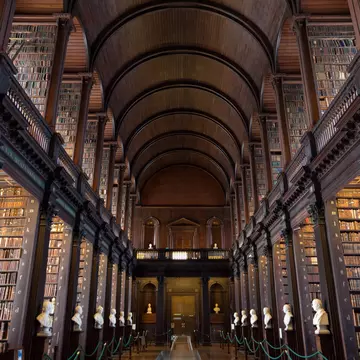
Trinity College is founded on the grounds of a former monastery just outside the city walls, on the basis of a charter granted by Elizabeth I to ‘stop Ireland being infected by popery’.

1640s–1682

Dublin’s resurgence begins as the city’s population grows from 10, 000 in the mid-1640s to nearly 60, 000 in 1682.

1680

The architectural style known as Anglo-Dutch results in the construction of notable buildings such as the Royal Hospital, Kilmainham, now the Irish Museum of Modern Art.

1695

Penal laws – aka the ‘popery code’ – prohibit Catholics from owning a horse (a military tactic), marrying outside their religion and, most importantly, from buying or inheriting property; within 100 years Catholics will own only 5% of Irish land.

1757

The Wide Street Commission is set up to design new civic spaces and the framework of a modern city: new parks are laid out, streets widened and new public buildings commissioned, rendering Dublin a magnificent example of Georgian town planning.

1759

Arthur Guinness buys a disused brewery on a plot of land opposite St James’ Gate, once part of the city’s western defences. Initially he brews only ale, but in the 1770s turns his expertise to a new beer called porter.

1801

The Act of Union unites Ireland politically with Britain. The Irish Parliament votes itself out of existence following an intensive campaign of bribery. Dublin’s role as ‘second city of the Empire’ comes to a swift end.

1845–51

A mould called phytophthora ravages the potato harvest. The Great Famine is the single greatest catastrophe in Irish history, with the deaths of between 500, 000 and one million people, and the emigration of up to two million others.

1905

Journalist Arthur Griffiths founds a new movement whose aim is independence under a dual monarchy, similar to that of the Austro-Hungarian empire. Making a case for national self-reliance, he names the movement Sinn Féin, meaning ‘ourselves alone’.

1916

The Easter Rising: dedicated republicans take the GPO in Dublin and announce the formation of an Irish Republic. After less than a week of fighting, the rebels surrender to the superior British forces and are summarily executed.

1919–21

The Irish War of Independence begins in January 1919. Two years (and 1400 casualties) later, the war ends in a truce on 11 July 1921, leading to peace talks.

1921–22

An Irish delegation signs the Anglo-Irish Treaty on 6 December. It gives 26 counties of Ireland independence and six largely Protestant Ulster counties the choice of opting out, with a Boundary Commission to decide on the final frontiers between north and south. The Irish Free State is founded in 1922.

1948

Fine Gael, in coalition with the new republican Clann an Poblachta, wins the 1948 general election and declares the Free State to be a republic at last. Ireland leaves the British Commonwealth (1949), and the south cut its final links to the north.

1969

Marches in Derry by the Northern Ireland Civil Rights Association (NICRA) are disrupted by Loyalist attacks and heavy-handed police action, culminating in the ‘Battle of the Bogside’ (August 12–14). It is the beginning of the Troubles.

1972

On Bloody Sunday, 30 January, 13 civilians are killed by British troops in Derry. Westminster suspends the Stormont government and introduces direct rule; a crowd of 20, 000 protest outside the British Embassy in Dublin, which is burnt to the ground.

1974

A series of simultaneous bombings in Monaghan and Dublin on 17 May leave 33 dead and 300 injured, the biggest loss of life in any single day in the history of the Troubles.

1988

Dublin celebrates its millennium, even though the town was established long before 988.

1990

Barrister and human rights campaigner Mary Robinson becomes Ireland’s first female president. She wields considerable informal influence over social policies, shifting away from traditionally conservative attitudes on divorce, abortion and gay rights.

1990s

Thanks to low corporate tax, decades of investment in domestic higher education, transfer payments from the EU and a low-cost labour market, the ‘Celtic Tiger’ booms, transforming Ireland from one of Europe’s poorer countries into one of its wealthiest.

2005

On 28 July the IRA issues a statement formally ending its campaign of violence and orders all of its units to dump arms and to assist ‘the development of purely political and democratic programmes through exclusively peaceful means’.

2007

A general election sees Fianna Faíl and Taoiseach Bertie Ahern re-elected for a third term, albeit as majority partners in a coalition that includes, for the first time, the Greens.

The general facts of the city’s history are outlined in the timeline that runs at the bottom of these pages, but in order to contribute to the general debate we have included four relatively compact examinations of some facet of Dublin history that has played an important role in shaping the city’s identity. On your travels, you will surely hear different spins on the same subjects and bear in mind that everybody has a bias – some are just cleverer at hiding it than others. See if you can spot ours.

Ireland rising: a glorious failure

Irishmen and Irishwomen: In the name of God and of the dead generations from which she receives her old tradition of nationhood, Ireland, through us, summons her children to her flag and strikes for her freedom.

As Pádraig Pearse read out these words on the steps of the General Post Office (GPO; see p107) on Easter Monday, 24 April 1916, the shoppers and passers-by listened with bemusement and then, in typical Dublin fashion, began making snide remarks about what must have appeared a pretty ridiculous scene. What they didn’t know, however, was that Pearse and his band of conspirators were in deadly earnest, and that within a week everyone in Ireland and England would know it too, as the most important revolt against British rule since the rebellion of 1798 was played out in bloody, dramatic fashion.

^ Back to top

To fight or not to fight

The rebellion was beset by major problems from the outset, not least a substantial debate over the use of physical force. Britain was comprehensively engaged in the Great War, and while a small group of Irish Volunteers (who were also members of the secret and revolutionary Irish Republican Brotherhood, founded in 1867) had adopted the dictum that ‘England’s difficulty is Ireland’s opportunity’, the chief-of-staff and founder of the Volunteers, Eoin MacNeill, opposed any rebellion unless Britain imposed conscription on Ireland. Consequently, the organisers, made up of Pearse, Eamonn Ceannt, Joseph Plunkett, Tom Clarke and Seán MacDiarmada, proceeded to plot in secrecy. They were later joined by socialist revolutionary James Connolly, founder of the Irish Citizens’ Army (a militia that grew out of the devastating experience of the Great Lockout of 1913), and nationalist poet and playwright Thomas MacDonagh.

The Rising was planned for Easter Sunday 1916, which fell on 23 April. As cover, Pearse arranged for three days of ‘parades and manoeuvres’ by the Volunteers: the plan was that the true republicans within the organisation would know what was really meant, while others like O’Neill would take it at face value. But O’Neill got wind of the rebels’ plans and threatened to do everything to thwart them ‘short of phoning Dublin Castle’. He was temporarily mollified when informed that a shipment of German weapons was about to land in Kerry, but when that landing was scuttled O’Neill ordered that all actions be cancelled for Sunday.

^ Back to top

Chaos reigns

It merely put off the rebels for one day, but it drastically reduced the number of men involved – no-one outside the capital would participate, leaving only a force of about 1250. The original plan had been to seize key buildings in Dublin, including Trinity College and Dublin Castle, but the lack of troops was to prove fatal, especially in their failure to take Dublin Castle – Connolly’s men made a half-hearted effort, not realising that the castle was poorly defended, but were repulsed. As a result, the various Volunteer brigades were left to occupy other locations around the city but had no way of joining up with each other.

The British reacted slowly at first. Unsure of how many rebels there were, the British commander, Brigadier-General Lowe, had only 1200 men at his disposal. Martial law was established, and they sought to consolidate the castle and isolate the leaders within the GPO. The gunboat Helga was used to shell the rebels from the Liffey, but the firing was initially so inaccurate that British troops thought it was the rebels who were shelling them, and so returned fire!

In the meantime, the rebel leaders weren’t having such a great time of it. Connolly had been badly injured in the fighting, and was forced to command his troops from a bed in the GPO. The continuous shelling of the GPO made it impossible for the leaders to fight any more than a holding action, whereas other rebels were ensconced within the likes of the Four Courts, Boland’s Mills and St Stephen’s Green, and were held there under heavy British fire (British numbers by now reinforced by the arrival of 16, 000 extra troops). The only real success for the rebels was in the Mount St area around the Grand Canal, where a mere 17 armed volunteers led by Cathal Brugha inflicted heavy losses on troops trying to enter the city over the canal bridge.

Not surprisingly, Dublin was in chaos. Widespread looting was common, as the city’s slum population took advantage of the breakdown of law and order to break into the shops on and around O’Connell St. Ever the socialist, Connolly reacted furiously to countermand a volunteer order that the looters be shot.

By 29 April the rebels could no longer hold their positions. The leaders had been forced to abandon the GPO, and from their new position on Moore St, Pearse ordered a cessation of all hostilities. In six days, 318 Irish were dead and 2217 wounded, of which 64 were volunteers. The British reported casualties of 116 dead, 368 wounded and nine missing. The Rising was over, and all the rebels had to show for it besides death and the destruction of the city centre was the resultant rage of most of the population.

It got even worse for the rebels. The new British commander, General John Maxwell, was hardly in a conciliatory mood and ordered the arrest of all Sinn Féiners (members of the political wing of the Irish Republican Army, IRA), including ‘those who have taken an active part in the movement although not in the present rebellion’. Sinn Féin was neither militant nor republican, and had not taken part in the rebellion, but the British failure to differentiate between the various strands of Irish nationalism was hardly new. It was to seriously backfire this time.

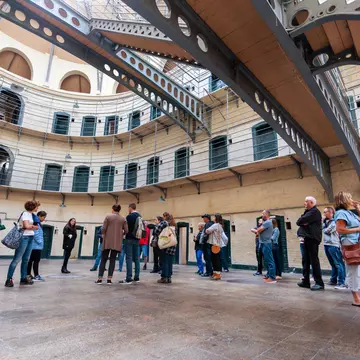
As Britain was engaged in the Great War, the rebels were treated as traitors and a series of court martials resulted in the sentencing to death of 90 men. Although only 15 of them were actually carried out in the grounds of Kilmainham Gaol, they included 18-year-old Willie Pearse, whose main crime was being the brother of Pádraig. James Connolly, the hero of the working man, was severely injured during the Rising and then detained at the military hospital in Dublin Castle. At dawn on 12 May, he was taken by ambulance to Kilmainham Gaol, carried on a stretcher into the prison yard, strapped into a chair and executed by firing squad. More than 3500 others were arrested, and many were deported to internment camps in Britain.

^ Back to top

Conscription & rebellion

Although it is commonly accepted that the cold-blooded execution of the rebels was the thing that turned popular opinion in favour of the rebels, the radicalisation of Irish political aspirations – from a limited form of home rule to total independence from Britain – was brought about largely by the conscription crisis of 1918, whereby the British government forced through conscription despite the total opposition of all Irish parties.

The British had won few Irish friends with the executions and the heavy artillery shelling that had left much of the city centre a smouldering wreck. But the conscription crisis hardened opinion to such a degree that the rebel leaders were now seen as visionaries and martyrs rather than misguided romantics, and returning internees from the British camps were given a hero’s welcome. The general election of 14 December 1918 resulted in the obliteration of the moderate Irish Parliamentary Party and their home rule agenda, and the almost total victory of Sinn Féin, which had been reorganised the previous year as the vanguard of the Irish independence movement.

On 21 January 1919, the newly elected Sinn Féin deputies, who had pointedly refused to take their seats in Westminster, gathered in the Mansion House to form Dáil Éireann and adopt the Declaration of Independence.

Although the Rising was by any stretch a total disaster, not even the leaders could have predicted that their doomed rebellion would be seen as the touch-paper that would ignite the independence movement and inspire the final push towards Irish freedom. British ignorance of and insensitivity towards Irish moods were a longstanding fact of occupation. But the events of 1916–18, which occurred against a backdrop of a war ostensibly in defence of small nations, proved to the Irish once and for all that Britain didn’t care about the needs of this small nation, and that the only recourse was for the Irish to strike out on their own.

^ Back to top

A matter of faith

Although officially the vast majority of Dubliners are Roman Catholic (around 90%), a majority of them could be considered á la carte Catholics, with faith for some amounting to having a quiet snooze at the back of the church during their very infrequent attendances at mass.

In 2007, a joint survey by a Catholic and a Protestant organisation revealed that only 52% of young people in the capital knew the names of the four Evangelists…and that only 38% knew that there were four of them (Matthew, Mark, Luke and John, just so you know). Only 10% knew that the Immaculate Conception referred to Mary and less than half could name the Father, Son and the Holy Spirit (or Ghost) as the three persons of the Trinity.

A sharp decline in religious practice is a Europe-wide phenomenon, particularly among Christians, but Ireland is a special case, for religion is a central feature of Irish history and the centuries-old struggle for identity and independence has been intimately intertwined with the struggle for recognition and supremacy between the Roman Catholic and Protestant churches. There are few European countries where religion has played such a key role and continues to exert huge influence – not least in the fact that the island remains roughly divided along religious lines. For many outside observers Ireland is akin to a Christian Middle East, a complex and confusing muddle that lends itself to over-simplified generalisations by those who don’t have two lifetimes to figure it all out. Like us, for instance, in this short essay.

^ Back to top

Early days

Dublin’s relationship with Christianity began with St Patrick, who founded the See of Dublin sometime in the mid-5th century and went about the business of conversion in present-day Wicklow and Malahide before laying hands on Leoghaire, the King of Ireland, using water from a well next to St Patrick’s Cathedral. Or so the story goes. Irrespective of the details, Patrick and his monk buddies were successful because they managed to fuse the strong tradition of druidism and pagan ritual with the new Christian teaching, which created an exciting hybrid known as Celtic, or Insular Christianity.

Compared to new hotspots like Clonmacnois in County Offaly and Glendalough in County Wicklow, Dublin was a rural backwater and so didn’t really figure in the Golden Age, when Irish Christian scholars excelled in the study of Latin and Greek learning and Christian theology. They studied in the monasteries that were, in essence, Europe’s most important universities, producing brilliant students, magnificent illuminated books like the Book of Kells (now housed in Trinity College), ornate jewellery and the many carved stone crosses that dot the island ‘of saints and scholars’.

The nature of Christianity in Ireland was one of marked independence from Rome, especially in the areas of monastic rule and penitential practice, which emphasised private confession to a priest followed by penances levied by the priest in reparation – which is the spirit and letter of the practice of confession that exists to this day. The Irish were also exporting these teachings abroad, setting up monasteries across Europe, such as the ones in Luxeuil in France and Bobbio in Italy, both founded by St Columbanus (AD 543–615).

^ Back to top

Papal intervention & Protestantism

The Golden Age ended with the invasion of Ireland by Henry II in 1170, for which Henry had the blessing of Pope Adrian IV and his papal laudabiliter, a document that granted the English king dominion over Ireland under the overlordship of the pope. Ireland’s monastic independence was unacceptable in the new political climate brought on by the Gregorian reform movement of 1050–80, which sought to consolidate the ultimate authority of the papacy in all ecclesiastical, moral and social matters at the expense of the widespread monastic network.

The long-standing (St) Laurence O’Toole, Archbishop of Dublin, tried his best to hold off the Norman onslaught – going so far as to implore an army of Danes to intercede – but it was to no avail. In 1179, Pope Alexander III softened the blow of Laurence’s loss of ecclesiastical freedom by appointing him papal legate in Ireland. The influence of the monasteries began to wane in favour of the Norman archbishops who succeeded Laurence – an unbroken line of 25 English-born archbishops that would last for 400 years. The first couple of these oversaw the construction of the great cathedrals, most notably Dublin’s two outstanding churches, St Patrick’s and Christ Church.

The second and more damaging reform of the Irish Church occurred in the middle of the 16th century, and once again an English monarch was at the heart of it. The break with the Roman Catholic Church that followed Henry VIII’s inability to secure papal blessing for his divorce of Catherine of Aragon in 1534 saw the establishment in Ireland (as in England) of a new Protestant church, with Henry as its supreme head. In 1536 Henry appointed George Brown to the Dublin see, and he set about breaking the resistance of the city’s clergy by gathering up all of their relics, including St Patrick’s crozier (known as the ‘staff of Jesus’), into a heap and setting them on fire. It wasn’t quite enough, however: the Irish resisted the new religion and remained largely loyal to Rome, setting the religious wars that would dominate Irish affairs for the next 200 years and cast a huge shadow over the country that has not quite faded yet. The new religion gained its strongest foothold in Dublin, where the clerical and lay authorities were soon overhauled by newly constituted Protestants.

Dublin’s role in the wars of pacification, initiated by Henry but really kicked into high gear by his daughter Elizabeth I, was at odds with the rest of the country. Dublin was the power-base of the English occupation, the heart of the Pale – the area of Ireland completely controlled by the Crown. Beyond it was the wild countryside, full of Irish rebel chieftains who would sooner die than abandon their freedom, which included the all-important right to refer to the pope as God’s number one emissary.

^ Back to top

Anti-Catholic laws

The resistance had its most glorious moment in the Nine Years’ War (1594–1603), when a combined alliance of Irish chieftains led by Hugh O’Neill fought the English armies to a standstill before eventually surrendering in 1603. The ‘Flight of the Earls’ in 1607, which saw O’Neill and his allies leave Ireland forever, marked the end of organised Irish rebellion and the full implementation of the policy of Plantation, whereby the confiscated lands of Catholic nobles was redistributed to ‘planted’ settlers of exclusively Protestant stock. This policy was most effective in Ulster, which was seen by the English as the hotbed of Irish resistance to English rule.

Alongside the policy of Plantation, the English also passed a series of Penal Laws in Ireland, which had the effect of almost totally disenfranchising all Catholics and, later, Presbyterians. The Jacobite Wars of the late 17th century, which pitted the Catholic James II against his son-in-law, the Protestant William of Orange, saw the Irish take sides along strictly religious lines. The disenfranchised Catholic majority – which included the poor of Dublin – supported James while the recently planted Protestant landowning minority lent their considerable support to William. It was William who won the day, and 12 July 1690 – when James was defeated at the Battle of the Boyne – has been celebrated ever since by Ulster Protestants with marches throughout the province.

Until the Catholic Emancipation Act of 1829, Irish Roman Catholics were almost totally impeded from worshipping freely. Clerics and bishops couldn’t preach, with only lay priests allowed to operate, and even then only so long as they were registered with the government. The construction of churches was heavily regulated, and when allowed, they could only be built in barely durable wood. The most effective of the anti-Catholic laws, however, was the Popery Act of 1703, which sought to ‘prevent the further growth of Popery’ by requiring that all Catholics divide their lands equally among their sons, in effect diminishing Catholic land holdings. When the Emancipation Act was passed, it only granted limited rights to Catholics who owned a set amount of land; the land separation that preceded it ensured that they were few in number.

^ Back to top

Influence of the church

It was hardly surprising then that the Catholic Church was heavily involved in the struggle for Irish freedom, although the traditionally conservative church was careful to only lend its support to lawful means of protest, such as Daniel O’Connell’s Repeal Movement and, later, Parnell’s Home Rule fight. When Parnell became embroiled in a divorce scandal in 1890, the church condemned him with all its might, thereby ending his career. It also condemned any rebel notion that smacked of illegality or socialism – the Easter Rising was roundly denounced from the pulpit for its bloodletting and its vaguely leftist proclamation.

If the Roman Catholic Church was shackled for much of the English occupation, it more than made up for it when the Free State came into being in 1922. The church’s overwhelmingly conservative influence on the new state was felt everywhere, not least in the state’s schools and hospitals and over virtually every aspect of social policy. Divorce, contraception, abortion and all manner of ‘scurrilous literature’ were obvious no-nos, but the church even managed to say no to a variety of welfare plans that would provide government assistance to young mothers in need, for instance.

The Free State – and the Republic of Ireland that followed it in 1948 – was 96% Catholic. Although 7.5% of the Free State population in 1922 was Protestant, their numbers had halved by the 1960s, with a disproportionately high rate of emigration among Protestants who felt threatened or unwelcome in the new Catholic state. The Catholic Church compounded the matter by emphasising the 1907 Ne Temere decree, which insisted that the children of mixed marriage be raised as Catholic under penalty of excommunication.

The dramatic decline in the influence of the church over the last two decades is primarily the result of global trends and greater prosperity in Ireland. But the terrible revelations of widespread abuse of children by parish priests, and the untidy efforts of the church ­authorities to sweep the truth under the carpet – including the shuffling of guilty priests from ­parish to parish – have provoked a seething rage among many Dubliners at the church’s gross insensitivity to the care of their flock. Many older believers feel an acute sense of betrayal that has led them to question a lifetime’s devotion to their local parishes. A belated apology on the part of church authorities has assuaged some, but is considered far too little, far too late by many others.

One group to buck this trend is the largely Catholic Polish community in Dublin, which has increased dramatically in recent years and continues to keep the faith, as do large numbers of the African community, although they tend to affiliate with smaller Reformist churches like the Baptists.

^ Back to top

A city of outsiders

One of Dublin’s most popular contemporary buzzwords is ‘multiculturalism’, used with pride and, in some quarters, concern to describe the city’s new culture, which is being transformed by new arrivals from Africa, Asia and – since the accession of 10 new states into the EU in 2004 – from Eastern Europe. Here’s a number for you: Dublin apparently has around 50, 000 new arrivals from Poland alone – in a city that barely tops 1.5 million, that’s a lot of people. Take a walk around the north city centre and you’ll see the multicultural melting pot in all its cosmopolitan glory, where Russians shop for tinned caviar and prianik cookies while Nigerian teenagers discuss the merits of hair extensions and Koreans hawk phone cards from their hatches.

Dubliners are, for the most part, tickled pink by the new cultures on display – it lends weight to their assertion to living in a truly international capital. And it makes going out for dinner a hell of a lot more interesting, given the new range of authentic choices.

^ Back to top

The Vikings & Strongbow

Labour shortages, a buoyant economy and a relatively generous social welfare system might be enticing this generation of immigrants, but this is hardly the first time that Dublin has opened its doors to accommodate outsiders. Lost in the overwhelming statistics of Ireland as a nation of emigrants is a history of immigration – beginning with the origins of the capital itself.

Raids by marauding Vikings had been a fact of Irish life for quite some time before a group of them decided to take some R-and-R from their hell-raising and built a harbour (or longphort) on the banks of the Liffey in 837. Although a Celtic army forced them out some 65 years later, they returned in 917 with a massive fleet, established a stronghold (or dun) by the black pool at Wood Quay, just behind Christ Church Cathedral, and dug their heels in. They went back to plundering the countryside but also laid down guidelines on plot sizes and town boundaries for their town of ‘Dyflinn’, which became the most prominent trading centre in the Viking world. But their good times came to an end in 1014 when an alliance of Irish clans led by Brian Ború decisively whupped them at the Battle of Clontarf, forever breaking the Scandinavian grip on the eastern seaboard. Rather than abandoning the place in defeat, however, the Vikings liked Dublin so much that they decided to stay and integrate.

When the Anglo-Normans arrived in 1169, led by Richard de Clare (better known as Strongbow), they were so taken with the place that they decided to stay. They took Dublin the following year, and essentially kept it for the following 750 years. Strongbow inherited the kingship of Leinster – of which modern Dublin is capital – and made himself at home. The English king, Henry II, soon sent his own army over to keep an eye on Strongbow and his consorts who, he reckoned, were becoming ‘more Irish than the Irish themselves’.

^ Back to top

The Huguenots

One of the most important immigrant groups to settle in Dublin was the Huguenots, mostly French Calvinist Protestants who began arriving in Dublin from about 1630 onwards. They were fleeing religious persecution in Europe – the worst example was in France, where 20, 000 were murdered during the infamous St Bartholomew’s Day Massacre of 1572. The trickle of arrivals became a flood after Louis XIV revoked the Edict of Nantes in 1685, which ended the little legal protection they had. Most of the Huguenot immigrants settled in the Coombe, which is part of the Liberties, where they immediately set about adding to the commercial and artistic life of the city with their skills in weaving, textile design and working with gold and silver. They were also involved in sugar baking, setting up no fewer than 30 sugar bakeries in the city.

The Huguenots knew how to make money, and they spent it on a city that was immensely grateful for their presence: Huguenot wealth went a long way towards financing the major urban redesign that was to transform Dublin from medieval misery pit into a Georgian masterpiece. One prominent Huguenot was goldsmith Jeremiah D’Olier, originally from Toulouse, who became a City Sheriff, a founder of the Bank of Ireland and a member of the Wide Streets Commission.

Other prominent Huguenot names include Georgian architects James Gandon and Richard Cassels; Gothic horror novelists Joseph Sheridan LeFanu and Charles Robert Maturin (authors of, respectively, the lesbian vampire classic Carmilla and Melmoth the Wanderer); and a certain Monsieur Becquet, who was not famous in his own right but whose descendant was none other than Samuel Beckett. His ancestor’s grave is in the small but centrally located Huguenot Cemetery, at the northeastern corner of St Stephen’s Green. Finally, the Huguenots had another important influence on the city: their extensive international trade links lent credence to the city’s Anglo-Irish gentry’s cosmopolitan pretensions, altogether necessary if Dublin was indeed to be thought of as the second city of the empire. And who says that history doesn’t repeat itself?

^ Back to top

The Jews

The other important group to arrive in Dublin as a result of religious persecution were Jews, the first wave arriving here in the mid-18th century from Spain and Portugal. They established a synagogue on Crane Lane, just off Dame St, which has long since disappeared (the most prominent building there now is a gay sauna) along with most of the original settlement, which had dispersed by 1790. Another small group arrived in 1820, opening synagogues in Wolfe Tone St and Mary’s Abbey on the northside, but it wasn’t until 1880 when Jewish settlers really established a foothold in Dublin. Fleeing the pogroms of Russia, they had intended to make their way to America, but many ended up staying here, settling around the South Circular Rd in an area that by the beginning of the 20th century was known as ‘Little Jerusalem’. By the mid-1940s there were about 4000 Jews living in Ireland, but post-war emigration to the US and Israel has diminished their number to around 1500.

Nevertheless, their Dublin legacy is a notable one: two former Lord Mayors of Dublin were Jewish, Robert Briscoe (1956–57) and his son Ben (1988–89). The Jewish Museum on Walworth Rd, in two adjoining houses that once served as the city’s most important synagogue, was opened in 1985 by the then President of Israel, Chaim Herzog (1918–97). He grew up just around the corner at 33 Bloomfield Ave and was educated at one of Dublin’s top schools, Wesley College. His son Isaac is currently the Israeli Minister for Social Affairs.

And who could forget the most famous Dublin Jew of them all, the man ‘who ate with relish the inner organs of beast and fowl’, James Joyce’s greatest creation, Leopold Bloom? Born and raised at 13 Clanbrassil St, he married Molly and moved to 7 Eccles St, from where he embarked on his famous adventure of one very long day.

^ Back to top

Nurse of the people, curse of the people

A wet, cold and inclement climate, a tendency towards self-reflection and the oppressive presence of a foreign occupier who just won’t go away are three pretty good reasons to justify a spot of escapism, and the capital has plenty of experts in ‘the cure’, as taking a drink to beat the blues is euphemistically known. And as demand will often generate supply, Dublin has a particularly rich history in the twin arts of brewing and distilling – providing, in the words of Arthur Guinness, the ‘nurse of the people’ (beer) and the ‘curse of the people’ (whiskey). Arthur’s bias notwithstanding, Dublin’s drinkers could at least console themselves that they were contributing to the cyclical wealth of the local economy by maintaining brand loyalty, which really meant they were drinking some of the best beer and whiskey in the world.

^ Back to top

Wine, mead & whiskey

There’s been booze in Dublin since Celtic times. The first settlers round these parts weren’t especially picky, displaying a love of malt liquor, imported wine (thanks to Roman traders) and other kinds of fermented drinks, including mead. The Vikings were especially partial to mead, a simple enough drink made of boiled honey and water, which was considered the drink of the Gods and the heroes living in Valhalla.

Wine and mead were good enough, but the Irish were looking for something with a little more punch, and by the 12th or 13th century (the early history is unclear – maybe the historians were a little too addled to note these things down?) they had it. And it was all thanks to monks who had picked up a couple of tricks from Middle Eastern perfume-making techniques and Roman texts about the distillation of aqua vitae – the ‘water of life’. The Irish, who were more inclined to feeling good than smelling well, translated the name directly and called their new potion uisce beatha (ish-ke ba-ha); the first word sounds suspiciously like…whiskey. And considering that the Irish and the Scots have been engaged in a longstanding rivalry as to who exactly invented the stuff, we’ll point out that the first recorded mention of whiskey in Ireland was in 1405, 91 years before the word (shorn of the ‘e’) was written down in Scotland. So there.

Until 1608, distilling was largely a clandestine affair, with pot stills all over the country producing whiskey of widely diverging quality. King James I’s ministers then recognised the taxable potential of this popular pastime and granted the governor of Ulster, Sir Thomas Phillips, the very first licence to distil uisce beatha.

In Dublin, the first commercial distillery was set up in 1757 when Peter Roe bought a small distillery on Thomas St and powered it with the largest smock windmill in Europe of the time – you can still see the blue-capped copper top of St Patrick’s Tower in the grounds of the Guinness Brewery.

^ Back to top

Guinness: a brand was born

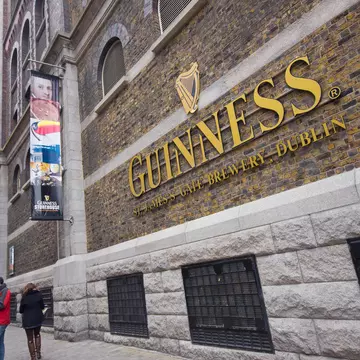
Two years later, another entrepreneur of booze got in on the act. Arthur Guinness, who had learnt the brewer’s trade from his father Richard, took out a long-term lease on a small, disused brewery across the street from Roe’s distillery and began producing ale. Then, in the mid-1770s, he got wind of a new, dark-coloured ale (due to the roasting of hops), which was the favourite of the porters of Covent Garden and Billingsgate in London. Arthur decided this was the way to go, so he refined and strengthened the dark ale, calling it extra stout porter, which soon became known simply as ‘stout’. When he died in 1803 he could hardly have realised that he had laid the foundations for not just one of the world’s most famous breweries, but arguably the world’s most beloved beer and the single most defining symbol of the city he lived in.

As an employer, the company reached its apogee in the 1930s, when there were more than 5000 people working here, making it the largest employer in the city. For nearly two centuries it was also one of the best places to work, paying 20% more than the market rate and offering a comprehensive package of subsidised housing, health benefits, pension plans, longer holidays and life insurance. In the 19th century, young women of marrying age in Dublin were advised by their mothers to get their hands on a Guinness man, as he’d be worth more than most alive or dead!

^ Back to top

The whiskey trade

The Guinness gang were so successful, so utterly dominant, that no other brewer could really survive in Dublin. Not so with whiskey, and for a time, the capital had a number of important distilleries whose aim, presumably, was to keep as many of the citizenry as possible in a state of sozzle. In 1780, John Jameson bought an interest in a small distillery in Bow St, creating one of the great whiskey dynasties. His son, grandson and great-grandson – all called John – steered the firm of John Jameson & Son towards huge success, eventually replacing the original distillery with a much bigger building in 1880, now a whiskey museum. Nine years later, Jameson’s united with Roe’s to form the Dublin Distilling Company, although each continued to sell under their own name. Roe’s distillery alone covered 17 acres – the largest in Europe – and was producing two million gallons of whiskey annually, with a chunk of it being exported to the US, Canada and Australia.

The whiskey trade might have been immensely popular, but its sale was riddled with problems, largely because all distillers sold their product through bonders – merchants who aged whiskey in a bonded warehouse for at least four years before bottling. Common practice, however, was to mix the good stuff with inferior provincial distillates and sell the lot under the bonder’s name. Then along came James Power, whose father James had founded a distillery on the grounds of what is now the National College of Art & Design on Thomas St in 1791.

In an early example of brand awareness, James devised a method whereby whiskey sold through merchant bonders could only carry a special ‘John Power & Son’ white label that also proclaimed it as a ‘Dublin Whiskey’. His innovations earned him a knighthood, an appointment as High Sheriff of Dublin and the friendship of no less than the Liberator himself, Daniel O’Connell. The company continued its groundbreaking tradition in 1866 by making the move towards glass bottles (whiskey was always sold in wooden casks), offsetting the expense by labelling the bottled whiskey as ‘Gold Label’ and selling it as a really special reserve. Finally, Powers was the first distiller to produce miniature bottles, the famous ‘Baby Powers’, which required an act of parliament before they were allowed. Airline travel and hotel overnights just wouldn’t have been the same.

The city’s brewers and distillers were unquestionably an entrepreneurial lot, but their particular business meant that they were directly contributing to the social ills of society – not everyone was content with a snifter of whiskey or a quick half of beer after a hard day at the grindstone. Consequently, some of the major names were quick to engage in acts of munificence, in part inspired by the 19th-century spirit of philanthropy but equally to ensure that they didn’t get labelled as purveyors of moral corruption. And what better way to avoid it than, say, to spend the modern-day equivalent of €30 million to fix up the city’s most famous cathedral (the Roe’s), or build a load of housing for low-income families and sponsor the clean-up of the city’s favourite green space (the Guinness family)?

^ Back to top

End of an era

The whiskey industry has long since disappeared in Dublin – nearly all of it is now produced in a purpose-built factory in Midleton, County Cork, but Guinness still rules supreme, for the moment. The once mighty brewery, which had grown even bigger with the 1949 acquisition of the old Roe Distillery (which had folded in 1945), was, as of 2007, examining its long-term options. Sadly this could mean selling up St James’s Gate (for a simply astronomical profit, we assume) and relocating to a new and smaller factory outside Dublin. If it does happen – and we pray fervently that it doesn’t – it’ll mean the end of a long and important tradition that has helped define and shape the city in ways few other enterprises ever could.

^ Back to top