Showing 1-12 of 12 results
-
Alexander's Prison
This 15th-century domed school is known as Alexander's Prison because of a reference to this apparently dastardly place in a Hafez poem. Whether the deep well in the middle of its courtyard was in fact built by Alexander the Great and used as a dungeon seems doubtful, no matter what your guide tells you.
-
Amir Chakhmaq Complex
The stunning three-storey façade of the takieh (a building used during the rituals to commemorate the death of Imam Hossein) in the Amir Chakhmaq Complex is one of the largest Hosseniehs in Iran. Its rows of perfectly proportioned sunken alcoves are at their best, and most photogenic, around sunset when the light softens and the towering exterior is discreetly floodlit. Recent work has added sides, though their exact purpose wasn't clear when we visited (hopefully not shops!).
-
Ateshkadeh
Zoroastrians come from around the world to visit this Ateshkadeh, often referred to as the Zoroastrian Fire Temple, which is said to have been burning since about AD 470. Visible through a window from the entrance hall, the flame was transferred to Ardakan in 1174, then to Yazd in 1474 and to its present site in 1940. Above the entrance you can see the Fravahar symbol.
-
Bagh-e Dolat Abad
Once a residence of Persian regent Karim Khan Zand, Bagh-e Dolat Abad was built in about 1750 and consists of a small pavilion set amid quiet gardens. The interior of the pavilion is superb, with intricate latticework and exquisite stained-glass windows throughout. It is also renowned for having Iran's loftiest badgir, standing over 33m high, though this one was rebuilt after it collapsed in the 1960s. The entrance can be reached from the western end of Shahid Raja'i St.
-
Bogheh-ye Sayyed Roknaddin
The beautiful blue-tiled dome of the Bogheh-ye Sayyed Roknaddin, the tomb of local Islamic notable Sayyed Roknaddin Mohammed Qazi, is visible from any elevated point around the city. Built about 700 years ago, the dome is most notable but the deteriorating interior stucco and other decoration remains impressive. The door is often closed but a knock should bring the caretaker.
-
Jameh Mosque
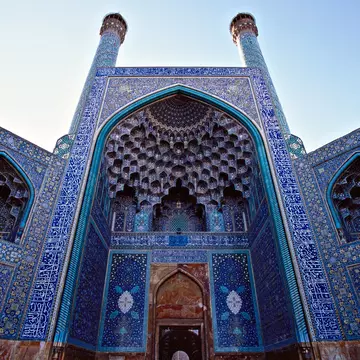
Dating from Yazd's period of greatest magnificence, the town's 'Friday Mosque' combines stately scale and intricate design to create a fabulously harmonious whole. Dominated by an exquisitely tiled 15th century entrance portal, the mosque occupies the former site of a Zoroastrian fire temple.
-
Khan-e Lari
The 150-year-old Khan-e Lari is one of the best-preserved Qajar-era houses in Yazd. The badgirs (windtowers or wind catchers) , traditional doors, stained-glass windows, elegant archways and alcoves mark it out as one of the city's grandest homes. The merchant family who built it have long gone, and it's now home to architecture students and cultural heritage officers. It's signposted west of Zaiee Sq.
-
Old City
With its badgirs (windtowers or wind catchers) poking out of a baked-brown labyrinth of lanes, the old city of Yazd emerges like a phoenix from the desert - a very old phoenix. Yazd's old city is one of the oldest towns on earth, according to Unesco, and is the perfect place to get a feel for the region's rich history. Just about everything in the old city is made from sun-dried mud bricks, and the resulting brown skyline is dominated by tall badgirs on almost every rooftop.
-
Saheb A Zaman Club Zurkhaneh
Just off the north side of Amir Chakhmaq Sq is the Saheb A Zaman Club Zurkhaneh, which is worth seeing both for its Iranian brand of body building and because it's a quite amazing structure. The modern club is inside a cavernous ab anbar (water reservoir) built about 1580. Looking like a 29m-high standing egg from the inside, and crowned with five burly badgirs, the reservoir stored water for much of the town. The hour-long workouts in the Zurkhaneh are an interesting window on Iranian culture.
-
Tomb of the 12 Imams
The early-11th-century brick Tomb of the 12 Imams is almost next door to Alexander's Prison. The once-fine (but now badly deteriorated) inscriptions inside bear the names of the Shiite Imams, though none are actually buried here.
-
Advertisement
-
Towers of Silence
Set on two lonely, barren hilltops on the southern outskirts of Yazd are the evocative Zoroastrian Towers of Silence. In accordance with Zoroastrian beliefs about the purity of the earth, dead bodies were not buried but left in these uncovered stone towers so that vultures could pick the bones clean. Such towers have not been used since the '60s.
-
Yazd Water Museum
For at least 2000 years Iranians have been digging qanats (underground water channels) to irrigate crops and supply drinking water. To build a qanat you first need to find an underground water source. This source could be more than 100m deep, but as the whole system is reliant on gravity the source must be higher than the final destination. Then you dig a tunnel just wide and tall enough to crawl along, so the water can flow across an extremely shallow gradient to its destination.
Showing 1-12 of 12 results