ShirazThings to do

Things to do in Shiraz

‹ Prev

of 2

  1. Tour Guide, Arash Sadeghzadeh

    Young, enthusiastic, knowledgeable and highly organised guide and fixer. Recommended.

    reviewed

  2. Yord Cultural Complex

    In an enormous colourful yord (tent) about 8km northwest of town, this complex not only offers the chance to enjoy some fine Iranian-nomad food, but also to experience the Qashqa’i culture. The warm atmosphere, colourful costumes, live music and delicious food afford a dreamy escape from modern life into a Qashqa’i tented embrace. Yord is almost impossible to reach by public transport, so ask your hotel to write the name in Farsi and get a taxi (about IR25,000); it is also worth paying the taxi to wait for you (about IR70,000 total) as taxis out here are rare indeed.

    reviewed

  3. Seray-e Mehr Teahouse

    This is a serendipitous place to find after wandering through the Bazar-e Vakil. Hidden away through a small door behind the Serai Mushir Bazar, the split-level teahouse has a small menu of tasty favourites (think dizi, kubideh, zereshk polo ) and a delightfully relaxed atmosphere in which to sit, sip tea and puff on qalyan.

    reviewed

  4. A

    110 Hamburgers

    The best, however, is this place to which Shirazis come like moths to a neon flame (two glowing palm trees). Their version of the shwarma, with meat sliced off a spit and shovelled into a bread roll with healthy bits like tomato and pickle (IR18,000), is good.

    reviewed

  5. Driver, Hossein Soltani

    Hossein works in the Shiraz Eram hotel and moonlights as a (safe) driver and fixer.

    reviewed

  6. B

    Bazar-e Vakil

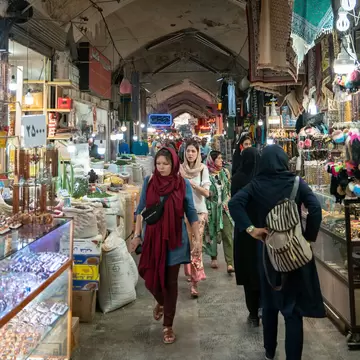
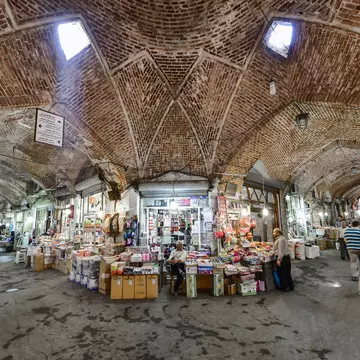
    Shiraz’s ancient trading district is comprised of several bazaars dating from different periods. The finest and most famous is the Bazar-e Vakil, a cruciform structure commissioned by Karim Khan as part of his plan to make Shiraz into a great trading centre. The wide vaulted brick avenues are masterpieces of Zand architecture, with the design ensuring the interior remains cool in summer and warm in winter. Today, it’s home to almost 200 stores selling carpets, handicrafts, spices and clothes and is one of the most atmospheric bazaars in Iran, especially in the early evening when it is fantastically photogenic. As usual, it’s best explored by wandering without concern fo…

    reviewed

  7. C

    Jameh-ye Atigh Mosque

    Walking through the southeastern (back) entrance to the Shah-e Cheragh courtyard and turning right after about 50m leads to the ancient Jameh-ye Atigh Mosque. Dating from 894 this is Shiraz's oldest Islamic structure, though most of what you see is from the late Safavid period onwards.

    While the dome of the north iwan and the hypostyle columns in the ancient prayer hall in the southeast corner are impressive, the highlight is the rare turreted Khodakhaneh. It was built in the mid-14th century (or perhaps earlier) to preserve valuable Qurans; poet Hafez is believed to have worked here. The Khodakhaneh (House of God) bears an uncanny likeness to the Kaaba at Mecca, and bear…

    reviewed

  8. D

    Aramgah-e Hafez

    Iranians have a saying that every home must have two things: first the Quran, then Hafez. And many would reverse that order. Hafez the poet is an Iranian folk-hero – loved, revered and as popular as many a modern pop star. Almost every Iranian can quote his work, bending it to whichever social or political persuasion they subscribe to. And there is no better place to try to understand Hafez’s eternal hold on Iran than here, at Aramgah-e Hafez, his tomb. Set at the back of the ground of Hafez’s tomb is a teahouse which is a great place to chill out with some live traditional music and a cup of chay, though the man himself might have preferred a glass of Shiraz.

    reviewed

  9. E

    Imamzadeh-ye Ali Ebn-e Hamze

    The Imamzadeh-ye Ali Ebn-e Hamze stands as the tomb of Emir Ali, a nephew of Shah Cheragh who also died here while en route to Khorasan to help Imam Reza. The existing shrine was built in the 19th century after earthquakes destroyed previous incarnations. It has an eye-catching bulbous Shirazi dome, dazzling mirror work, stained-glass windows and an intricate, ancient wooden door. The tombstones around the courtyard, for which families of the deceased paid a small fortune, are also interesting. Unlike some other shrines, the caretakers here are very welcoming of foreigners; women are happily handed a chador , and in you go!

    reviewed

  10. Masjed-e Vakil

    The beautiful Masjed-e Vakil was begun by Karim Khan and is the only major mosque surviving from the late Zand period. Beside the entrance to the bazaar, it has two vast iwans to the north and south, a magnificent inner courtyard surrounded by beautifully tiled alcoves and porches, and a pleasingly proportioned 75m-by-36m vaulted prayer hall supported by 48 carved columns. Inside the prayer hall are an impressive mihrab and 14-step marble minbar, carved from a monolith carried all the way from Azerbaijan. Much of the tiling, with its predominantly floral motifs and arabesques, was added in the early Qajar era.

    reviewed

  11. Advertisement

  12. Masjed-e Nasir-ol-Molk

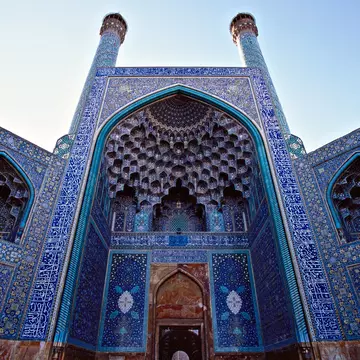
    Masjed-e Nasir-ol-Molk is one of the most elegant and photographed mosques in southern Iran. Built at the end of the 19th century, its coloured tiling (an unusually deep shade of blue) is exquisite. There is some particularly fine stalactite moulding in the smallish outer portal and in the northern iwan, but it is the stunning stained glass, exquisitely carved pillars and polychrome faience of the winter prayer hall that are most eye-catching. Photographers should come as early as possible in the morning for shots of the hall lit up through the glass (you might have to tip the caretaker to open the curtains).

    reviewed

  13. F

    Bagh-e Naranjestan

    Bagh-e Naranjestan is Shiraz’s smallest garden and is famous as the setting for the opulently decorated Naranjestan-e Ghavam pavilion, built between 1879 and 1886, as part of a complex owned by one of Shiraz’s wealthiest Qajar-era families. The pavilion’s mirrored entrance hall opens onto rooms covered in a breathtaking combination of intricate tiles, inlaid wooden panels and stained-glass windows. Ceilings in the upstairs rooms are particularly interesting, with the beams painted with European-style motifs, including Alpine churches and busty German frauleins.

    reviewed

  14. G

    Madraseh-ye Khan

    In 1615, Imam Gholi Khan, governor of Fars, founded the serene Madraseh-ye Khan theological college for about 100 students. The original building has been extensively damaged by earthquakes and only the impressive portal at its entrance has survived; watch for the unusual type of stalactite moulding inside the outer arch and some intricate mosaic tiling with much use of red, in contrast to the tiles used in Yazd and Esfahan. The college (still in use) has a fine stone-walled inner courtyard and garden.

    reviewed

  15. Martyr’s Mosque

    One of the largest ancient mosques in Iran, the rectangular courtyard of the Martyr’s Mosque covers more than 11,000 sq metres. Founded at the start of the 13th century, the mosque has been partially rebuilt many times and now has very little in the way of tiling or other decorations, though it does boast some impressive barrel vaulting. It lives under acres of unsightly corrugated fibreglass and is only open on Fridays, when it is still used for prayer. Entry is through a gate off Ahmadi Sq.

    reviewed

  16. H

    Khan-e Zinat ol-Molk

    Down a small lane beside the garden is the Khan-e Zinat ol-Molk, which was originally the private, andaruni area of the complex and is named after its last owner, the daughter of the builder Qavam. Today most of the finely decorated rooms are stuffed with exhibits in the Fars History Museum, while others serve as galleries for young Shirazi artists. The gardens are in a walled compound 400m south of the Nasir ol-Molk Mosque.

    reviewed

  17. I

    Sharzeh Traditional Restaurant

    Talk about atmosphere! The night we ate at the Sharzeh it was going off like the proverbial frog in a sock, with diners singing and clapping along with musicians playing traditional music in the centre of the two-level space. Great fun! The Iranian food was well-prepared, tasty and plentiful. It’s diagonally opposite the entrance to the Vakil Bazaar. There’s no English sign; look for the man in costume outside an arcade.

    reviewed

  18. Anglican Church of St Simon the Zealot

    The Anglican Church of St Simon the Zealot, built by R Norman Sharp in 1938, is very Iranian in character and even contains stone tablets with biblical stories incised on them in cuneiform, probably by Sharp. According to local tradition, St Simon was martyred in Persia together with St Thaddeus, another of the 12 Apostles. The great metal door bearing a Persian cross is usually closed – ring the doorbell.

    reviewed

  19. J

    Bagh-e Eram

    Famous for its tall cypress trees, the delightful Bagh-e Eram will impress budding botanists and social anthropologists – the many hidden corners of the gardens are popular with young Shirazis. The gardens are managed by Shiraz University, which chooses to charge foreigners 10 times the local price. The gardens are easy enough to reach by taking any shuttle taxi going along Zand towards the university.

    reviewed

  20. K

    Arg-e Karim Khan

    Dominating the city centre, the burly Arg-e Karim Khan was built in the early Zand period and formed part of the royal court that Karim Khan had hoped would develop to rival Esfahan. The exterior is fairly mundane, with high walls punctuated by four 14m-high circular towers. The southeastern tower has a noticeable lean, having subsided onto the underground sewerage system that served as the Arg’s bathhouse.

    reviewed

  21. L

    Pars Museum

    Bagh-e Nazar and the octagonal Pars Museum at its centre are other notable Zand-era additions. It's possible to walk around the garden and view the delightfully decorated pavilion where Karim Khan received foreign dignitaries. The interior is stunning, with the stalactite ceiling a particular highlight. Exhibits include Karim Khan Zand's sword and indeed, his grave. Photography is not allowed.

    reviewed

  22. Advertisement

  23. M

    Bagh-e Nazar

    Bagh-e Nazar at its centre is a notable Zand-era additions. It’s possible to walk around the garden and view the delightfully decorated pavilion where Karim Khan received foreign dignitaries. The interior is stunning, with the stalactite ceiling a particular highlight. Exhibits include Karim Khan Zand’s sword and indeed, his grave. Photography is not allowed.

    reviewed

  24. N

    Aramgah-e Shah-e Cheragh

    Sayyed Mir Ahmad, one of Imam Reza’s 17 brothers, was hunted down and killed by the caliphate on this site in AD 835. His remains are housed at the glittering Aramgah-e Shah-e Cheragh. A mausoleum was first erected over the grave during the 12th century but most of what you see dates from the late-Qajar period and the Islamic Republic; expansion is ongoing.

    reviewed

  25. O

    Hammam-e Vakil

    After years as one of the most popular traditional restaurants in Iran, the Hammam-e Vakil was closed because the kitchen was damaging this classic old building. Shame. In early 2008 it reopened as a modest carpet museum, but its future remained uncertain. If it is open in some form, it’s worth popping in for a look at the classic old bathhouse.

    reviewed

  26. P

    Shater Abbas Restaurant 1

    The low light, open kitchen, bustling staff and modern design touches create an atmosphere that is hugely popular with middle-class Shirazis. The menu mixes the classic range of kababs with some less familiar dishes – turkey kabab and mushroom steak, for example. Prices seem to have climbed with demand, sharply. Look for the flame torches outside.

    reviewed

  27. Darvazeh-ye Quran

    The Darvazeh-ye Quran, a modern and not desperately impressive structure built in 1949 to replace two earlier gateways. The gateway holds a Quran and travellers have traditionally passed underneath it before undertaking any journey. The fine original Quran, installed during the Zand period, was stolen from the Pars Museum in 2003.

    reviewed