ThessalonikiSights

Sights in Thessaloniki

  1. A

    Church of Agios Dimitrios

    Thessaloniki's enormous, 5th-century Church of Agios Dimitrios , is named in honour of the city's patron saint. A Roman soldier, Dimitrios was killed around 303 on the site (then a Roman bath), on the command of Galerius, infamous for persecuting Christians. The martyrdom site is now an eerie underground crypt, which you can visit during the day or during the special Friday-night service. In 1980, the saint's relics were returned from Italy, and now lie in an elaborate silver reliquary inside.

    The Ottomans made Agios Dimitrios a mosque and plastered the walls. After they were kicked out, the plaster was removed, revealing Thessaloniki's finest church mosaics. While the 19…

    reviewed

  2. B

    White Tower

    The history of Thessaloniki's most famous landmark, the pacific White Tower , is actually bathed in blood. In 1826, Ottoman Sultan Mahmud II ordered here the massacre of janissaries (elite troops made up of forcibly Islamicised Christian boys) deemed disloyal. After Greeks captured the city in 1913, the 'bloody tower' was whitewashed to expunge the dark memories.

    The whitewash has long been removed, though the name stuck. At time of writing, the tower's small Byzantine Museum was about to get a new permanent exhibit; it's up a wide circular stairway, where stands a small café offering impressive views of the city and sea.

    reviewed

  3. C

    Museum of Byzantine Culture

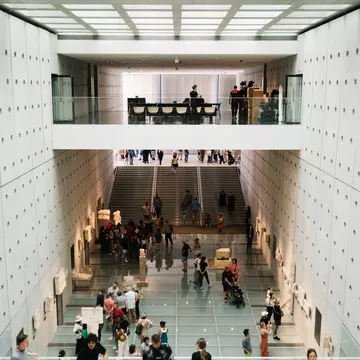
    The Museum of Byzantine Culture is a well-presented modern museum that uses ambient lighting and a good running wall text to enliven the 3000 or so artefacts in its permanent collection. They include frescoes, mosaics, embroidery, ceramics, inscriptions and icons from the early Christian period to the Fall of Constantinople (1453) in Macedonia.

    reviewed

  4. D

    Archaeological Museum

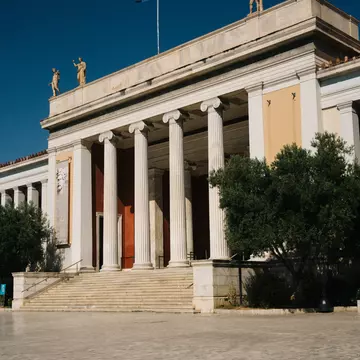
    The Archaeological Museum has finds from the prehistoric period through to ancient Macedonian and Hellenistic times. The most famous exhibit, the Gold of Macedon, presents precious objects (6th- to 2nd-century BC) from the royal tombs and other central Macedonian excavation sites. The craftsmanship is phenomenal; delicate filigree wreaths, pins for fastening dresses, and grave masks from Sindos are among the best.

    The Derveni Crater (330-320 BC), a vast, ornate Hellenistic vase of bronze and tin used initially for mixing wine and water and later as a funerary urn, has intricate relief carvings illustrating the life of Dionysus, with mythical figures, animals, vines and iv…

    reviewed

  5. E

    Palace of Galerius

    Very close to one another, from Plateia Navarinou north across Egnatia, stand three major monuments associated with the early-4th century Roman emperor Galerius. The ruined Palace of Galerius sprawls east-west across the square. You can descend into it, or just peer over the handrail. Pieces of floor mosaic, columns and a few walls survive.

    Across Egnatia is the Arch of Galerius, featuring sculpted soldiers in combat; it was erected in 303 AD to celebrate the emperor's victories over the Persians in 297.

    reviewed

  6. F

    Church of Agia Sofia

    The 8th-century Church of Agia Sofia , a not-so-small miniature of its namesake in İstanbul, occupies Plateia Agias Sofias south of Egnatia. The dome has a striking mosaic of the Ascension of Christ.

    Also see the restored, 5th-century Church of the Panagia Ahiropiitos, which has an early basilica form; some mosaics and frescoes remain. The name, meaning 'made without hands', refers to the miraculous 12th-century appearance of an icon of the Virgin.

    reviewed

  7. G

    Galerius Rotunda

    Just north of the Arch of Galerius is the Galerius Rotunda. Galerius built this hulking brick structure as his future mausoleum, though he never used it, dying in retirement in what is now Serbia instead. Constantine the Great made the Rotunda Thessaloniki's first church (Agiou Giorgou); the Ottomans would transform it into a mosque (the minaret's been mostly restored). There are surviving frescoes inside the enormous building.

    reviewed

  8. H

    Roman Agora

    The Roman Agora lies north of Plateia Aristotelous, across Egnatia on upper Plateia Dikastirion. Commercial activity began in the 3rd century BC and peaked under the Romans, when the area was buzzing with public affairs, services and shops. A helpful, English-language board explains the layout of the remains, which include clustered shop walls and a few mosaic floor remnants.

    reviewed

  9. I

    Museum of the Macedonian Struggle

    The story of how heroic Greek revolutionaries wrested Macedonia from the clutches of both Turks and Bulgars is graphically told at the Museum of the Macedonian Struggle . Housed in the former Greek consulate to the Ottoman Empire, this museum has hard-to-find maps, old firearms, photos, uniforms and more.

    reviewed

  10. J

    Church of Osios David

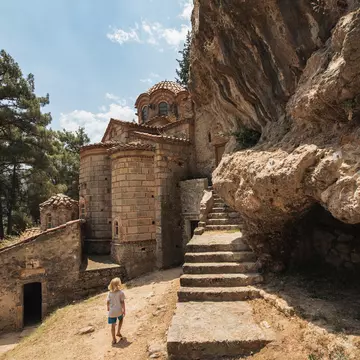
    Just down from the Monastary of Vlatadon is the little 5th-century Church of Osios David , allegedly built to commemorate the secret baptism of Galerius' daughter, Theodora, while father was away. It contains well-preserved mosaics and rare 12th-century frescoes depicting the baptism of Christ.

    reviewed

  11. Advertisement

  12. K

    Jewish Museum of Thessaloniki

    The Jewish Museum of Thessaloniki traces Jewish history in Thessaloniki from 140 BC to the Spanish arrivals in 1492 and until WWII through well-presented displays and photos. The museum houses remains from Thessaloniki's large Jewish cemetery, vandalised in 1942 by the Nazis.

    reviewed

  13. L

    Thessaloniki Museum of Photography

    The Thessaloniki Museum of Photography , located in a cool former warehouse on the port, displays historical and contemporary Greek photography, plus dynamic temporary exhibitions. The small café overlooks the water.

    reviewed

  14. M

    Atatürk's House

    Atatürk's House , located within the Turkish Consulate grounds, is where the dashing Mustafa Kemal was born in 1881. The museum honours modern Turkey's founder, and has original furnishings and memorabilia.

    reviewed

  15. N

    Museum of Ancient Greek & Byzantine Instruments

    The Museum of Ancient Greek & Byzantine Instruments is an unusual, three-floor museum that displays instruments from antiquity to the 19th century. Excellent multi-lingual museum catalogues are available.

    reviewed

  16. O

    Yeni Hamam

    Yeni Hamam is a grand 17th-century Ottoman structure with great acoustics; it's now used as a sophisticated concert hall. If something's on, it's well worth seeing a show there.

    reviewed

  17. P

    Bey Hamam

    Bey Hamam , also known as Paradeisos Baths, is Thessaloniki's oldest Turkish bath, dating from 1444. This large and labyrinthine structure is now used for art shows.

    reviewed

  18. Q

    Monastery of Vlatadon

    Up near the walls, the Monastery of Vlatadon has a leafy, secluded location and a small museum. A gift shop selling icons is inside.

    reviewed

  19. R

    Church of Nikolaos Orfanos

    Also in the Kastra is the 4th-century Church of Nikolaos Orfanos , which has superb frescoes.

    reviewed