Museum sights in Berlin
-
A
Sammlung Kindheit & Jugend
On the upper floor of a GDR-era school, this small museum takes you on a sometimes entertaining, sometimes pedantic journey through the history of growing up in Germany, Berlin in particular. Nostalgia buffs can squeeze behind the wooden desks of a re-created 1912 classroom or discover the purpose of an Eselskappe (donkey hat), which had to be worn by undisciplined kids, or test their penmanship using quill and ink. The big collection of toys from the past two centuries brings smiles to faces young and old.
reviewed
-
B
Deutscher Dom
reviewed
-
C
Museum für Film und Fernsehen
Germany's film history gets the star treatment year-round in the engaging Museum für Film und Fernsehen in the Sony Center. Make use of the excellent audioguide as you skip around galleries dedicated to pioneers such as Fritz Lang, ground-breaking movies such as Olympia by Leni Riefenstahl and legendary divas such as Marlene Dietrich. The TV exhibit is not nearly as engrossing, although if you ever wondered what Star Trek sounds like in German, this is your chance.
reviewed
-
D
Historischer Hafen Berlin
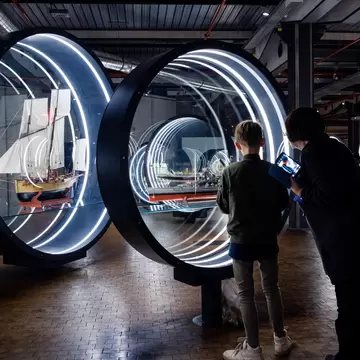
Laced by rivers, canals and lakes, it’s not surprising that Berlin has a long history in inland navigation and it even had the busiest river port in Germany until WWII. The Historischer Hafen (Historical Harbour), at the southern tip of Museumsinsel, is an outdoor museum with over 20 vessels, barges and tugboats, many still operational. One boat doubles as a café in summer while another contains a small exhibit documenting 250 years of river shipping on the Spree and Havel.
reviewed
-
Haus Der Wannseekonferenz Gedenkstätte
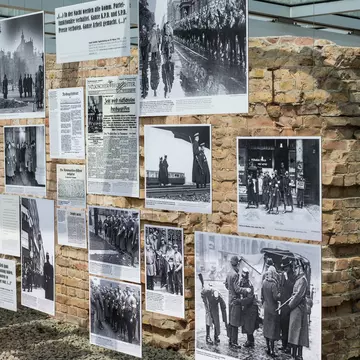
In January 1942, a group of elite Nazi officials met in a stately villa on Wannsee to hammer out the details of the 'Final Solution' - the systematic deportation and murder of European Jews in eastern Europe. Today the same building houses the memorial Haus der Wannseekonferenz Gedenkstätte. You can stand in the room where discussions took place and study the conference minutes. Other rooms chronicle the horrors leading up to - and perpetrated during - the Holocaust.
reviewed
-
E
Das Verborgene Museum
Founded by a pair of feminist artists and art historians, the nonprofit Hidden Museum has a unique focus: the largely forgotten works by early-20th-century women artists, mostly from Germany. Past exhibits have highlighted the works of expressionist artist Ilse Heller-Lazard and photographs by Henriette Grindat. Curators mount about two exhibits annually, which run for three or four months each. At other times, the museum is closed.
reviewed
-
F
IM Pei Bau
Temporary exhibits of the Deutsches Historisches Museum take up a modern annexe called IM Pei Bau for its architect. Fronted by a glass spiral, it’s a strikingly geometrical space, made entirely from triangles, rectangles and circles, yet imbued with a sense of lightness achieved through an airy atrium and generous use of glass. Check your email at the internet terminal in the basement (free with museum admission).
reviewed
-
G
Bauhaus Archiv
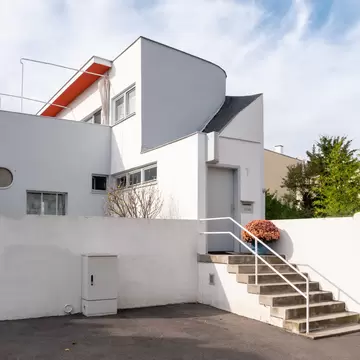
Bauhaus founder Walter Gropius himself designed the avant-garde building that now houses the Bauhaus archive and museum with its distinctive white shed roofs. Inside, changing exhibits using study notes, workshop pieces, photographs, blueprints, models and other objects and documents, illustrate the Bauhaus theories.
Highlights include material relating to Gropius’ 1925 Bauhaus buildings in Dessau and Lázló Moholy-Nagy’s clever kinetic sculpture called Light-Space-Modulator. Nice cafe and cool shop stocked with Bauhaus-inspired gewgaws.
reviewed
-
H
Ramones Museum
They sang ‘Born to Die in Berlin’ but the legacy of the Ramones punk pioneers is kept very much alive in the German capital, thanks to this eclectic collection of memorabilia. Look for Marky Ramone’s drumsticks and Johnny Ramone’s jeans amid signed album covers, posters, flyers, photographs and other flotsam and jetsam. The on-site cafe also hosts the occasional concert.
reviewed
-
I
Museum Knoblauchhaus
The 1761 Knoblauchhaus is the oldest residential building in the Nikolaiviertel and the one-time home of the prominent Knoblauch family, which included politicians, architects and patrons of the arts who enjoyed tea and talk with Schinkel, Schadow and Begas. Take a spin around the neatly furnished period rooms to get a sense of how the well-to-do lived, dressed and made their money during the Biedermeier period.
reviewed
Advertisement
-
J
Zucker Museum
Got a sweet tooth? Check out the quirky Zucker Museum (Sugar Museum), a surprisingly entertaining exhibit where you’ll learn all about the origin of sugar and its chemistry. Find out about its uses in the production of vinegar, pesticides and even interior car panelling and also discover its role in the slave trade. Descriptions are in German only, but a free English-language pamphlet is available.
reviewed
-
K
Kennedy Museum
US president John F Kennedy of 'Ich bin ein Berliner' fame is the focus of the small Kennedy Museum, an intimate, nonpolitical exhibit set up like a walk-through family photo album. Besides a great array of photographs there are scribbled notes, JFK's crocodile-leather briefcase, Jackie's Persian lamb pillbox hat and a Superman comic-book edition starring the president.
reviewed
-
Liebermann-Villa am Wannsee
This lovely villa was the summer home of Berlin Secession founder Max Liebermann from 1909 until his death in 1935. Liebermann loved the lyricism of nature and gardens in particular and often painted the scenery right outside his window. Some can be seen in the upstairs rooms and his barrel-vaulted studio. In summer, there are few more languid spots then the garden and Wannsee-facing cafe terrace.
reviewed
-
L
Museum für Kommunikation Berlin
Three cheeky robots welcome you to this elegant, neo-baroque museum, which takes you on an entertaining romp through the evolution of communication technology – smoke signals to computers. Admire such rare items as a Blue Mauritius stamp, test out time-honoured communication techniques or ponder how information technology has changed our daily lifes. A multimedia iPod touch guide (€1.50) provides the full low-down.
reviewed
-
M
Märkisches Museum
This old-school history museum is a rewarding stop for anyone keen on learning how the tiny trading village of Berlin-Cölln evolved into today’s metropolis. Official documents, weapons, sculptures and objects from daily life are thematically arranged, often in opulent historic rooms such as the Gothic chapel and the Great Hall.
Scale models help visualise the city's physical growth. Crowd favourites include the 19th-century Kaiserpanorama, basically a 3-D slide show that was a form of mass entertainment back then. A good time to visit is around 3pm on Sundays when the historic mechanical musical instruments are launched on their cacophonous journey (adult/concession…
reviewed
-
N
Story of Berlin
This multimedia museum breaks down 800 years of Berlin history into bite-sized chunks that are easy to swallow but substantial enough to be satisfying. Each of the 23 rooms encapsulates a different theme or epoch in the city's history, from its founding in 1237 to the fall of the Berlin Wall. A highlight is a tour of a still functional atomic bunker beneath the building.
reviewed
-
O
Kreuzberg Museum
The ups and downs of one of Berlin’s most colourful districts are chronicled in this converted red-brick factory. The permanent exhibit zeros in on such themes as Kreuzberg’s radical legacy or how immigrants have shaped the area. The 1928 printing press on the mezzanine level can still be cranked into action on occasion.
reviewed
-
P
Altes Museum
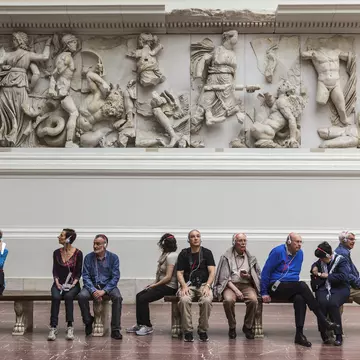
Schinkel pulled out all the stops for the grand neoclassical Old Museum, the first exhibition space to open on Museumsinsel in 1830. A curtain of fluted columns gives way to a Pantheon-inspired rotunda that’s the focal point of the prized Antiquities Collection of Greek, Roman and Etruscan art and sculpture. The museum has been revamped and reorganised as part of the Museumsinsel master plan, so if you haven’t visited in a while, you’re in for lots of surprises.
The Etruscan collection, for instance, gets airplay for the first time since 1939 in the new upstairs exhibit. Admire a circular shield from the grave of a warrior and amphora, vessels, jewellery, coins and…
reviewed
-
Q
Käthe-Kollwitz-Museum
This exquisite museum is devoted to Käthe Kollwitz (1867–1945), one of the greatest German women artists, whose social and political awareness lent a tortured power to her lithographs, graphics, woodcuts, sculptures and drawings. Recurring themes include motherhood and death; sometimes the two are strangely intertwined as in works that show death as a nurturing figure, cradling its victims.
Highlights include the antihunger lithography Brot! (Bread!, 1924) and the woodcut series Krieg (War, 1922–23). There’s also a copy of Gustav Seitz’ Kollwitz sculpture on Kollwitzplatz in Prenzlauer Berg. Special exhibits supplement the permanent exhibit twice annually.
reviewed
-
R
Berliner Medizinhistorisches Museum
Affiliated with the Charité Hospital, this museum chronicles 300 years of medical history in an anatomical theatre, a pathologist's dissection room, a laboratory and a historical patients' ward. The heart of the exhibit, though, is the grisly pathology collection that's essentially a 3D medical textbook on human disease and deformities. Definitely not for the squeamish. In fact, those under 16 must be accompanied by an adult.
Monstrous tumours, inflamed organs and a colon the size of an elephant’s trunk and two-headed fetuses are all pickled in formalin and neatly displayed in glass jars. Changing exhibits are shown on the 2nd floor. The basis of the specimen collection…
reviewed
Advertisement
-
S
Alte Nationalgalerie
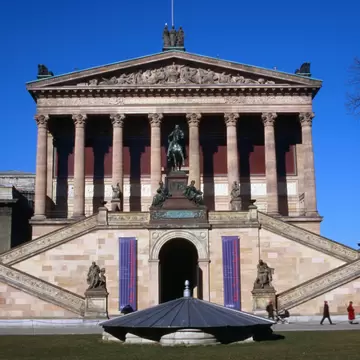
The Greek temple-style Old National Gallery, open since 1876, is a three-storey showcase of top-notch, 19th-century European art. To get a sense of the virtuosity of the period, study the canvasses glorifying Prussia - epics by Franz Krüger and Adolf Menzel and the moody landscapes by Romantic heart-throb, Caspar David Friedrich. There’s also a sprinkling of French impressionists in case you’re keen on seeing yet another version of Monet’s Waterlilies and plenty of sculpture by Rauch and Schadow, possibly to tease you into visiting the much larger collection in the nearby Friedrichswerdersche Kirche.
reviewed
-
T
Musikinstrumenten-Museum
Packed with fun, precious and rare sound machines, the Musical Instruments Museum shares a building with the Philharmonie. There are plenty of old trumpets, bizarre bagpipes and even a talking walking stick as well as a handful of 'celebrity instruments': the glass harmonica invented by Ben Franklin, a flute played by Frederick the Great and Johann Sebastian Bach's cembalo. Stop at the listening stations to hear what some of the more obscure instruments sound like.
A crowd favourite is the Mighty Wurlitzer (1929), an organ with more buttons and keys than a troop of beefeaters that's cranked up at noon on Saturday. Classical concerts, many free, take place year-round (ask…
reviewed
-
U
Bodemuseum
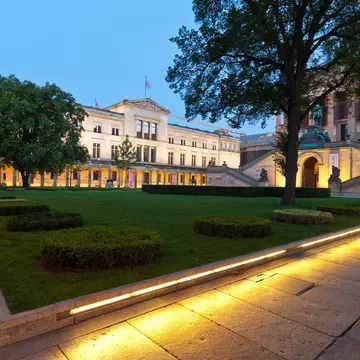
Mighty and majestic, the Bodemuseum has pushed against the northern wedge of Museumsinsel like a proud ship’s bow since 1904. The gloriously restored neo-baroque beauty presents several collections in largely naturally lit galleries with marble floors and wood-panelled ceilings.
Prime billing goes to the sculpture collection, hailed as ‘the most comprehensive display of European sculpture anywhere’ by none other than British Museum director Neil MacGregor. There are works here from the early Middle Ages to the late 18th century, including serious masterpieces like Donatello’s early Renaissance Pazzi Madonna, Giovanni Pisano’s Man of Sorrows relief and the…
reviewed
-
V
Kunstgewerbemuseum
The cavernous Kunstgewerbemuseum brims with precious objects created through the ages from gold, silver, ivory, wood, porcelain and other fine materials. From medieval gem-encrusted crosses to art-deco ceramics and Philippe Starck furniture, it's all here.
reviewed
-
W
Museum für Naturkunde
Fossils and minerals don’t quicken your pulse? Well, how about a 23m-long and 12m-high brachiosaurus? Do we have your attention? The world’s largest mounted dino is the star of Berlin’s famed natural history museum. The gentle giant is joined by about a dozen Jurassic buddies, including the ferocious allosaurus and a spiny-backed kentrosaurus. All are about 150 million years old and hail from the Tendaguru in southeast Tanzania. Clever ‘Juraskopes’ bring half a dozen of them back to virtual flesh-and-bone life. In the same hall, in the far left corner, is the museum’s rarest critter, a 25cm tall archaeopteryx, which shows the evolutionary link between…
reviewed