Dubrovnik Sights

  1. Cathedral of the Assumption of the Virgin

    Across the square from the Rector's Palace is the Cathedral of the Assumption of the Virgin . The church was built on the site of a 7th-century basilica that was enlarged in the 12th century, supposedly as the result of a gift from England's King Richard I, the Lionheart, who was saved from a shipwreck in the nearby island of Lokrum. Soon after the earlier cathedral was destroyed in the 1667 earthquake, work began on this new cathedral, which was finished in 1713 in a purely baroque style.

    Read more about Cathedral of the Assumption of the Virgin

  2. Cathedral of the Assumption of the Virgin Treasury

    The treasury contains relics of St Blaise as well as 138 gold and silver reliquaries largely made in the workshops of Dubrovnik's goldsmiths between the 11th and 17th centuries. Among a number of religious paintings, the most striking is the polyptych of the Assumption of the Virgin, made in Titian's workshop.

    Read more about Cathedral of the Assumption of the Virgin Treasury

  3. Dominican Monastery & Museum

    The Dominican Monastery & Museum is another architectural highlight in a transitional Gothic-Renaissance style with a rich trove of paintings. Built at the same time as the city walls in the 14th century, the stark exterior resembles a fortress more than a religious complex. The interior contains a graceful 15th-century cloister constructed by local artisans after the designs of the Florentine architect Massa di Bartolomeo, and a large, single-naved church with an altarpiece by VlahoBukovac.

    Read more about Dominican Monastery & Museum

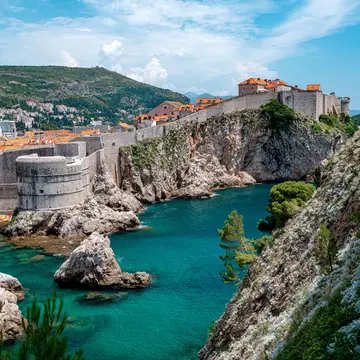
  4. Dubrovnik City Walls

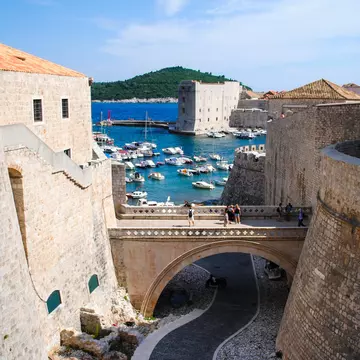
    No visit to Dubrovnik would be complete without a leisurely walk around the city walls. Built between the 13th and 16th centuries and still intact today, these powerful walls are the finest in the world and Dubrovnik's main claim to fame.

    Read more about Dubrovnik City Walls

  5. Dubrovnik Synagogue

    This city's 15th-century synagogue is the oldest Sephardic and the second-oldest synagogue in Europe.

    Read more about Dubrovnik Synagogue

  6. Ethnographic Museum

    The Ethnographic Museum, in the 16th-century Rupe Granary, contains exhibits relating to agriculture.

    Read more about Ethnographic Museum

  7. Franciscan Monastery & Museum

    Next to St Saviour Church is the Franciscan Monastery & Museum. Over the door of the monastery church is a remarkable pietà sculpted by the local masters Petar and Leonard Andrijić in 1498. Unfortunately, the portal is all that remains of the richly decorated church that was destroyed in the 1667 earthquake. Inside the monastery complex is the mid-14th century cloister, one of the most beautiful late-Romanesque structures in Dalmatia.

    Read more about Franciscan Monastery & Museum

  8. Lapad Bay

    There are hotel beaches along the Lapad Bay, which you are able to use without a problem. The largest beach is outside the Hotel Kompas.

    Read more about Lapad Bay

  9. Little Onofrio Fountain

    Little Onofrio Fountain is part of the same water project as its larger cousin to the west but built to supply water to the market place on Luža Sq.

    Read more about Little Onofrio Fountain

  10. Luža Square Clock Tower

    The Clock Tower dominates the square and makes an elegant punctuation point at the end of Placa. First built in 1444, it was restored many times, most recently in 1929, and is notable for the two bronze figures in the bell tower that ring out the hours.

    Read more about Luža Square Clock Tower

  11. Advertisement

  12. Maritime Museum

    This museum traces the history of navigation in Dubrovnik with ship models, navigational objects and paintings.

    Read more about Maritime Museum

  13. Memorial Room of the Defenders of Dubrovnik

    Also in the interior is the Memorial Room of the Defenders of Dubrovnik, a heartbreaking collection of portraits of young people who perished between 1991 and 1995.

    Read more about Memorial Room of the Defenders of Dubrovnik

  14. Museum of Modern Art

    Art-lovers will enjoy the Museum of Modern Art for a look at contemporary Croatian artists, particularly the local painter Vlaho Bukovac.

    Read more about Museum of Modern Art

  15. Orlando Column

    The Luža Sq was formerly used as a market place. The Orlando Column is a popular meeting place that used to be the place where edicts, festivities and public verdicts were announced. Carved in 1417, the forearm of this medieval knight was the official linear measure of the Republic - the ell of Dubrovnik, which measures 51.1cm.

    Read more about Orlando Column

  16. Pile Gate

    Begin your visit at Old Town's Pile Gate, which dates from 1537. Notice the statue of St Blaise, the city's patron saint, set in a niche over the Renaissance arch. Originally, the drawbridge at the gate's entrance was lifted every evening, the gate was closed and the key handed to the prince.

    Read more about Pile Gate

  17. Rector's Palace

    This elegant 15th-century building was erected on the site of an old fort in order to house the rector, Dubrovnik's ruler. Though predominantly Gothic, it also contains Renaissance elements, particularly in the lavishly sculptured capitals on the exterior porch.

    Read more about Rector's Palace

  18. Serbian Orthodox Church & Museum

    Further down Placa, Nikole Božidarevića leads to the Serbian Orthodox Church & Museum, which dates from 1877 and contains a fascinating collection of icons dating from the 15th to 19th century. In addition to portraits of the biblical family originating in Crete, Italy, Russia and Slovenia, there are several portraits by the illustrious Croatian painter Vlaho Bukovac.

    Read more about Serbian Orthodox Church & Museum

  19. Sponza Palace

    Across the square is the 16th-century Sponza Palace which was originally a customs house, then a minting house, a State treasury and a bank. Now it houses the State Archives, which contains a priceless collection of manuscripts dating back nearly a thousand years. This superb structure is a mixture of Gothic and Renaissance styles beginning with an exquisite Renaissance portico resting on six columns. The 1st floor has late-Gothic windows and the 2nd-floor windows are in a Renaissance style, with an alcove containing a statue of St Vlaho.

    Read more about Sponza Palace

  20. St Blaise's Church

    The imposing St Blaise's Church was built in 1715 to replace an earlier church destroyed in the earthquake. Constructed in a baroque style following the church of St Mauritius in Venice, the ornate exterior contrasts strongly with the sober residences surrounding it. The interior is notable for its marble altars and a 15th-century silver gilt statue of St Blaise who is holding a scale model of pre-earthquake Dubrovnik.

    Read more about St Blaise's Church

  21. St Ignatius Church

    St Ignatius was built in the same style as the Cathedral of the Assumption of the Virgin and completed in 1725. Inside are frescoes displaying scenes from the life of St Ignatius, founder of the Jesuit society.

    Read more about St Ignatius Church

  22. Advertisement

  23. St Saviour Church

    The lovely St Saviour Church was built between 1520 and 1528 and was one of the few buildings to have survived the earthquake of 1667. It's open for occasional exhibitions and concerts.

    Read more about St Saviour Church

  24. War Photo Limited

    For a change from the ancient and the artsy, try the excellent War Photo Limited managed by former photojournalist Wade Goddard. The award-winning photos on display here concentrate on the subtleties of human violence rather than on its carnage. The permanent exhibition focuses on the Balkan wars and temporary exhibits include other wars.

    Read more about War Photo Limited