go to content go to search box go to global site navigation

Moscow

Sights in Moscow

‹ Prev

of 7

  1. A

    St Basil’s Cathedral

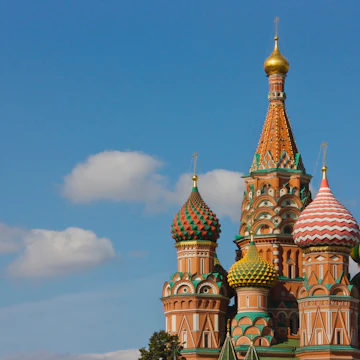
    At the southern end of Red Square, framed by the massive facades of the Kremlin and GUM department store, stands the icon of Russia: St Basil’s Cathedral. This crazy confusion of colours, patterns and shapes is the culmination of a style that is unique to Russian architecture. Before St Basil’s, this style of tent roofs and onion domes had been used to design wooden churches. In 1552 Ivan the Terrible captured the Tatar stronghold of Kazan on the feast of Intercession. He commissioned this landmark church, officially the Intercession Cathedral, to commemorate the victory. From 1555 to 1561 architects Postnik and Barma created this masterpiece that would become the…

    reviewed

  2. B

    Armoury

    The Armoury dates back to 1511, when it was founded under Vasily III to manufacture and store weapons, imperial arms and regalia for the royal court. Later it also produced jewellery, icon frames and embroidery. During the reign of Peter the Great all craftspeople, goldsmiths and silversmiths were sent to St Petersburg, and the armoury became a mere museum storing the royal treasures. A fire in 1737 destroyed many of the items. In the early 19th century, new premises were built for the collection. Much of it, however, never made it back from Nizhny Novgorod, where it was sent for safekeeping during Napoleon’s invasion in 1812. Another building to house the collection was…

    reviewed

  3. C

    Cathedral of Christ the Saviour

    This gargantuan cathedral now dominates the skyline along the Moscow River. It sits on the site of an earlier and similar church of the same name, built between 1839 and 1860, and finally consecrated in 1883. The church commemorates Russia’s victory over Napoleon. The original was destroyed during Stalin’s orgy of explosive secularism. Stalin planned to replace the church with a 315m-high Palace of Soviets (including a 100m-high statue of Lenin), but the project never got off the ground – literally. Instead, for 50 years the site served an important purpose: the world’s largest swimming pool. This time around, the church was completed in a mere two years, in time for…

    reviewed

  4. D

    Gulag History Museum

    In the midst of all the swanky shops on ul Petrovka, an archway leads to a courtyard that is strung with barbed wire and hung with portraits of political prisoners. This is the entrance to a unique museum dedicated to the Chief Administration of Corrective Labour Camps and Colonies, better known as the GULAG. Guides dressed like guards describe the vast network of labour camps that once existed in the former Soviet Union and recount the horrors of camp life. Millions of prisoners spent years in these labour camps, made famous by Alexander Solzhenitsyn’s book The Gulag Archipelago. More than 18 million people passed through this system during its peak years, from 1929 to…

    reviewed

  5. E

    Tretyakov Gallery

    The exotic boyar castle on a little lane in Zamoskvorechie contains the main branch of the State Tretyakov Gallery, housing the world’s best collection of Russian icons and an outstanding collection of other pre­revolutionary Russian art. Show up early to beat the queues.

    The building was designed by Viktor Vasnetsov between 1900 and 1905. The gallery started as the private collection of the 19th-century industrialist brothers Pavel and Sergei Tretyakov. Pavel was a patron of the Peredvizhniki, or Wanderers, a group of 19th-century painters who broke away from the conservative Academy of Arts and started depicting common people and social problems. Nowadays, these are…

    reviewed

  6. F

    Kolomenskoe Museum-Reserve

    Set amid 4 sq km of parkland, on a bluff above a bend in the Moscow River, this Museum-Reserve is an ancient royal country seat and Unesco World Heritage Site. Many festivals are held here, so check if anything is happening during your visit. From Bolshaya ul, enter at the rear of the grounds through the 17th-century Saviour Gate to the whitewashed Our Lady of Kazan Church, both built in the time of Tsar Alexey. The church faces the site of his great wooden palace, which was demolished in 1768 by Catherine the Great. Ahead, the white, tent-roofed 17th-century front gate and clock tower mark the edge of the old inner-palace precinct. The golden double-headed eagle that…

    reviewed

  7. G

    Alexandrovsky Garden

    The first public park in Moscow, Alexandrovsky Garden sits along the Kremlin’s western wall. Colourful flower beds and impressive Kremlin views make it a favourite strolling spot for Muscovites and tourists alike. Back in the 17th century, the Neglinnaya River ran through the present gardens, with dams and mills along its banks. When the river was diverted underground, the garden was founded by architect Osip Bove, in 1821. Enter through the original gates at the northern end. The Tomb of the Unknown Soldier (Mogila neizvestnogo soldata) at its north end is a kind of national pilgrimage spot, where newlyweds bring flowers and have their pictures taken. The tomb contains…

    reviewed

  8. H

    Izmaylovsky Park & Royal Estate

    Izmaylovo is best known for its extensive arts and crafts market, held every weekend beside the royal estate. After shopping, Izmaylovsky Park and the crumbling royal estate are nice for a picnic or more serious outdoor activity. A former royal hunting reserve 10km east of the Kremlin, Izmaylovsky Park is the nearest large tract of undeveloped land to central Moscow. Its 15 sq km contain a recreation park at the western end and a much larger expanse of woodland (Izmaylovsky Lesopark) east of Glavnaya alleya, the road that cuts north–south across the park. Trails wind around this park, making it a good place to escape the city for hiking or biking. From Partizanskaya metro…

    reviewed

  9. I

    ZKP Tagansky Cold War Museum

    On a quiet side street near Taganskaya pl sits a nondescript neoclassical building. This is the gateway to the secret Cold War–era communications centre, ZKP Tagansky. Operated during the Cold War by Central Telephone and Telegraph, the facility was meant to serve as the communications headquarters in the event of a nuclear attack. As such, the building was just a shell and served as entry into the 7000-sq-metre space that is 60m underground.

    Now managed by private interests, the facility is being converted into a sort of museum dedicated to the Cold War. Unfortunately, not much remains from that era. The vast place is nearly empty, except for a few exhibits set up for…

    reviewed

  10. J

    Novodevichy Cemetery

    Adjacent to the Novodevichy Convent, the Novodevichy Cemetery is one of Moscow’s most prestigious resting places – a veritable who’s who of Russian politics and culture. Here you will find the tombs of Bulgakov, Chekhov, Gogol, Mayakovsky, Prokofiev, Stanislavsky and Eisenstein, among many other Russian and Soviet cultural notables.

    In Soviet times Novodevichy Cemetery was used for eminent people the authorities judged unsuitable for the Kremlin wall, most notably Khrushchev. The intertwined white-and-black blocks round Khrushchev’s bust were intended by sculptor Ernst Neizvestny to represent Khrushchev’s good and bad sides.

    The tombstone of Nadezhda Alliluyeva,…

    reviewed

  11. Advertisement

  12. K

    Gorky Park

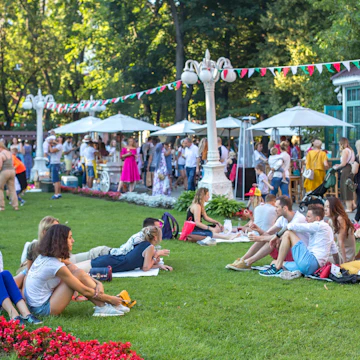
    Part ornamental park, part fun fair, Gorky Park is one of the most festive places in Moscow – a perfect way to escape the hubbub of the city. Officially the Park Kultury (Park of Culture), it’s named after Maxim Gorky. The park stretches almost 3km along the river, upstream of Krymsky most. You can’t miss the showy entrance, marked by colourful flags waving in the wind, and the happy sounds of an old-fashioned carousel. Inside, Gorky Park has a small Western-style amusement park, which features two roller coasters and almost a dozen other terror-inducing attractions (that is, aside from the view of the Peter the Great statue). Most of the rides cost around R50 to R100.…

    reviewed

  13. L

    Lenin’s Tomb

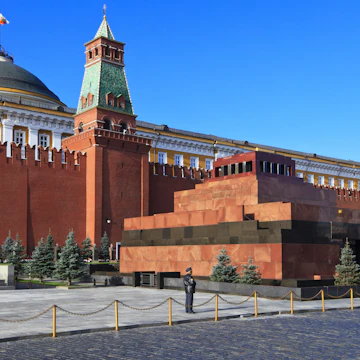
    Although Vladimir Ilych requested that he be buried beside his mum in St Petersburg, he still lies in state at the foot of the Kremlin wall, receiving visitors who come to pay their respects to the founder of the Soviet Union. The embalmed leader has been here since 1924 (apart from a retreat to Siberia during WWII). Before joining the queue at the northwestern corner of Red Square, drop your camera at the left-luggage office in the State History Museum, as you will not be allowed to take it with you. Humourless guards ensure that visitors remain respectful. After trouping past the embalmed figure, emerge from the mausoleum and inspect the Kremlin wall, where other…

    reviewed

  14. M

    Moscow House of Photography

    With impressive archives of contemporary and historic photography, the Moscow House of Photography organises occasional exhibits at its small on-site museum, often featuring works from prominent photo­graphers from the Soviet period. You can also see its exciting and innovative contemporary exhibits around town, especially at Manezh Exhibition Centre and Winzavod. MDF is also responsible for several month-long photography festivals, Photobiennale (held in even-numbered years) and Fashion & Style in Photography (held in odd-numbered years).

    reviewed

  15. N

    Borodino Panorama

    Following the vicious but inconclusive battle at Borodino in August 1812, Moscow’s defenders retreated along what are now Kutuzovsky pr and ul Arbat, pursued by Napoleon’s Grand Army. Today, about 3km west of Novoarbatsky most and Hotel Ukraina (where Russian commander Mikhail Kutuzov stopped for a war council) is the Borodino Panorama, a pavilion with a giant 360-degree painting of the Borodino battle. Standing inside this tableau of bloodshed – complete with sound effects – is a powerful way to visualise the event.

    reviewed

  16. O

    Tolstoy Estate-Museum

    Leo Tolstoy’s winter home during the 1880s and 1890s now houses an interesting museum dedicated to the writer’s home life. While it’s not particularly opulent or large, the building is fitting for junior nobility – which Tolstoy was. Exhibits here demonstrate how Tolstoy lived, as opposed to his literary influences, which are explored at the Tolstoy Literary Museum. See the salon where Rachmaninov and Rimsky-Korsakov played piano, and the study where Tolstoy himself wove his epic tales.

    reviewed

  17. P

    Tsaritsyno Palace

    On a wooded hill in far southeast Moscow, Tsaritsyno Palace is a modern-day manifestation of the exotic summer home that Catherine the Great began in 1775 but never finished. Architect Vasily Bazhenov worked on the project for 10 years before he was sacked. She hired another architect, Matvey Kazakov, but the project was eventually forgotten as she ran out of money. For hundreds of years, the palace was little more than a shell, until the government finally decided to finish it in 2007.

    reviewed

  18. Q

    Red Square

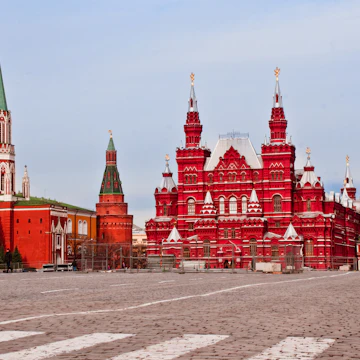
    Immediately outside the Kremlin’s northeastern wall is the celebrated Red Square, the 400m by 150m area of cobbles that is at the very heart of Moscow. Commanding the square from the southern end is St Basil’s Cathedral. This panorama never fails to send the heart aflutter, especially at night.

    reviewed

  19. R

    Assumption Cathedral

    On the northern side of Sobornaya ploshchad, with five golden helmet domes and four semicircular gables facing the square, the Assumption Cathedral is the focal church of prerevolutionary Russia and the burial place of most of the heads of the Russian Orthodox Church from the 1320s to 1700. A striking 1660s' fresco of the Virgin Mary faces Sobornaya ploshchad, above the door once used for royal processions. If you have limited time in the Kremlin, come straight here.

    The visitors entrance is at the western end.

    In 1470, Russian architects Krivtsov and Myshkin were commissioned by Ivan the Great to replace the old dilapidated cathedral which was previously here from 1326.…

    reviewed

  20. S

    Annunciation Cathedral

    The Annunciation Cathedral, at the southwest corner of Sobornaya ploshchad, contains the celebrated icons of master painter Theophanes the Greek. They have a timeless beauty that appeals even to those usually left cold by icons.

    Vasily I built the first wooden church on this site in 1397. Between 1484 and 1489, Ivan III had the Annunciation Cathedral rebuilt to serve as the royal family's private chapel. Originally the cathedral had just three domes and an open gallery round three sides. Ivan the Terrible, whose tastes were more elaborate, added six more domes and chapels at each corner, enclosed the gallery and gilded the roof.

    Under Orthodox law, Ivan's fourth marriage…

    reviewed

  21. T

    Novodevichy Convent

    The Novodevichy Convent was founded in 1524 to celebrate the taking of Smolensk from Lithuania, an important step in Moscow’s conquest of the old Kyivan Rus lands. From early on, noblewomen would retire to the convent, some more willingly than others.

    Novodevichy was rebuilt by Peter the Great’s half-sister Sofia, who used it as a second residence when she ruled Russia as regent in the 1680s. By this time the convent was a major landowner: it had 36 villages and about 10,000 serfs around Russia. When Peter was 17, he deposed Sofia and confined her to Novodevichy; in 1698 she was imprisoned here for life after being implicated in the Streltsy rebellion. (Legend has it…

    reviewed

  22. Advertisement

  23. U

    Pushkin Fine Arts Museum

    This is Moscow’s premier foreign-art museum, showing off a broad selection of European works, mostly appropriated from private collections after the revolution. The Pushkin’s collections are located not only in this main building, but also in the Museum of Private Collections and the Gallery of European & American Art of the 19th & 20th Centuries. A collective ticket to all three museums is available for adults/students for R500/300.

    To see the incredible collection of Impressionist and post-Impressionist paintings, visit the Gallery of European & American Art. What’s left in the main building is still impressive, especially since the place has been revamped, with…

    reviewed

  24. V

    Danilovsky Monastery

    The headquarters of the Russian Orthodox Church stand behind white fortress walls. The Danilovsky Monastery was built in the late 13th century by Daniil, the first Prince of Moscow, as an outer city defence. It was repeatedly altered over the next several hundred years, and served as a factory and a detention centre during the Soviet period. It was restored in time to replace Sergiev Posad as the Church’s spiritual and administrative centre, and became the official residence of the Patriarch during the Russian Orthodoxy’s millennium celebrations in 1988. Today, it radiates an air of purpose befitting the Church’s role in modern Russia. On holy days this place seethes with…

    reviewed

  25. All-Russia Exhibition Centre

    No other place sums up the rise and fall of the great Soviet dream quite as well as the All-Russia Exhibition Centre. The old initials by which it’s still commonly known, VDNKh, tell half the story – they stand for Vystavka Dostizheny Narodnogo Khozyaystva SSSR (USSR Economic Achievements Exhibition). Originally created in the 1930s, the VDNKh was expanded in the 1950s and ‘60s to impress upon one and all the success of the Soviet economic system. Two kilo­metres long and 1km wide, it is composed of wide pedestrian avenues and grandiose pavilions, glorifying every aspect of socialist construction from education and health to agriculture, technology and science. The…

    reviewed

  26. W

    Archangel Cathedral

    The Archangel Cathedral at the southeastern corner of Soborny ploshchad, was for centuries the coronation, wedding and burial church of tsars. It was built by Ivan Kalita in 1333 to commemorate the end of the great famine, and dedicated to Archangel Michael, guardian of the Moscow princes. By the early 16th century it fell into disrepair and was rebuilt between 1505 and 1508 by the Italian architect Alevisio Novi.

    Like the Assumption Cathedral, it is five-domed and essentially Byzantine-Russian in style. However, the exterior has many Venetian Renaissance features - notably the distinctive scallop shell gables and porticoes.

    The tombs of all Muscovy's rulers from the 1320s…

    reviewed

  27. X

    Melnikov House

    On a side street near the Arbat, the home of Konstantin Melnikov still stands as testament to the innovation of the Russian avant-garde in the 1920s. This plot of land was granted to the architect on the grounds that the house was a social experiment that would then be applied to mass housing. (It never was.) He created his unusual new home – the only private house built during the Soviet period – from two interlocking cylinders. It is an ingenious design that employs no internal load-bearing wall and has a self-reinforcing wooden grid floor. The house was also experimental in its designation of living space: the whole family slept in one room, painted a golden yellow and…

    reviewed