Santiago de Cuba

Save

Advertisement

Note: Javascript is disabled in your browser.
To see the gallery in all its glory, you'll need to enable Javascript.

Introducing Santiago de Cuba

Santiago de Cuba is the island's second largest city and a glittering cultural capital in its own right. Anyone with even a passing interest in Cuban literature, music, architecture, politics or ethnology should spend at least a day or two kicking through the myriad of assorted attractions here.

Advertisement

Enlivened by a cosmopolitan mix of Afro-Caribbean culture and situated closer to Haiti and the Dominican Republic than Habana, Santiago's influences have tended to come as much from the east as they have from the west, a factor that has been crucial in shaping the city's distinct individual identity. Nowhere else in Cuba will you find such a colorful combination of people, or such a resounding sense of historical destiny. Diego Velázquez made the city his second capital, Fidel Castro used it to launch his embryonic nationalist revolution, Don Facundo Bacardí based his first ever rum factory here and just about every Cuban music genre from salsa to son first emanated from somewhere in these dusty, rhythmic and undeniably sensuous streets. Then there are the local heroes - Antonio Maceo: soldier; José María Heredia: poet; Frank País: revolutionary; Emilio Bacardí: entrepreneur. The list is long; you can pursue their individual legends further in a rich array of local museums.

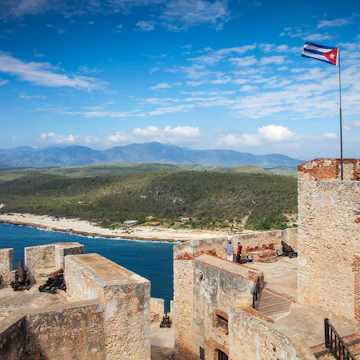
Setting-wise Santiago could rival any of the world's great urban centers. Caught dramatically between the indomitable Sierra Maestra and the azure Caribbean, the city's casco histórico (historical center) retains a time-worn and slightly neglected air that's vaguely reminiscent of Barbados, Salvador in Brazil, or New Orleans.

Santiago is also hot, in more ways than one. While the temperature rises up into the thirties out on the street, Jineteros/as (both the male and female varieties of touts) go about their illicit business in the shadows with a level of ferocity unmatched elsewhere in Cuba. Then there's the pollution, particularly bad in the central district where cacophonous motorcycles swarm up and down narrow streets better designed for horses or pedestrians. Travelers should beware. While never particularly unsafe, everything in Santiago feels a little madder, more frenetic, a tad more desperate, and visitors should be prepared to adjust their pace accordingly.

Surprisingly compact for Cuba's second largest city, Santiago was kitted out for the new millennium with a cluster of monumental buildings thrown up in the early 1990s including the Legoland Meliá Santiago de Cuba, the Teatro José María Heredia, the dramatic Antonio Maceo Monument, the modern train station on the northwestern side and the flashy new terminal building at Antonio Maceo International Airport.

Last updated: Oct 20, 2009

Tips & articles

  1. Revolutionary roll call: Cuba’s fighting heroes

    13 August 2009

    Cuba churns out revolutionaries like other countries produce movie stars and, with outside influence...

    Read more

  2. Festival fun, Cuban style

    13 August 2009

    Through war, austerity, rationing and hardship, the Cubans have always retained their infectious joie...

    Read more

  3. El ritmo cubano: Cuba’s musical soul

    10 August 2009

    Rich, vibrant, layered and soulful, Cuban music has long acted as a standard-bearer for the sounds and...

    Read more

See all tips & articles for Santiago de Cuba

Travel Insurance

Going to Cuba? Make sure you're covered.

Get a quote

See all travel services

Advertisement