Posted Sunday, May 11, 2008, 3:55 AM by Lonely Planet
The overnight train from Hanoi to the Vietnam-China border town of Lao Cai gets in at 4:30am. It's a befuddling time, and it's easy to lose your bearings - especially if you're heading to Sapa. Stay firm, bargain hard, and insist on your destination, though, and you'll end up at the hill station (albeit after more than an hour in a bumpy, crowded minivan).
It's worth it. Sapa is magical: cool, misty and magnificent. The first day we arrived was so foggy that we couldn't see across the street. That didn't stop us from doing a day walk to nearby Cat Cat village, which rewarded us with close-up views of waterfalls and drastically improved lung capacities.
But it wasn't until the next day that we could see what we had been missing: endless, sweeping valley views. Paddies terraced across the hillsides, right down to the rivers. Heavily forested mountains, their tops always invisible. We were looking forward to our 10km walk through the villages dotting the valley floor.
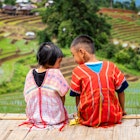
That's when it got interesting. The Sapa region is home to several minority groups, most noticeably the Black Hmong, the Red Dzao and the Dzai groups. All three have their own distinct, mutually incomprehensible languages (Vietnamese is the language of commerce). Most members of these groups live a subsistence lifestyle, growing crops and occasionally selling the surplus for agricultural supplies and equipment.
As we walked, several Black Hmong women gathered around us, peppering us with questions and telling us stories of their lives. Their command of English, French and Chinese was admirable. They talked with us all the way along the mountainside. And when we crossed from their village to the next, the solicitations began. "Buy from me?" several asked, displaying beautifully crafted blankets, dubiously put-together bracelets, and cheap trinkets. We smiled and declined politely, but they persisted. "We walk all the way with you, we talk with you, and now you don't buy from us?"
We felt torn. We really didn't want anything. Our packs were full enough for our liking, and we had resolved to buy nothing we didn't need on this trip. We hadn't asked the women to walk with us, and we felt vaguely upset that their friendliness may only have been a commercial front (and yes, we knew that was a possibility from the beginning).
But some of the goods they were selling were of high quality. The prices were reasonable. They weren't begging or asking for handouts - they were supplementing their meager incomes with a potential windfall from tourism. And they had definitely enhanced our experience of the valley. Would it be so bad to exchange some money for their handicrafts, despite the fact that we didn't want them?
What would you have done?
- Vivek Wagle
Join the Discussion:
Posted Thursday, May 08, 2008, 9:14 PM by Lonely Planet
In this age of food snobbery, airline food is looked down upon as the toothless, penniless guttersnipe of the gourmet world. Many travellers abhor it, although there are a number (me included) who actually dig the stuff - the anticipation, the surprise/shock/horror, the little containers, the comedy bread bun that is impossible to bite. I had my first crab stick on a flight to Hawaii as a fourteen-year-old and it felt like the height of glamour.
If you have an in-flight food fascination, airlinemeals.net covers all bases, even taking you behind the scenes of airline catering or showing you what the crew eats. Travellers the world over send in photos of their meals. Get depressed by a miserly vegan breakfast! Long for the campy delights TWA were serving up in the 50s! Mourn the loss of a post-dinner Baileys on Swiss Air!
So what's been your worst in-flight meal?
Labels: airline food, in-flight meals
Join the Discussion:
Posted Wednesday, May 07, 2008, 5:14 PM by Lonely Planet
The United Nations says that up to 1.5 million people may have been affected by Cyclone Nargis, which devastated the Irrawaddy Delta region of Myanmar (Burma) on Saturday. Burmese state media say 22,980 people were killed, but there are fears the figure could rise to 100,000. The regions of Irrawaddy, Yangon, Bago, Karen and Mon have been declared disaster zones.
The
Thorn Tree community are sharing news, information, updates, personal accounts and reports. For the latest,
click here.
Many aid organisations are accepting donations, including Medicins Sans Frontier and Australian Aid International.
From inside Myanmar, BBC reporter Paul Danahar describes the misery and fear in the delta region.
Labels: Asia and Pacific, world news
Join the Discussion:
Posted Tuesday, May 06, 2008, 10:35 PM by Lonely Planet
Every city has spaces that confront us with events of the past. Buildings, squares and monuments bear witness to people's struggles and their scars record significant episodes in history. They're the silent players in the city narrative.
It's easy to miss these often subtle references to the past. Take Barcelona's Plaza Sant Felip Neri. At first glance, it's a tranquil, unassuming square. With its shade and fountain, it's a romantic spot offering respite from the relentless buzz of La Rambla. Go in closer, though, and you'll get a glimpse of the stories preserved in its walls. The facade of the plaza's baroque church is pockmarked from the shrapnel of a bomb dropped during the Spanish Civil War. Forty-two people taking refuge inside were killed in the blast, most of them children. The plaza was also the site of civil-war executions. In some way, it serves as an unofficial memorial to the war's victims.
Tell us about the scarred places you've come across, places that tell you something of a city's history.
- Eli Arduca
Labels: Barcelona, Europe
Join the Discussion:
Posted Monday, May 05, 2008, 4:08 PM by Lonely Planet
If you're planning a trip to New York and have a desire to uncover the city's best street art or are off to Berlin to shop for spring, check out Gridskipper, an award-winning travel blog that combs the web for the latest happenings in the coolest cities around the globe. The self-confessed urban fanatics behind the venture publish daily posts covering a vast range of themes under the broad umbrella of 'urban lifestyle'.
Some great recent posts include: indie pop/rock summer concerts in Paris, an overview of London's best design shops and a guide to drinking in Berlin's Friedrichshain.
It's by far and away one of my favourite travel blogs. What's yours?
Labels: Art, drinking, shopping, travel blog
Join the Discussion:
The sun doesn't rise until 6:30, but our tuk-tuk driver insists that we have to meet before 5am. We exchange doubtful glances. However, everyone in Siem Reap has been honest and friendly, so we agree.
The next morning, we stumble downstairs from our hotel (the Ancient Angkor Guesthouse - a surprisingly awesome-value find) and he's not there. But his brother is, and he's been waiting since 4:30.
Bleary-eyed, we're not ready for the long, dusty road. We're not the only ones: during the 7km ride from town, we're passed by scores of taxis and other tuk-tuks. And our guy was right about the early start, as lashings of color start to streak through the sky. We arrive at Angkor Wat and dutifully join the shuffle of tourists walking the long causeway. There are hundreds of people around.
We look up, and the reflections of water-lilies shimmer on the moat surrounding the temple complex. Through the morning haze, the central tower looms in the distance. The chanting of monks wafts over on the breeze.
We enter through the outer walls, and everyone stops. The crowd fans out onto the grassy fields and huddles up on the steps of the ancient library, west of the towers. They all have their cameras out, ready to catch the first, magical moment of the sun peeking out from behind the tower.
But it's a cloudy day. The colors have already disappeared from the sky, and all is grey. We exchange glances and move on. The crowd is now behind us, and we enter the stone corridors of the inner temple. Our footsteps ring out in the dark hallways. We can barely make out the delicate bas-relief carvings on the wall, but we can take our time. No one is around to hurry us on. We're in a ghost of a place.
We pass through the temple center and come out the other side. There is only forest here, with a dirt trail heading east. We come out the building as the towers begin to light up. Fifty paces onward, and we turn to face the structure with the sun at our backs. We share the sunrise with only the giant naga sculptures and the chirping cicadas.
- Vivek Wagle, site editor
Join the Discussion:

Last weekend
I made the trek to the goldfields of Victoria (in the southeast corner of Australia) to visit the post-gold rush burg of
Clunes, which declared itself a 'booktown' in 2007. Bibliophiles flocked to the town to fossick through the mix of secondhand and new bookstores set up for the weekend-long event.

Some booktowns open year-round, like the grand-daddy of them all, Hay-on-Wye, which made headlines in 1977 when bookseller Richard Booth declared the Welsh town an independent kingdom and himself King Richard. Naturally he made his horse prime minister. Today Hay-on-Wye hosts an
influential book festival and a simultaneous event for kids called Hay Fever.
There's booktowns around the world, including in
Italy and
Finland, but my favourite is Scotland's oddly named
Wig town. It sounds more like a centre for fake hairdressing.
What kind of town would you like to go to? Beertown? Coffeetown? Funky Town?
- George DunfordLabels: books, Festivals and events
Join the Discussion:
Posted Thursday, May 01, 2008, 10:20 PM by Lonely Planet
Is there any bigger pain in the arse than flying long haul on your own and getting the crummy middle seat? The Jan Brady of plane seats. There's no window to lean against, no aisle to stretch your legs into - you're forced to sit upright like a goody two-shoes at the front of the class. So, what are the tricks to getting a good seat? First up, you can look at SeatGuru, which has a layout of planes, rates the seating and tells you which ones have power-port access or immovable arm rests. Doing the early internet check-in can also help you snag the seat you want (window seat, near the exit, close to the john). Of course, none of this will guarantee you don't get sat in front of the hyperactive two-year-old who kicks your seat during an entire movie - the day you can check that box will be a day for aviation progress indeed.
What's your preferred spot on a plane?
Labels: check in, plane travel, seats
Join the Discussion:
Posted Wednesday, April 30, 2008, 9:51 PM by Lonely Planet
I like to consider myself the kind of traveller that's open to new experiences. I take my shoes off in temples, I never once asked for a fork in Japan and I make sure I wear t-shirts ripped and off-the-shoulder on kibbutz. I'm a paragon of the 'tread lightly' school of travel, honest. But everybody's got a limit and it's just a matter of time before it finds them.
I met mine in a yurt in a summer meadow in Kyrgyzstan, in the form of kymys: smoked, fermented mare's milk. Fabled to be the beverage of champions, the milk is also a dietary staple and pride and joy of Kyrgyz nomads. The mares are milked every hour, and over several days the milk is fermented and stirred in a smoke filled barrel. The result is a fizzy, smoky, vaguely alcoholic milk drink.

With an audience of a Kyrgyz nomadic family, my Russian speaking host and translator as well as the neighbours from the yurt over the stream, I smiled politely and tried desperately to calm my gag reflex as I placed the bowl back down. It's not an easy thing to do, but sometimes learning your limits is a crucial part of the travel experience.
Where have you had to draw the line?
- Jenni Kauppi
Join the Discussion:
It was going to be a fairly typical travel-blog entry: a horrific series of bum-busting bus rides and sloooow boats, complete with mosquitos and leg paralysis and drunk Scottish backpackers.
That was before we went to the Killing Fields.
For an American, exploring Saigon can be confronting. The War Remnants Museum, just north of the buzzing backpacker area, is graphic and brutal. One feels hot in the languorous sunshine; then one sees the tiny prison where hundreds of women were stuffed for months without fresh air. One flinches at the pain from a cramped boat ride; then one views the pictures of torture and the maiming resulting from chemical warfare - wounds that carry over into a new generation of Vietnamese.
But terrible as this place is, it cannot prepare a traveller for the Killing Fields of Cheuong Ek, Cambodia. About 15km outside Phnom Penh, this is where Pol Pot set up his death camp. Millions of innocents were slaughtered here, sometimes several thousand a day. A stupa filled with the skulls of the slain looms over the entrance. One tries to imagine faces on the bones staring back, seeing the features of men, women and children. There is a tree nearby against which Khmer Rouge guards smashed children until they were broken corpses.
Back in the capital, the Tuol Slang Genocide Museum continues the horror. It was a school once, and in the breezy open air one can almost hear the children running about at playtime. Enter the classrooms, though, and the voices of the ghosts change to wails and moans. The Khmer Rouge cadre brought people here to be questioned, tortured, and massacred. Out of the tens of thousands of prisoners who entered the compound, seven survived. The faces of the dead stare out from photographs - mugshots and torture photos taken days, or hours, before and after their deaths.
Why, I wonder, do we go to these places? Is it some macabre instinct we have - the same draw that leads one down the path of dark tourism? I'm not so sure: I haven't wanted to visit the torture dungeons of Europe since I got out of my teens, for example. I prefer to think that we have to live through these experiences to remember. Sometimes I wish that these spots had been razed, and eradicated from human memory. But then we would learn nothing.
Part of me imagines that I'm comforting myself by insisting that it's not some vile voyeuristic urge that draws travellers to places such as the Killing Fields or the Nazi death camps in Germany and Poland. But I think back to the description written next to the old death shed in the Killing Fields: "These men had human bodies, but they had the hearts of demons."
The horror is that it's not true. These were people like you and me. I cannot forget.
- Vivek Wagle, Site Editor
Join the Discussion: