Things to do in Antwerp
-
A
Koninklijk Museum voor Schone Kunsten
The Koninklijk Museum voor Schone Kunsten is a monumental neoclassical edifice built at the end of the 19th century. Its stately rooms house an impressive collection of paintings dating from the 14th century to contemporary times and includes works by Flemish masters.
The size of the museum's collection means that paintings are sometimes rotated. To find the highlights you'll need to pick up a museum plan and audio headset (both free) from reception.
The Flemish Primitives are represented by Jan Van Eyck, Hans Memling, Rogier Van der Weyden and Gerard David. Highlights include Van Eyck's unusual, almost monotone Saint Barbara (1437), Memling's rich Christ among Angels Sing…
reviewed
-
B
Mode Museum
Fashion followers must start with Antwerp's mode museum, MoMu. It's located in the much-celebrated ModeNatie complex, home also to both the Flanders Fashion Institute and the fashion department of the Royal Academy of Fine Arts. Sticking firmly to avant-garde, MoMu changes its exhibits every six months.
reviewed
-
C
Grote Markt
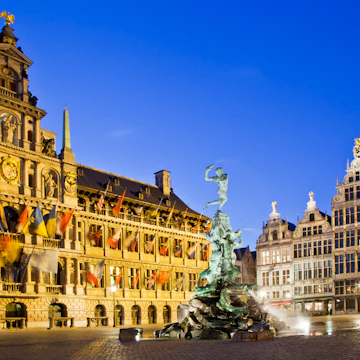
As in every great Flemish city, life in Antwerp radiates out from the Grote Markt, a vast, pedestrianised, triangular market square presided over by the impressive Renaissance-style stadhuis.
The Grote Markt is lined on two sides by Renaissance-style guildhalls, most of which were reconstructed in the 19th century. The tallest and most impressive is No 7, topped by a gilded statue of St George astride a rearing horse as he spears a dragon.
The voluptuous, baroque Brabo Fountain rises from a rough pile of rocks in the centre of the Grote Markt. Crafted in 1887 by Jef Lambeaux (who lived at Grote Markt 44), it depicts the legend of Antwerp's name.
reviewed
-
D
Centraal Station
One of the city's premier landmarks is the extraordinary Centraal Station, designed by Louis Delacenserie at the start of the 20th century in a harmonious blend of styles. Steps lead from the main hall with its enormous dome up to the glass-covered train platforms above. The station and adjoining Koningin Astridplein have been undergoing massive works for years to accommodate the Eurostar and Thalys fast trains, thus directly linking the city to London and the rest of Europe. .
The station is also diamond central, with many shops selling diamonds inside the station, and the Diamond District immediately south-west of it.
reviewed
-
E
Openluchtmuseum voor Beeldhouwkunst Middelheim
Some 4km south of the city centre is a large, landscaped park known as the Openluchtmuseum voor Beeldhouwkunst Middelheim. It contains more than 300 works by sculptors, including notable nationals (Rik Wouters) and influential internationals (Auguste Rodin and Henry Moore).
Don't deny yourself the opportunity to ask a randomly selected passerby how to get to the (take a deep breath now) Openluchtmuseum voor Beeldhouwkunst Middelheim (Middelheim Open-Air Statuary Museum), a large park 4km (2.5mi) south of the centre that is scenically littered with over 300 sculptures, including carvings by Rik Wouters and Auguste Rodin.
reviewed
-
F
Lombardia
A legendary health-food shop and café located at the heart of the pedestrianised Quartier Latin shopping district. It's run by a hip crew, the décor's way out and the food's all bio (organic). Sells a bit of everything, has English-language newspapers, snappy service and a few tables for diners (plus a huge summer terrace under a shady tree). Bio milkshakes (either beastie or vegan), fresh juices, and there's a range of salads, vegetable pies and sandwiches.
The sign above the counter asks that customers 'Do not spit' - now that's health conscious.
reviewed
-
G
Dansing Chocola
Things get loose at this old-fashioned café, with staff grooving behind the bar or vaulting Tarzan-like up to the wrought-iron mezzanine railing to take orders from upper-level tables, while busking violinists serenade diners. Dishes - Belgian and a few international options like spicy Thai soup - are simple and incredibly filling (go for the 'small' portions unless you're ravenous), and there are sensational fries (around €3 for a bowlful). The kitchen closes at 22:00.
reviewed
-
H
Museum aan de Stroom
The purpose-built multistorey Museum aan de Stroom is located between two docks - Bonapartedok and Willemdok - in the flourishing 't Eilandje district. Architecturally it's a big draw, designed like a modern spiral tower with a panorama platform offering city views. It brings together exhibits of the city's history from its earliest beginnings to recent times.
reviewed
-
I
Paeters Vaetje
On a bleak, rain-swept afternoon, there's no cosier spot to hole up than this snug bruin eetcafé ('brown eating café'), with glowing lamps illuminating its dark timber main room and upper-level mezzanine. Dishes are simple and inexpensive, and the beer selection choice.
reviewed
-
J
El Pintxo's
Antwerp's first pintxo (the Basque version of tapas) bar has a cool, sober interior lorded over by a big red bull. The pintxos variados dinner menu includes five cold and four warm servings - great for satisfying those who want to test the lot.
reviewed
Advertisement
-
K
Stadsfeestzaal
The 19th-century neoclassical architecture of this former city festival hall is jaw-dropping, particularly when viewed from the champagne-glass-shaped platform rising beneath its glass roof. It contains a shopping mall, but the building is the real star.
reviewed
-
L
Brabo Fountain
The voluptuous, baroque Brabo Fountain rises from a rough pile of rocks in the centre of the Grote Markt. Crafted in 1887 by Jef Lambeaux (who lived at Grote Markt 44), it depicts the legend of Antwerp's name.
reviewed
-
M
International Magazine Store
The place for foreign and local newspapers and top-selling magazines.
reviewed
-
N
Frituur No 1
Makes the city's finest frites (fries). Close to the Grote Markt.
reviewed
-
O
-
P
-
Q
Onze Lieve Vrouwekathedraal
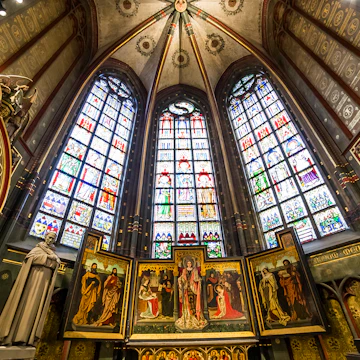
The splendid Onze Lieve Vrouwekathedraal is the largest and finest Gothic cathedral in Belgium. It was 169 years in the making (1352-521) and the work of several architects (Appelmans, Domien and Keldermans). Its graceful 123m-high spire was a mighty landmark in early times and is still visible from kilometres around today.
The combined effects of a fire in the Middle Ages, the Iconoclastic Fury and plundering during the French occupation mean that little of what you see today inside the cathedral is original Gothic. Instead, baroque decorations - notably four early canvases by Rubens - adorn its light but imposing interior.
From the centre of the seven-aisled nave, look s…
reviewed
-
R
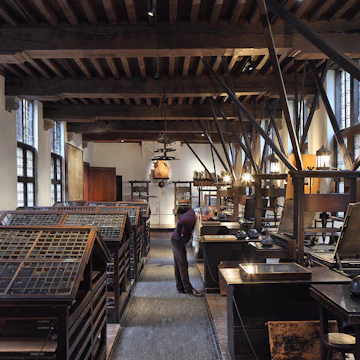
Museum Plantin-Moretus
The World Heritage-listed Museum Plantin-Moretus is home to the world's first industrial printing works. This fascinating museum deals with a prosperous 16th- and 17th-century printing family headed by Christoffel Plantin. Plantin moved from France to Antwerp where he set up as a bookbinder in 1548. Eight years later he started a printing business that eventually became the Low Countries' largest printing and publishing concern and a magnet for intellectuals, scientists and humanists.
On Plantin's death, the business passed to his son-in-law, Jan Moretus, and later to Jan's son, Balthasar, a friend of Rubens.
Some of the family portraits exhibited inside this museum are …
reviewed
-
S
Rubenshuis
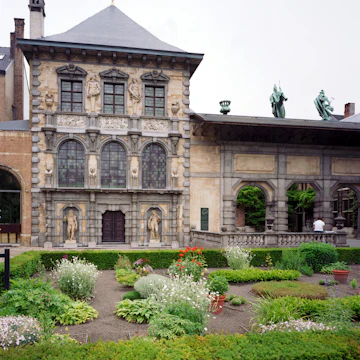
Rubenshuis, the prestigious home and studio of the city's most celebrated painter, Pieter Paul Rubens, it was little more than a ruin when acquired by the city in 1937. Superbly restored along original lines, it's now Antwerp's chief attraction, despite the fact that only a handful of Rubens' lesser works are exhibited here. Rubens built this beautiful Flemish baroque mansion in 1611 when he was 34 years old; he died here 29 years later.
The building is divided in two: on the left are the living quarters and an elaborate art gallery where Rubens displayed sculptures and paintings by artists he admired; to the right you'll see the master's studio where he taught and worke…
reviewed
-
T
Gin Fish
Didier Garnich knew it was risky closing his seafood restaurant De Matelote and relinquishing its Michelin star. But he longed for the pre-Michelin days, when an open kitchen allowed him to laugh with the people whose meals he was preparing, and there was no mandate to slavishly follow classic formulas. So he took the gamble and opened Gin Fish. Same address, same attention to quality, same devotion to fish… only this time he's doing it his way.
There's no exhaustive seafood menu, as out-of-season fish is not an option. Instead, only the freshest catch is cooked, and only one menu-of-the-day is offered: two entrées, a main and dessert. Each evening has three sittings - …
reviewed
Advertisement
-
U
Cogels-Osylei
This area, about 2km southeast of Centraal Station, is famed for the eclectic architecture found in a handful of streets. The showcase is Cogels-Osylei, a bazaar of all possible house styles. Here the city's affluent citizens went wild a century ago, creating competing and highly contrasting façades ranging in style from Art Nouveau and Flemish baroque to neoclassical and neo-Renaissance. Roofs and towers spiked with onion tops or witches' hats, wrought-iron balconies, bay windows, slate tiles, stained glass and mosaics…you name it, this street's got it.
Most of the buildings were constructed between 1894 and 1914 and involved many architects. In the 1960s the houses f…
reviewed
-
V
Rockoxhuis
The Rockoxhuis is a 17th-century mansion that once belonged to Nicolaas Rockox, a former city mayor and friend and patron of Rubens. It's built around a central courtyard, is furnished in classical Flemish style, and holds a small but esteemed collection of paintings, including works by Rubens, Jordaens, Van Dyck and Pieter Breughel the Younger.
Seek out the latter's Proverbs (De Spreekwoorden in Flemish). This engaging work is no run-of-the-mill village scene - it depicts 108 Flemish proverbs. Find the man bashing his head against a brick wall (ie symbolising stupidity) or the guy peeing on the moon (ie trying to do the impossible). The museum sells a card explaining eac…
reviewed
-
W
Museum Mayer Van den Bergh
Museum Mayer Van den Bergh occupies a simulated 16th-century townhouse, built in 1904 by the mother of Fritz Mayer Van den Bergh, a prosperous art connoisseur who had died a few years earlier aged 41. His highly prized collection of sculptures and paintings, including works by Quinten Matsijs and Cornelius De Vos, form the core of the museum.
The collection's most famous piece is Pieter Breugel the Elder's Dulle Griet (Mad Meg), an allegorical painting in which a demented woman roams a grotesque war-torn landscape marked by demons and monsters. This is one of Breugel's most Bosch-like paintings and interpretations of its meaning vary - some say it's an allegory of misogyn…
reviewed
-
Diamond District
Immediately southwest of Centraal Station is the Diamond District. The first things most people see of this quarter are the gold and diamond shops newly located inside Centraal Station. Here you'll find people from all over the world, including plenty of newly engaged Brits (prices here average 30% lower than in UK High Sts) browsing the bright lights and gleaming displays.
But outside, it's a vastly different world. Orthodox Jewish men clad in distinctive black coats and hats shuffle around the lacklustre quarter, traders with briefcases handcuffed to their wrists hurry into diamond exchanges and armed guards keep watch over the little huddle of streets where multimillio…
reviewed
-
X
Nationaal Scheepvaartmuseum Steen
This engaging museum houses model ships, maritime maps and instruments in the gatehouse and front section (which is all that remains) of the 13th-century castle, Steen. Highlights include an intriguing nautical totem shaped like a snake's head and boats from around the world, including an 18th-century coracle or skin boat. Beneath the next-door raised promenade is the museum's open-air collection of river barges, canal boats and De Schelde P905, a 1950's Belgian navy patrol ship.
It's on the foreshore of the River Scheldt to the immediate west of the old centre, within the partly-restored confines of a castle called the Steen that dates from 1200 and is Antwerp's oldest …
reviewed