The Mediterranean Coast & The RifShopping

Shopping in The Mediterranean Coast & The Rif

‹ Prev

of 4

  1. A

    Covered Market

    This is the place in Meknès to get fresh produce, and is virtually a tourist attraction in itself, with its beautifully arranged pyramids of sugary sweet delicacies, dates and nuts, olives and preserved lemons in glistening piles. There’s also good-quality fruit and veg here, as well as meat – the faint-hearted may choose to avoid the automated chicken-plucking machines at the rear of the hall.

    reviewed

  2. Souqs

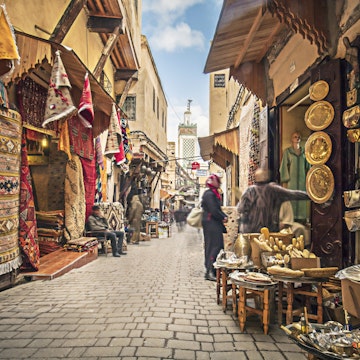
    While the Souqs of Meknès aren't as extensive as those of Fès or Marrakesh, the lack of hassle makes them a great place to potter around looking for souvenirs.

    The easiest route into the souqs is through the arch to the left of the Dar Jamaï Museum on the north side of Place el-Hedim. Plunge in and head northwards, and you will quickly find yourself amid souvenir stalls and carpet shops.

    As you walk, notice the qissariat (covered markets) off to either side. A couple of these are devoted to textiles and carpets, which are noisily auctioned off on Sunday mornings. Okchen Market, in the last qissaria on the left before you reach the T-junction with Rue Najjarine, speciali…

    reviewed

  3. B

    Rue Sekkakine

    For centuries, trading in gold or silver was forbidden to Muslims. This was because working precious metals to be sold at higher prices than their base value was considered usury, something forbidden under Islamic law. Jews faced no such prohibitions, though; when members of Fez's Jewish community moved into the Mellah in the 14th century they set up goldsmithing businesses in Rue Sekkakine.

    Originally patronised by the palace, these days the shops are run by Muslims and cater to the locals' penchant for bling, specialising in jewellery made from garish yellow gold and sparkly stones of every description.

    reviewed

  4. Ensemble Artisinal

    Chefchaouen remains an artisan centre and, as such, an excellent place to shop - especially for woven rugs and blankets in bright primary colours. Many shops have looms in situ, so you can see the blankets being made. Previously silk was the material of choice: the mulberry trees in Plaza Uta el-Hammam are a legacy of these times. Most of the weaving nowadays is with wool, one of the area's biggest products.

    It's worth stopping at the Ensemble Artisinal, if only for the sake of comparison.

    reviewed

  5. C

    Parfumerie Medina

    The knowledgeable owner Rachid Ouedrhiri will explain all about the perfumes, cosmetics and essential oils he stocks in his small stall in the Henna Souk, off Talaa Kebira and if you've always hankered after arabesques swirling of henna, here's the ideal place. The henna artist applies the mixture while you relax under the plane tree in the Henna Souk, off Talaa Kebira. She charges around DH30 for a finger-and-wrist design, or around DH200 for the full treatment of hands, forearms and feet.

    reviewed

  6. D

    Market

    The Market is excellent for fresh fish, meat, fruit and vegetables, and particularly throngs on Monday and Thursday, when people come from outside Chefchaouen to sell produce.

    Several local specialities are worth checking out, particularly the fragrant mountain honey and soft ewe's cheese - both served up at breakfast. Add fresh dial makla (a type of bread) and you have all the ingredients for a heavenly picnic.

    reviewed

  7. E

    Kissariat

    The kissariat (covered markets) at the bottom of Talaa Kebira have dozens of tiny shops selling babouches in every colour, fabric and design. Here, you can get yourself a top-quality, hand-stitched pair of leather babouches for around DH120. Only men wear yellow or white. Venture further into the kissariat to discover a wealth of bright yellow-gold wedding jewellery and superb fabrics.

    reviewed

  8. Medina craft shops and showrooms

    Tetouan's medina has the usual mix of craft shops and showrooms for the souvenir hunter. Wood and leatherwork are the local specialities. Unique to the Rif are the eye-catching mendeels (hand-woven, brightly coloured striped cloths), worn by farmers. The best place to buy them is from the women on the tiny square to the northeast of Bab er-Rouah. The tannery is the best place to browse for leatherwork.

    reviewed

  9. F

    Neq Broderie

    Walk right to the end of this grubby lane, off Talaa Kebira near the Bou Inania Medersa, and into a modern-looking house (signposted from Talaa Kebira). It's worth the effort: here is handcrafted traditional Fassi embroidery (watch the women at work) on excellent quality cotton-linen mix. Placemats cost around DH100 to around DH200; a tablecloth and six napkins from Dh450; napkins are Dh70 each.

    reviewed

  10. G

    Antiquité Nejjarine

    Samir Bousfiha's shop bulges with antiques - large pieces of furniture, doors and even whole painted ceilings, as well as smaller items like wooden writing boards at around DH1000 for an original, or around DH600 for a copy. For more portable souvenirs, check out the wide range of silver jewellery: thick bangles, old fibulas (brooches) and necklaces. Old silver is Dh15 per gram.

    reviewed

  11. Advertisement

  12. H

    Coin Berbere

    A trio of shops can be found here at the junction of Talaa Kebira and Derb el-Horra, all owned by the Bouzidi-Idrissi family. The largest stocks seriously good antique ceramics, embroidery, doors and furniture. Across the street is a carpet shop with antique and new carpets made by various Berber tribes, and next door to that is good jewellery, mostly silver and coral.

    reviewed

  13. I

    Au Petit Bazar Du Bon Acceuil

    This treasure-house is worth a visit. It stocks old and modern jewellery including some seriously good Berber pieces such as fibulas and pendants, old carpets and traditional clothing, objets d'art, embroidery, ceramics, glassware and metalware. Upstairs are good pieces of wooden furniture. Women by themselves may not feel comfortable shopping here.

    reviewed

  14. J

    Boutique Majid

    You can get lost for hours in this exotic antique shop, but the real gem is Majid himself. Straight out of central casting, to include his red fez, he will regale you with stories of the Rolling Stones and other luminaries while showing you his amazing collection of Moroccan doors. ‘If you want a door, ’ he confides in his husky voice, ‘you must talk to Majid!’.

    reviewed

  15. K

    Herboristerie Bou Inania

    This large shop sells natural soaps, vegetable oils such as argan and olive, essential oils, musk perfume, ghassoul (clay that comes in chips or powder form) which is a natural soap and exfoliant excellent for skin and hair, and incense. There's also a wide range of traditional medicines and spices. It's off Talaa Kebira, near the Bou Inania Medersa.

    reviewed

  16. L

    Centre Artisanale

    The government-run Centre Artisanale is the place to go if you want to get an idea of what to look for and how much to spend. Quality is high but prices are fixed. Other shops are located just outside the Mausoleum of Moulay Ismail. There are also some good pottery stalls set up on the western side of Place el-Hedim.

    reviewed

  17. M

    Spice Shop

    Hassan Graoui and his son Khalid are justly proud of their emporium of spices. This is an excellent place to stock up on ras el-hanoot (shopkeeper's spice mixture) that Hassan grinds himself, from his own secret blend of cinnamon, mace flowers, star anise, turmeric, nutmeg, black pepper, coriander and more. Perfect for Moroccan cooking.

    reviewed

  18. N

    Riad Alkantara

    A complex of six grand houses around a pool and garden, Riad Alkantara was due to open early in 2008. There are workshops in Moroccan crafts, art workshops for children, a café and evenings of poetry, storytelling and music. The spa (opening late 2008) has a hammam and massage room, and offers classes in movement, yoga and meditation.

    reviewed

  19. O

    Chez Boutbi Nadia

    Nadia is one of the few women shopkeepers in the medina. Her small shop sells traditional Fassi ceramics at excellent prices (tiny tajines for salt and pepper around DH15; plates from around DH35) and it's the best place for that tajine so you can cook Moroccan-style at home (tajine for three servings Dh40, for six servings Dh50).

    reviewed

  20. P

    Au Coin Du Bois

    Worth visiting if only to see a beautiful example of a Fassi house, this shop stocks large pieces of furniture which they'll arrange to ship home for you. There are tables, doors and windows, cupboards and chairs - some antique and some not. An old carved door will set you back some around DH4500, a carved and painted box Dh1700.

    reviewed

  21. Q

    Art Du Bronze

    Handcrafted brass and metalware gleam from every corner of this large shop. Much is made on the premises and you can see the craftsman at work every day from 09:00 to 17:00. Brass plates and teapots start at around DH150. Good quality camel-bone mirrors start at around DH500 and there are filigree lanterns from around Dh2500.

    reviewed

  22. Advertisement

  23. R

    Derb Fez El-Jdid

    The kissariat along this bustling thoroughfare are home to stalls selling jellabas of every possible colour, quality, price and cut. Utilitarian polyester and wool styles predominate, but it's also possible to access Bollywood-style confections in satin and silk, as well as truly frightening faux-leopard-skin numbers.

    reviewed

  24. S

    L'art Traditionnel

    Pierced brass, sometimes with opaque or coloured Iraqi glass, is used for all the lanterns here: an ostrich-egg size costs around DH900, a small lantern around DH1400 and one with glass inserts around DH1200. There are also carved wooden chests, tables and old doors. The shop is contracted to Medina Express for easy shipping.

    reviewed

  25. T

    Salon De Thé Batha

    Here's one of the best patisseries selling excellent bread, cakes and croissants but the pièce de résistance is the patisserie: tiny exquisite biscuit creations featuring almonds, sesame paste, chocolate and macaroons. A 250g box of the best (essential when visiting Moroccan families) costs around DH30.

    reviewed

  26. U

    Riad Maison Bleue Spa

    This spa uses Moroccan products such as ghassoul, argan oil, orange flower water and rose petals. The basic hammam treatment costs DH500, a session including the steam room, gommage (exfoliation) and massage costs around DH800; the Thousand & One Nights treatment adds a manicure, pedicure and facial.

    reviewed

  27. V

    Galerie Nejarine

    Ahmed specialises in reproductions of old ceramics, so while a 40-year-old bowl in his shop costs around DH650, the reproductions are around DH250. He also has small bowls, resin and bronze candleholders and two-seater rectangular pouffes. He's contracted to Medina Express so shipping things home is safe and easy.

    reviewed